Hi Patrik,

>> As mentioned, CD audio is "only" 16-bit and "only" 44.1KHz, but I don't
>see
>> angry mobs of listeners boycotting record labels until they replace the
>> format with something better.  And the Prophet 5 was "only" five-voice --
>> and mono-timbral to boot -- but great music has been, and is still being,
>> made with it.
>
>Yes, but there is a biiiig difference between a production format and a
>release format. When mixing, you will need more bits than the release format
>to be able to maintain full quality of all the signals when mixing. If you
>want to mix say 8 16-bit signals without quality loss due to truncation of
>the signals, you'll need a total resolution of 2^16 * 2^3 = 2^19, that is 19
>bits. (since 2^3 = 8 = the number of signals to mix). Then in the end you'll
>have to dither down to 16 bit, but then you'll loose quality only once, not
>for each channel being mixed. Also, when usig good dither+noiseshaping,
>you'll retain more than 16 bits worth of information. This information will
>be below the (dither) noise floor, but still audible. I'm not convinced that
>you'll gain a lot by using a higher samplerate, but higher bitdepth while
>mixing, definitley. Note however that the original files can be 16-bit. It's
>just during mixing you need higher "internal" resolution.
>
>About the Prophet 5. It's an analogue synth. The main reason for building
>mostly VA today (or for using digital equipment at all) is because it's a
>lot cheeper than really good analogue exuipment...

All valid points, but perhaps my original position wasn't clear:  I wasn't claiming that 16-bits is all anyone ever needs, anywhere; I was  bemoaning the fact that so many musicians get on the flavor-of-the-month carousel, and never really learn their instruments, because they are always selling them and moving to something with more bits, voices, effects, etc.  In a producing environment, high bit resolutions and additional channels are often necessary, but that doesn't mean the instruments themselves must follow suit.  Great music was made with the Ensoniq Mirage (10-bit?), the DX7 (originally 12-bit), and the Poly-800 (not sure of the VCA/VCF bit depth, but it was very grainy -- maybe, 6-bit?).  Also, the same could be said for even lowly Mini-Korg -- a monophonic instrument with almost no programming capabilities, and even those were unusual.

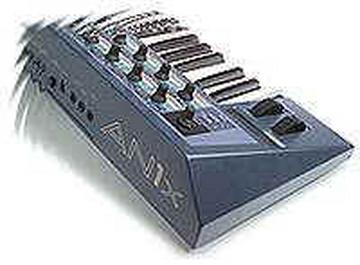
My musical situation is probably somewhat unusual on this list:  I use the AN1x mostly for live performance in rock and funk bands.  I record very little -- at least, for public consumption -- and despite being a working musician for almost 40 years, I don't own a collection of synths.  I just own the AN1x, plus an organ and a ROMpler for the sounds that the VA synth doesn't do well.  I do, however, get compliments on the sound of my synth leads and pads.  Maybe it's because of the number of years that I've been programming -- or having just the one synth forces me to really dig into its capabilities more than the average owner.

My main instrument is really Hammond-style organ.  It's a great instrument, but it's only two-part multitimbral, just like the AN1x.  It also makes a mediocre bass, a lousy piano, a very poor horn section, and a terrible drum machine.  Organists, OTOH, don't seem to care about these limitations; they work around them, or switch to another instrument when the need arises.  Only synth players seem to get caught up in the need to have a one-size-fits-all solution.

Regards,

-BW

--
Bruce Wahler
Design Consultant
Ashby Solutions\ufffd   http://consult.ashbysolutions.com
978.386.7389  voice/fax
bruce@...
Message
Re: [AN1x] Use what you have (Was: AN/DX200 problem)
2003-01-21 by Bruce Wahler
Attachments
- No local attachments were found for this message.