ot analog synths
2012-01-31 by spaceanimals
Yahoo Groups archive
Index last updated: 2026-04-28 22:40 UTC
Thread
2012-01-31 by spaceanimals
A friend of mine built a radio shack synth. It uses one osc and something to divide it into 10 frequencies. How many ocs does a polyphonic synth have, and how do you get them to different pitches--I'm guessing there aren't 61 osc.

Jim
2012-02-01 by Bob S.
Depends on the polyphony of the synth......for example, a Roland Jupiter 6 has 6 pairs of oscillators dynamically assigned by an on board cpu that scans the keyboard.  When a key is pressed, a free oscillator pair is given a control voltage that represents the value needed to create the pitch of the pressed key and an audio gate is opened to allow that oscillator pair to sound through the synth's audio bus.

Bob S.
El Segundo, CA


Sent from my iPad

On Jan 31, 2012, at 2:54 PM, "spaceanimals" <jim.alciere@...> wrote:

> A friend of mine built a radio shack synth. It uses one osc and something to divide it into 10 frequencies. How many ocs does a polyphonic synth have, and how do you get them to different pitches--I'm guessing there aren't 61 osc.
>
> Jim
>
>


[Non-text portions of this message have been removed]
2012-02-01 by Jeff
Hi Jimmy !


spaceanimals a \ufffdcrit :
>
> A friend of mine built a radio shack synth. It uses one osc and
> something to divide it into 10 frequencies. How many ocs does a
> polyphonic synth have, and how do you get them to different
> pitches--I'm guessing there aren't 61 osc.
>
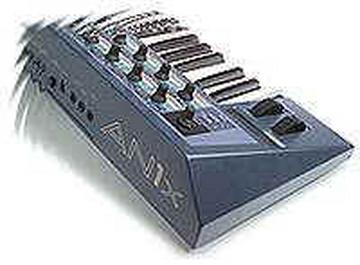
They have as many "oscillators" (or pairs of oscillators as in your
AN1x) as the maximum polyphony. 10 notes maximum allowed = 20
oscillators. The internal software (all polyphonic synths or at least
99%) allows dynamically one note (pitch and velocity) to one free
oscillator until all of them are busy. Then, depending on the synth the
lower note, the upper, the first or the last is omitted or cancelled. On
some instruments you can choose how the soft reacts to polyphony overflow.
The Radio Shack synth is one of the 1% based on an upper octave
generator and a frequency divider for lower notes. This is very easy
with square waves only, because you can easily do that with basic logic
flip flop or binary counters : divided by 2 = one octave lower. But
famous early Korg polyphonic synths like this one :
http://www.vintagesynth.com/korg/ps3100.php
and its bigger brothers were based on the same system. One another hand
99% of electronic organs were based on frequency division, because they
mostly work with square waves and the filtering is fixed and much more
simpler than in a synth. Today's organs are mostly based on samples, as
digital pianos, including.... Hammond or other vintage organs samples !
Hope that it helps.
Cheers.
J.F.
>
>
> Jim
>
>