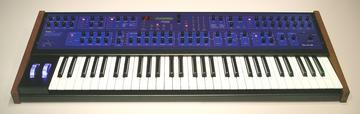
I think that a good way to look at synthesizers is in the 'modular'
view.  (Except that particular synthesizers are limited in particular
aspects of their modularity, which is a good reason for proposed
Evo-Noob-Guide). I find the Evo very 'internally' flexible, and that
is the reason I bought one (well, it sounds cool too.)

Main point of writing, to understand-->>

The types of signals--->>>

1. Audio (Oscillators, Feedback)
2. Control (LFOs, ADSR (envelopes), Sequencer
3. Gate(Keypress)/Sequencer Triggers

That's it!

[I think the Evo's "flow chart" diagram that is supplied with the
manual says everything about its 'Audio Path.']

'Audio' from Oscillators 1-4 (& 'Feedback')--->this into the VCF
(filter), Filter goes into the 'Effects section' (Distortion/Delay.)
Something like that.

The rest is understanding the 'Control Signals' or as I've read
somewhere else, the 'invisible hands' that 'tweak the knobs' over time.

The 'control signals' (modulators) LFO's, ADSR's, and the Sequencer -
these do not 'produce' audio, they in essence, 'turn the knobs' of
their selected destinations.  (LFO 1 to OSC 1 pitch means that the LFO
will 'turn the pitch knob' of OSC 1 at whatever speed/intensity is
selected.  ADSR 3 to Pulsewidth 1 means that when the ADSR (envelope)
receives a keypress/seqencer gate-on, it will create the shape
programmed (ADSR) and 'invisibly turn the pulsewidth knob' of OSC 1.

The 'Evo sequencer' is a beast of its own and I think a little page
could be written just on it and its possibilities.  But do think of
the Sequencer as just another modulator/control signal generator
(LFO/ADSR) just a lot more pliable.

The 'Feedback section of the Evo' is yet another beast which deserves
its own little section.  But don't forget that it is just an 'Audio
Signal'.  That is processed by the Filter and Effects just like the
Oscillators.

Then, 'keypress/sequencer steps or gate'.  This is a little spike or
trigger that occurs when there is a keypress/midi note received, or of
course the sequencer is a trigger generator.  Basically, this 'gate'
Triggers the ADSRs!  So when a gate is received, the envelope is
'started' and its signal goes and 'modulates/turns the knob' of
whatever it is assigned to modulate.  (Try ADSR 3 to and OSC while it
is synced to the other.)

[The Evo (or any synthesizer with programmable 'Audio and Control
signals') is like a Casio keyboard with knobs for every parameter (in
a sense) so you can change anything you like to make it not sound like
a shitty piano.  ALSO, using the LFO, ADSR, and SEQ is like having ~15
'extra-hands' that will turn certain knobs for you with respect to
time/keypress.

...or, maybe like a guitar that is plugged into some efx pedals and
then into an amp.  You play (or MIDI plays) the guitar strings, and
the LFOs, the ADSRs and the SEQuencer turns the knobs of the effects
pedals as you do your thing.

..or like, your vocal chords are the 'audio signal', your throat/mouth
is the filter, and your hand is the 'control signal' tugging on the
skin of your neck to give your voice 'vibrato'.  I guess your soul is
the keypress.]

So, there is a little mess of words to hopefully give you a better
picture of the way synths work.  It's simple, I think.

[Synth-vets, don't take shots because I left out any FM, RM, or VCF
self-oscillation, etc.
-And I don't mean to take away any momentum from the prospective
authors of the proposed Guide, just to throw in my 2 cents for the
time being.  Go on and write that thing!]

Time to go make some custom waveforms for my Evo!!!!

Chris
Message
Re: Evolver Guide ***Here's one now
2004-11-06 by z_flash_ram
Attachments
- No local attachments were found for this message.