Hi James.

I can use menus to a degree but what I find troublesome in most new gear is
that they are rolllover menus that don't have a zero point.  So when you go
into a menu on the evolver for instance and come out of it, does it remember
where you were the next time you enter that same page or does it go back to
a default place?  And when you say the encoders are endless, wouldn't I be
able to tell where it begins and ends based on the character of the sound
I'm changing?  For instance, and I don't know a whole lot about this so I
hope my example is accurate.  If I apply ring modulation to a sound and keep
turning the knob for that parameter, eventually wouldn't it get to a point
where you couldn't physically have that effect going, like you can only have
so much ring modulation and at some point, with an endless encoder, it will
cycle back to the point in the parameter adjustment where the effect would
no longer be present?

By the way, what's the potentiometer option?  I've seen that but don't know
what it means.

I'm very new to all this analog stuff in terms of applying it and knowing
the technical terms for it all.  My first keyboard was an ensoniq sq1 and I
used that for a good many years before I took a break from composing for a
while.  That was a digital board as you'll probably remember.   So is the
destination chain you're talking about something like the following?

I have a sound and I want to apply some effects to it like an echo delay and
chorus.  Is the destination the same thing as the order in which the effects
are applied to the dry sound source or is it simpler than that?

My wife and kid says that I have a propensity to complicate everything and
professors used to tell me the same thing as well so there's probably some
truth to that.

Thanks for the further help.

I emailed those dudes so hopefully I'll hear something soon.

Scott

----- Original Message -----
From: James Elliott
To: DSI_Evolver@yahoogroups.com
Sent: Monday, July 19, 2010 10:14 AM
Subject: Re: [DSI Synths] introduction


Scott, unfortunately, I don't know of any new synths that would fit that
criteria. The only think I could recommend are classic analogs. I think the
most flexible analog polysynths with no menus would be the prophet 5,
jupiter 6 & 8, and the oberheims i.e. ob8.

Stay far far away from the alesis andromeda even though it has at least
150,000 real time controls it probably has as much if not more menu diving
than the most complex Kurzweils.

I know a couple other fellows from other synth mailing lists who have lost
their eyesight that might be able to give you some better advice than I.

Rick Massey: seafox@...
Veli-Pekka T�til�: vtatila@...

I don't know either of them personally, however, I'm sure neither would mind
helping you out.

-Jim


From: Scott Lawlor <sklawlor@...>
To: DSI_Evolver@yahoogroups.com
Sent: Mon, July 19, 2010 9:39:38 AM
Subject: Re: [DSI Synths] introduction


\ufeff
Hi James.

Thanks for the info.

I was also considering the possibility of a different setup like using a
midi controler like the CakeWalk a-800 with a dedicated pc for recording and
the omnisphere softsynth.  I'm told though that realtime control with
softsynths via midi controlers isn't as standard or as integrated as it
could be because different manufacturers have different standards for a lot
of this stuff.

I wonder if there's a keyboard like the poly evolver that doesn't have menus
at all?  I was going to look into the arturia origin as well but I don't
know a whole lot about that one.

Scott

----- Original Message -----
From: James Elliott
To: DSI_Evolver@ yahoogroups. com
Sent: Monday, July 19, 2010 9:01 AM
Subject: Re: [DSI Synths] introduction


Scott,

I do not have any direct experience with the new polyevolvers with the
potentiometer option, however I would imagine it would be much more user
friendly for you than your kurzweil - to some degree. There is not a lot of
menu diving on the polyevolver however there is some. For example, all of
the main envelope, filter, oscillator, and vca controls would have fixed
range pots. However, you would still need to be familiar with the ordering
of the "destination list" for the third envelope (this has a free mod slot
associated with it). I think the LFO controls are still endless encoders
though, so you could be spinning those forever. The thing that would make
the LFO section a little difficult, and this also applies for the delay's
time parameters, is that the frequencey selection is in ascending order
followed by clock divisions. So not only would you have to have the
"destination list" memorized, you would also have to have the
frequency/time/ clock divisions memorized as well. Things would become a
little tricky with the general modulation section (the modulation routings),
the parameter section (where you set things like envelope shape, oscillator
slop, and trigger modes), the sequencer section, and of course the global,
program, and combo setting menus. Not only will those sections all have
endless encoders, you will also need to memorize menu sequences for each of
them.

With that said, I want to state that none of the menus are all that deep
though, most are only one page. The only real exceptions would be the
global, program, & combo menus. There is almost a one knob or button control
for each parameter. For example, there is a knob for each envelope, lfo,
filter, vca, oscillator, delay, feedback, and sequencer function. Also,
there is a dedicated control for modulation destination for the third
envelope and each of the lfo's. There is also a source, destination, and
value knob for each parameter in the general modulation section - you just
have to be familiar with the ordering of each list for each of the
modulation source and destination functions (this also includes the envelope
& lfo as mentioned above).

Overall I don't think the polyevolver will provide as much of a challenge as
the kurzweil, however, it won't necessarily be a cakewalk either.

As far as the polyevolver and ambient music production goes. Well, they go
hand in hand. If you could manage to wrap your head around some of the
endless encoders, some of the weird parameter listings (like lfo & delay
frequency, glide controls, pre-post high pass filter modes, and the pre-post
external input volume level) I think you would be rewarded with beautiful
evolving soundscapes.

I hope I've managed to help you along in your journey....

Take care,
Jim


From: Scott Lawlor <sklawlor@mac. com>
To: DSI_Evolver@ yahoogroups. com
Sent: Wed, June 30, 2010 8:46:56 AM
Subject: [DSI Synths] introduction


Hello.

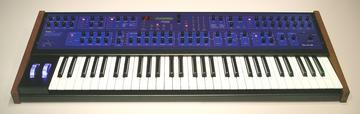
I'm thinking about getting one of these poly evolver keyboards.

I currently have a kurzweil pc3 but since I'm blind, the menus are a bit
much for me to memorize and since they roll over and there's no actual zero
point, I figured that the evolver might be a good fit.

I like to feel the control as I work and with all these knobs and switches,
I'm hoping this synth will be much more accessible for me.

I'd like to play more ambient electronic music and the people at sweetwater
feel that this might be a good fit for me.

My inspirations for space and ambient music include people like Tangerine
Dream, Steve Roach, Robert Rich, Free System Projekt, Jonn Serrie, Radio
Massacre International and others.

I was using the sound tower software with the pc3 and I could go through the
default sounds and presets but that was about it.  I don't know how useable
this software is for someone who is blind.

There isn't anywhere locally for me to get my hands on this thing to check
it out but I've heard some of the sounds listening to various YouTube videos
and it sounds impressive.

I just wanted to write to say hi and I hope to learn a lot about this unit
and gain some tips and tricks along the way.

Thanks for reading.

Scott
Message
Re: [DSI Synths] introduction
2010-07-19 by Scott Lawlor
Attachments
- No local attachments were found for this message.