--- In DTXpress@yahoogroups.com, "deanerdrummer" <deanscott@a...>
wrote:
>
>
> I have a dtx3 with added mono pads already in outputs 9/10. I am
considering
> buying the RHH130 hihat. I want to then use the old hihat pad as a
second
> floor tom and eventually add even more pads (possibly the new round
cymbal
> pads). What is the best route for doing this since my existing
module is filled
> up? Should I purchase another dtx brain?
>
> OR
>
> It may be cheaper in the long run to just get a second dtx kit and
marry them
> together. I am considering this as well.
>
> Either way, I have gathered from reading other posts that I would
need to run
> both brains through a mixer and then to an amp. Correct? Or can the
brains
> be piggybacked off one another without the need for a mixer?
>
> How many of you use a second dtx brain? It seems in the photo
section I only
> see one brain on the kits. Yet the kits have a multitude of pads. I
am very
> much a novice on this subject and would appreciate any feedback you
can
> give me in "simple" terms.

Hi Deaner,

Good to have you with us. Whether you buy another module, a trigger
to MIDI interface, or a second complete kit to expand your horizons
will depend on budget and how many more pads you want in your
configuration. Check out OGD's multiple DTXtremeIIS bonanza for a
real treat; it's in the photo section.

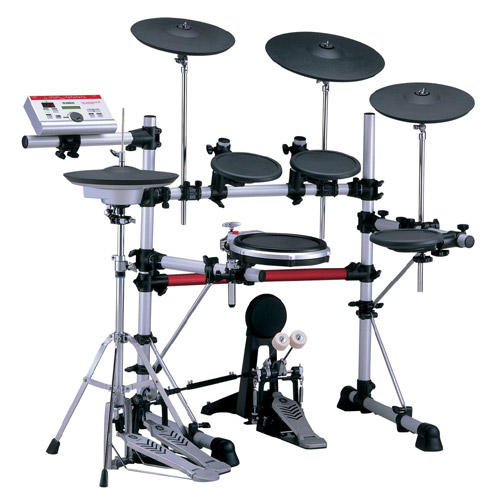
One thing for sure is that the DTXpress rack runs out of room really
quickly. Many people swap it out for something bigger and sturdier,
often from Gibralter, fairly early in the game, though the Yamaha
rack is expandable with some ingenuity. You can get parts from
Drumbalaya.com. It might be more cost-effective and prudent to buy,
say, a second module and a few more pads that you can integrate with
your existing kit and gradually move up as desired, required, or
financially feasible. You don't need to get another DTXpressIII for
your second module. You could get an affordable new one from another
company, or even a used one to create some variation in your sound.
An older DTXpressI or II would save you some money and probably fit
the bill for a good long while.

Trigger-to-MIDI interfaces add inputs to modules via, as their name
suggests, MIDI. They have no sounds of their own; they take them from
the connected module. Roland's TMC-6 may be the only current model
out there, but even at a reduced price, it still costs more than many
used modules, and some of its features may be overkill with a
DTXpress. The late great discontinued TMDs, however, like the Roland
PM-16, Aphex, or the Kat MIDIkiti, if you can find one, can be
completely satisfactory, even though they are limited to mono pads.

One way or another, Keith's magic box, which exists solely to add
inputs to a situation like yours will become available, either as a
DIY project or for sale below the cost of most, good used modules.
Stay tuned for that development if you're interested. We'll be
sending out a questionnaire to assess members' interest in it shortly.

I can't remember what you might be seeing in our photo section to
suggest that people are magically adding pads to their DTXpress
without adding inputs. The DTXpress has an extra input that will
permit the addition of two more mono pads or one dual-zone pad. Some
people split their inputs in two, allowing them to use two pads with
the same voice and trigger settings.

A mixer is the best way to join modules at the hip, either for common
amplification or listening via headphones. Running them together
together via MIDI is possible but a waste of the voice capabilities
of one of them. A better option would be to connect one module to the
other's auxiliary input (the mini jack, for instance, on the face of
the DTXpress) for mixing, and maybe use the other module's auxiliary
to connect a CD player.  Although this option is a cheap and
relatively competent way to bide time, it is limiting in the quality
and control of the resulting sound. A mixer need not be expensive. I
keep promoting the three channel Rolls MX28, which sounds good and
costs less than $100. It will take the stereo outputs of two modules
as well as another feed (be it a CD player or another human), pan
them, and mix them together with great aplomb for either headphones
or a monitor. Of course, there are other more elaborate mixer options
from numerous companies--a portable recording device with an embedded
mixer, either analog or digital, being one of them.

I hope this outline gives you some ideas.

Ed
Message
Re: best way to expand?
2005-03-15 by emf
Attachments
- No local attachments were found for this message.