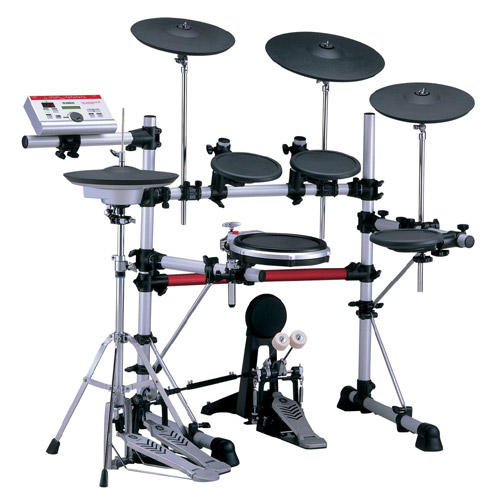
Scott,

I was thinking about this, too. I was lucky, or unlucky, enough to
have been born in the mid-20th century. When I was growing up,
drummers used very simple kits, and they tended to be very practical
about what they wanted. The hardware was simple and flimsy, and the
range of effects for drummers was narrow (cowbell and woodblock).
But also communications were on a relatively small scale; people
didn't think, or didn't have to think, so much about how things
appeared. I'll cut to the chase. When the sixties arrived with
widespread telecommunications (television), rejuvenated pop music,
and a booming economy, the stage was set for a cultural revolution.
Drumming became not just an art but also a performance art, and
drums themselves became a signature, an art form in themselves. Just
like pop stars had to seem larger than life to get grabbed by the
public eye, drums became a highly visible/sudible showcase for bands
or individuals, and they became fodder for competitive advertising.
Gear in itself became important, because it could reach people on
all sorts of new levels--aesthetics, economics, manufacturing
techniques, etc. Bigger became better in this culture. Obviously,
the effects were not all beneficial, but bigger often translates
into more interests and new technical skills. Though I wouldn't say
that large kits have made drummers better in every respect, they
have certainly made them better in some. And they have turned drums
themselves into a commercial and highly coveted commodity that has a
life of its own.

Ed

--- In DTXpress@yahoogroups.com, "hairytrigger" <artifax@i...> wrote:
> I am reading and enjoying the descriptions and photos of some
members'
> "Monster Kits.' I have resisted this urge. It is powerful!
> One of the main reasons I switched to Electronics was the
portability
> and onstage space factors.
> When I played acoustic, I had a lot of extra stuff: many toms,
many
> cymbals; Cowbells, tambourines,etc. I needed all this stuff. But,
I
> never played all that stuff on any one song.
>
> When I bagan triggering my acoustic kit, I added 3 extra pads for
> accessories. One was a home-made device I put in front of my
HiHats to
> trigger a cowbell or tambourine while playing the hats.
>
> Now that I have gone all electronic, I find a basic kit works
great
> for my needs. Snare (dual-zone), HiHat, Kick, 3 Toms, 2 Crashes,
Ride,
> and two or three extra pads for the percussion accessories. When I
> need something different, I just switch kits.
>
> My only problem is the basic kit takes up all the inputs. I could
> manage one accessory pad if i do without the dual zone snare.
>
> So I had to add another module or trigger interface for a couple
lousy
> pads.I tried the Roland SPD-6, but it had a terrible cross-talk
> problem.
>
> I have a Roland TD-5, and a PM-16 that I am alternating. I can't
> decide which I like best. The PM-16 is kind of unweildy, but I can
use
> the XPress sounds. The TD-5 has some very cool sounds, plus it is
> almost exactly the same size and shape as the XPress.
>
> I was wondering, is this how the 'Monster Kits' began? You had the
> extra inputs, so you had to fill them up?
>
> Just wondering....Scott
Message
Re: observations
2003-04-12 by liberatusvirus
Attachments
- No local attachments were found for this message.