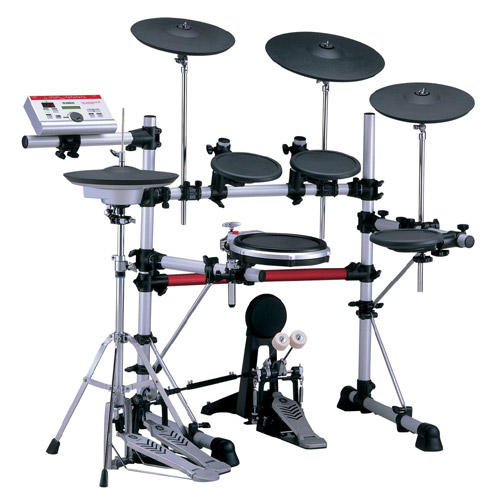
--- In DTXpress@yahoogroups.com, "Jay" <jayluv6@y...> wrote:
> Wow. Now we're getting a little philosophical here. So let's say you
> learned to play the acoustic guitar, and spend your whole life
playing
> without ever touching an electric. Aren't you still a 'guitarist'?
As
> a former *classical* musician, as well as guitarist, I'd have to say
> no. Mastering your instrument means exactly what it means: mastering
> the instrument-in all of its forms.
>
> But aren't there some forms of edrums out there that cross the line
> between traditional and electronic? The ones with real heads and
> shells that I've seen out there on the web seem to be able to give
> almost the exact same physical sensation as playing a real drum. I
> suspect that line will be blurred more as technology advances. As
for
> the DTX, you're hitting 8" rubber pads. It may sound as realistic as
> the best kit out there, but you're still just hitting rubber pads.
> They will never *feel* the same as an acoustic kit, but they're also
> another form of drum that needs to be explored for you to become a
> master of your craft.
>
> As far as my 2 cents goes, edrums are indeed 'real' drums.

That's pretty much how I see it, too. But I would add one thing: E-
drums that approximate, or share, the feel and geography of acoustic
drums still depend on electronics for their sounds. As good as the
sounds have become over the years, they still do not come close to
the richness and nuance of genuine acoustics to the extent that they
invite the comparison. As impressive as my ddrum module is in that
respect, it falls far short of the acoustics that it samples. The
deficiency is not just sonic either; it affects what you can do with
sticks when you strike the pad. Beyond a certain point (which changes
with every module), you can't control what the sticks are able to
deliver, and that fact impacts technique. You can coax much more from
sticks on acoustic drums than you can on electronic drums. Some of
the deficiency is due to bits and sampling rates, but some of it is
also due to design. Drums are complex instruments, not susceptible to
naked mathematical modeling in the way that keyboards are. But drum
modules are, arguably, by-products of the keyboard revolution. They
have not yet received the attention that they deserve in their own
rights--for a lot of reasons, many of them boiling down to economics.

That said, as Jay and others maintain, electronic instruments are
still instruments in themselves, worthy of respect and serious use.
They can do things that acoustic drums cannot even approach, both
formally and materially. At this point, however, they fall under a
larger envelope of percussive possibilities rather than being an
independent, or transcendent, realm of their own. The shadow of
acoustics still falls heavily over them (how many of us program our e-
drums to sound like our favorite acoustic kits? how many of us set
them up exactly like acoustic drums?), and their promise as purely
digital instruments remains yet to be fulfilled--whatever that may
turn out to be; many of the possibilities of extracting subtlety and
finesse from them are untapped.

The future may well forget that any such comments were ever made.
Maybe one day, when wood has become scarce and digital technology has
progressed to the nth degree, electronic drumming will rule the world
and analog percussion of all kinds will be subsumed under it, if it
even exists in anyone's memory. Right now, however, if your goal is
to be a master drummer (whatever that is), electronic drumming will
only take you so far--which is not to say that where it does take you
doesn't count for much. It counts for quite a lot.
Message
Re: Are "edrums", "real" drums? (was: Comparison: electronic vs. acoustic kit
2003-12-23 by emf
Attachments
- No local attachments were found for this message.