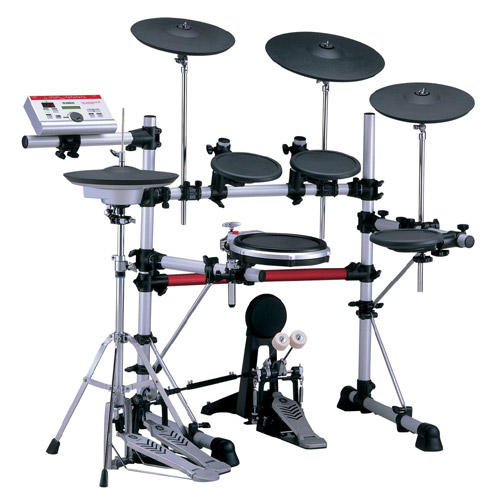
Yamaha DTXpress/DTXplorer/DTXtreme group photo

Yahoo Groups archive

Yamaha DTXpress/DTXplorer/DTXtreme

Index last updated: 2026-04-28 22:44 UTC

Thread

Linux?

Linux?

2004-07-26 by Creighton Higgins

Thus far I have not attached my DTXpress module to a PC. I am about to
turn some old hardware into a Linux box and I am wondering if anyone
has any experience running Linux for this purpose. I am mainly
interested in backing up kits- I think this is a sysex function. Is
sysex Windows only?
Thanks- hope all are having a great Summer. 

Creighton

Re: [DTXpress] Linux?

2004-07-26 by Vernon Graner

Creighton Higgins said:
> sysex Windows only?

I thought I'd re-use this answer real quick, then address the "Linux"
angle in another post... :)

SYSEX stands for SYSTEM-EXCLUSIVE and it refers to MIDI codes that are
outside of (seen as an extension to) the agreed upon MIDI spec. SYSEX
codes are defined by each manufacturer for use with their specific
product(s).

M.I.D.I. (Musical Instrument Digital Interface) is a *standard* and so
the data that can be sent and received by a device must strictly conform
to that standard. Only instruments that do conform to the standard may
display a MIDI logo. Compliance with the spec. will insure the device
will interact with other MIDI devices.

Though the MIDI spec defines a huge amount of data (have a look here
http://www.borg.com/~jglatt/tech/midispec.htm ), there will always be a
case when it would benefit a device to be able to send data that is
specific to itself. So, when you use a SYSEX editor to alter settings on
your DTXpress, you're using codes that are sent on the MIDI interface,
but only "make sense" to a specific device.

For example, the SYSEX dump utility we use to offload all the settings
from the DTXpress would not work with a Roland module (and vice versa),
through both the Roland and the Yamaha are MIDI standard devices, their
SYSEX codes and data would not be compatible with each other.

Clear as mud? :)

Vern

-- 
Vern Graner CNE/CNA/SSE    | "If the network is down, then you're
Senior Systems Engineer    | obviously incompetent so why are we
Texas Information Services | paying you? Of course, if the network
http://www.txis.com        | is up, then we obviously don't need
Austin Office 512 328-8947 | you, so why are we paying you?" \ufffdVLG
Re: [DTXpress] Linux?

2004-07-28 by Creighton Higgins

Vern wrote, "Clear as mud? "

So far- yes Vern- seems like the main issue so far is communication between midi devices (in this case a DTXpress module and a sound card?) which is a standard outside of minor issues like operating systems. So I can trigger midi sounds based on located in the PC assuming I have an appropriate application and sound card driver?

Re: [DTXpress] Linux?

2004-07-31 by Vernon Graner

Creighton Higgins said:
>> Vern wrote, "Clear as mud?"
> So far- yes

Hmm lets try again then.. :)

In direct answer to your question, SYSEX is not "Windows only". As an
analogy, this is akin to asking "Is English Language Human Only?". Though
humans can produce English language, other things may do so as well. A
computer can "speak" English and even a vinyl LP can "speak" English.
English is the name we give to a series of rules that dictate how various
sounds/symbols go together. Another term for this would be a "protocol".

SYSEX is also a series of rules that dictate how data should be put
together (i.e. formatted).  SYSEX really doesn't care what is "speaking"
the SYSEX code (Windows, Apple/Mac, Linux). The information that is
transmitted on a MIDI cable can either be "standard MIDI", as in "all
devices understand it", or "SYSEX MIDI" (system-exclusive) as in "only
specific devices understand/respond to it".

The device generating or listening to the MIDI signal can be a PC running
Windows or Linux (or a Mac for that matter) or a specific piece of MIDI
equipment like a keyboard, drum machine, drum module, light controller,
etc.

MIDI is similar to "sheet music" in that it has a list of what the
instrument(s) should play, but the sheet music *itself* does not make the
sounds it describes. MIDI data is *instructions* for devices. So, if you
use the DTXpress to send MIDI data to you PC, it is possible to configure
the PC to interpret those MIDI commands and to create sound in response.
Also, the DTxpress can receive MIDI instructions and make sounds in
response as well...

If you are interested in Linux and MIDI, there are some MIDI products
that are made for Linux PCs for example, Rose Garden:

http://www.rosegardenmusic.com/

or "MUSE" located here:

http://lmuse.sourceforge.net/

The nice thing is that these programs are GNU/Open Source so you do not
need to purchase them. They are FREE for all people to use and enjoy.
Hopefully, this time the answer is a little clearer than mud. ;)

Vern

--
Vern Graner CNE/CNA/SSE    | "If the network is down, then you're
Senior Systems Engineer    | obviously incompetent so why are we
Texas Information Services | paying you? Of course, if the network
http://www.txis.com        | is up, then we obviously don't need
Austin Office 512 328-8947 | you, so why are we paying you?" \ufffdVLG

Move to quarantaine

This moves the raw source file on disk only. The archive index is not changed automatically, so you still need to run a manual refresh afterward.