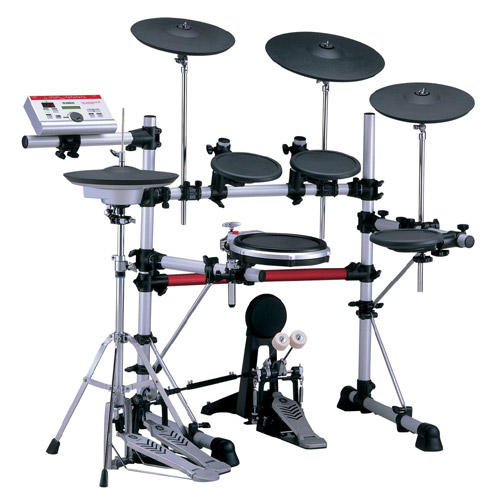
Yamaha DTXpress/DTXplorer/DTXtreme group photo

Yahoo Groups archive

Yamaha DTXpress/DTXplorer/DTXtreme

Index last updated: 2026-04-28 22:44 UTC

Thread

Thoughts on electronic hi hats

Thoughts on electronic hi hats

2003-09-09 by liberatusvirus

Hey OGD,

Recalling your dissection of the HH65, I've been reading the thread 
at vdrums that Chris Jude started a while back about hi hat 
modification (for me, a little like reading War and Peace in Russian, 
I'm afraid). I'm wondering how many of the Roland problems translate 
into the Yamaha context--that is, the long throw of the pedal vis a 
vis the short range of motion that actually picks up the middle 
ground between open and closed on the sensor. The Yamaha sounds don't 
seem too abundant either, but are they handled the same way as the 
Roland sounds, with each hh sample serially mutated to create a 
simulated range (the COSM system, at least in my understanding), or 
are they all individual samples? (And we still haven't figured out 
whether the HH80 is fully variable or discontinuous like the HH65). 
It would seem that the original Visu-lite hat for Roland users was an 
attempt to eliminate the wasted motion of the FD-7, though it could 
do nothing about the limited sonic geography. It would also be nice 
to stretch out the Yamaha sensor as well, especially since something 
like the Visu-lite theoretically would allow the hh voices to 
activate more quickly and fully. The Roland crowd seems pretty 
cynical about it, but a sampler-based module might be the ticket, 
assuming that the company were to make a controller to take advantage 
of it; the Visu-lite, or other aftermarket controller, certainly 
wouldn't be a good enough excuse to do it. I can't help but think 
that the shortcut in electronic hi hat technology is a little like 
the popularity for lossy compression schemes in audio. 
Notwithstanding the issue of cost, after a point, even though it is 
easier and more convenient, the masking is not completely effective, 
and you do notice the difference in quality.

Ed

RE: [DTXpress] Thoughts on electronic hi hats

2003-09-09 by rdamon@mckinney-usa.com

> Ed wrote: Recalling your dissection of the HH65, I've been reading the
> thread 
> at vdrums that Chris Jude started a while back about hi hat 
> modification (for me, a little like reading War and Peace in Russian, 
> I'm afraid).
> 
> 
I read through the same thread, I think it was 95 percent War between two
individuals and 5 percent peace between the other members....


..And we still haven't figured out 
> whether the HH80 is fully variable or discontinuous like the HH65
> 
> 
If I had an HH80, of course, I would take it apart and see how it works. (I
love taking things apart, by the way my screw drivers and cutting knife
would work just as well on other manufacturers samples, heh,heh)

Even if a pedal has a reostat style sensor for sensing continuous input
levels, it would still fall back on the module. How many positions can it
translate into? The other question in my mind is, are there five distinct
sounds in the module for the hihat or is just two (open/closed) that are
being extrapolated with an algorithim. 

If there are five levels of sounds in the module for the high hihat, then
having a variable pedal, would have no benefit. The pedal would output say
0-128, but the module would have to bracket the levels and assign them to
one of the five sounds:

output of 0 = open
output of 1-32 = closed 25%
output of 33-64 = closed 50%
output of 65-96 = 75% closed
output of 97-128 = 100% closed

The real question then is what can the module interpet, five input levels or
128 input levels (or more)?  It seemed that the Roland pedal could output
the 128 levels (I think) to the computer based software that Chris was
using. 

I said it in vdrums and I say it again here. If you can make a optical
tracking mouse (which senses motion across a surface) that can translate an
inch of movement across a mouse pad into 1024 position on a computer screen,
and sell that mouse for under $30, then a hihat pedal based on that type of
sensing technology could be cheaply incorporated into a hihat pedal. Can you
imagine 1024 positions sensing on the pedal translating into 1024 of sounds
between open and close or 800 sounds from open to close and 224 sounds
between close and closed real tight? 

I really think that the module manufacturers are going to have take a
lession from the computer industry. Where as computers have graphic cards
with dedicated high speed processors and memory for doing nothing but video,
I think they need to either have a "add-on" processor card or a built-in
dedicate processor for handling nothing but the hihat/pedal input. Then and
only then will it approach the accoutics version in quality of sound and
expression.


OGD
> 
 
**************************************************************************
The information transmitted herewith is sensitive information intended only
for use to the individual or entity to which it is addressed. If the reader
of this message is not the intended recipient, you are hereby notified that
any review, retransmission, dissemination, distribution, copying or other
use of, or taking of any action in reliance upon, this information is
strictly prohibited. If you have received this communication in error,
please contact the sender and delete the material from your computer.

________________________________________________________________________
This email has been scanned for all viruses by the MessageLabs Email
Security System. For more information on a proactive email security
service working around the clock, around the globe, visit
http://www.messagelabs.com
________________________________________________________________________

Re: Thoughts on electronic hi hats

2003-09-09 by moosetication

--- OldGuyDrummer wrote:
> If you can make a optical tracking mouse (which
> senses motion across a surface) that can translate an
> inch of movement across a mouse pad into 1024 position
> on a computer screen, and sell that mouse for under
> $30, then a hihat pedal based on that type of sensing
> technology could be cheaply incorporated into a hihat
> pedal.

Hmmm ... 'cept, dunno 'bout you, but I don't move my optical mouse 
around by hitting it with a significant chunk of 300lb applied via a 
size 11-and-a-half foot playing 1 and 3 at 180bpm.

> Can you imagine 1024 positions sensing on the pedal
> translating into 1024 of sounds between open and
> close or 800 sounds from open to close and 224 sounds
> between close and closed real tight? 

<beavis> uuunhhh-huh ... uhhhuh ...*cool* ... uuuuuh </beavis>

Stewart (busy, busy, busy)

Re: Thoughts on electronic hi hats

2003-09-09 by liberatusvirus

--- In DTXpress@yahoogroups.com, rdamon@m... wrote:
> If I had an HH80, of course, I would take it apart and see how it 
works. 

I don't have one, but I did procure one for Tom Pickard. I've sent 
him a message asking whether it has discrete notches or complete 
variability.

 Even if a pedal has a reostat style sensor for sensing continuous 
input
> levels, it would still fall back on the module. How many positions 
can it
> translate into? The other question in my mind is, are there five 
distinct
> sounds in the module for the hihat or is just two (open/closed) 
that are
> being extrapolated with an algorithim. If there are five levels of 
sounds in the module for the high hihat, then
> having a variable pedal, would have no benefit. The pedal would 
output say
> 0-128, but the module would have to bracket the levels and assign 
them to
> one of the five sounds:
> 
> output of 0 = open
> output of 1-32 = closed 25%
> output of 33-64 = closed 50%
> output of 65-96 = 75% closed
> output of 97-128 = 100% closed


That's the question, whether Roland and Yamaha are ultimately doing 
the same thing, taking a few samples at best and propagating more 
from them, which seems like a limited and limiting approach. Again, 
assuming that the controller being used was up to it, more intensive 
sampling, as Jude is doing, would definitely help the situation. It 
will not, however, totally eliminate the problem that came up 
recently in another context: The accumulated sound from repeated 
strikes will have to be generated artifically in the digital realm.

> The real question then is what can the module interpet, five input 
levels or
> 128 input levels (or more)?  It seemed that the Roland pedal could 
output
> the 128 levels (I think) to the computer based software that Chris 
was
> using. 

Someone apparently at vdrums (the moderator, as I recall) tested and 
got 127 levels of open to closed, and I think that Jude verified it. 
Tom's answer and a question to Yamaha might get us further along.
 
> I said it in vdrums and I say it again here. If you can make a 
optical
> tracking mouse (which senses motion across a surface) that can 
translate an
> inch of movement across a mouse pad into 1024 position on a 
computer screen,
> and sell that mouse for under $30, then a hihat pedal based on that 
type of
> sensing technology could be cheaply incorporated into a hihat 
pedal. Can you
> imagine 1024 positions sensing on the pedal translating into 1024 
of sounds
> between open and close or 800 sounds from open to close and 224 
sounds
> between close and closed real tight? 

If ddrum can accomplish 1000 levels of gain, as opposed to Roland's 
288, then modules as we know them can accomplish more than they do 
now. The tracking laser or optical assmebly would need to be encased 
in something inordinately protective to translate into a percussive 
context. Does ddrum achieve this degree of detail because it is 
essentially an analog device? It is interesting to note, however, 
that its hi hat, though apparently good, still isn't a world beater.

Ed

RE: [DTXpress] Re: Thoughts on electronic hi hats

2003-09-10 by rdamon@mckinney-usa.com

> Stewart wrote: Hmmm ... 'cept, dunno 'bout you, but I don't move my
> optical mouse 
> around by hitting it with a significant chunk of 300lb applied via a 
> size 11-and-a-half foot playing 1 and 3 at 180bpm.
> 
Stewart,

I was thinking more along the lines of the optical sensor being fixed inside
the pedal and the "surface" being tracked as the "moving" surface that takes
the abuse. There is a vertical metal member at the top of the pedal that
limits the vertical movement of the pedal (both up and down) that would be
the "moving" surface. The sensor would sit safely beside the PCB/TRS jack.
Clearly optical sensors/laser are more than capable of track even the
fastest drummer, so even at 1000 bpm, it wouldn't be a problem. The real
problem here is not that it can't be done but in coming up with the R&D
dollars to experiment with new ideas/concepts to improve a product that uses
tried and true technology, that only gives us 30 percent performance of a
real acousitic hihat.

OGD
 
**************************************************************************
The information transmitted herewith is sensitive information intended only
for use to the individual or entity to which it is addressed. If the reader
of this message is not the intended recipient, you are hereby notified that
any review, retransmission, dissemination, distribution, copying or other
use of, or taking of any action in reliance upon, this information is
strictly prohibited. If you have received this communication in error,
please contact the sender and delete the material from your computer.

________________________________________________________________________
This email has been scanned for all viruses by the MessageLabs Email
Security System. For more information on a proactive email security
service working around the clock, around the globe, visit
http://www.messagelabs.com
________________________________________________________________________

Move to quarantaine

This moves the raw source file on disk only. The archive index is not changed automatically, so you still need to run a manual refresh afterward.