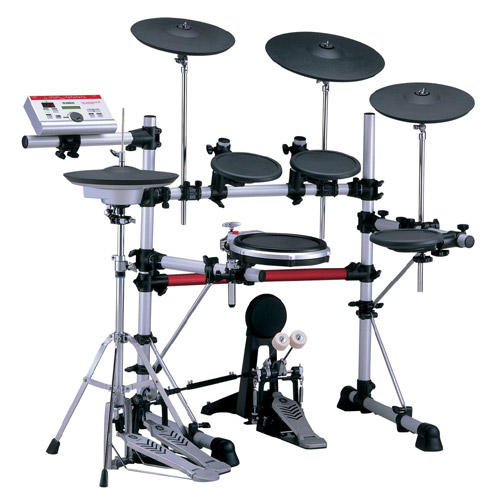
--- In DTXpress@yahoogroups.com, "woody30913" <woody.1@b...> wrote:
> hey people, had the dtx II for about 3 months now,absolutly amazed
by
> it!

Stu,

Welcome. Glad to hear that it's working out for you.

> 1. we are struggling to find a full time bass player,and was
> wondering if i could utilise the upload from the pc to have bass
> riffs or full songs playing alongside the kit.
> is this possible?
> (also, how would i do this ?)

I'm not completely sure what you're getting at, but the downloading/
uploading of kits via sysex software and the recording/sequencing of
MIDI material to and from the DTXpress are two different kettles of
fish. The DTXpress has a two track sequencer for recording MIDI and
adding a drum track to it. It's a nice little practice tool, but it
isn't for laying down ensemble material, unless your band is
exclusively MIDI. But you could certainly create a MIDI bass part for
band members to accompany, if that's all you need. You could play it
out of the DTXpress outputs, with or without the kit, to record or
amplify. You'd simply need a MIDI instrument, either external or
software-based, to play it into the sequencer.

Full-blown sequencing software, however, is necessary for recording
MIDI and/or instruments and vocals to be eventually converted to an
audio codex like WAV or MP3 on a disk. If you convert your PC into a
recording studio of this sort, using software from Cakewalk (Sonar),
Steinberg (Cubase), or others, you'll need an interface/soundcard to
give you the inputs, not to mention resolution, that you require.
This method runs all the gamut of prices depending on features and
resolution qualities.

Perhaps a simpler, and possibly cheaper, method for creating music
that you can give to potential bass players, as well as for making
demos of your material, is to get one of those four track (more or
less) portable studios that Tascam and Fostex have been selling for
years. The earliest ones used cassette tapes as the media; they're
still around, hovering at the $100 to $250 mark. More tracks,
effects, and mixing, as well as digital recording/burning, will set
you back more. Maybe you know all this, or don't need to know it. If
so, forgive my longwindedness.
>
> 2. when repeadedly hitting the crash cymbol fast, the brain thinks
im
> holding the pad,thus stuttering the sound.
> is there a way of curing this at all?

If what you mean is that you can't create a realistic roll on a
cymbal, you've stumbled on one of the DTXpress' limitations. Since
each strike of the pad is interpreted as a new, discrete event by the
brain, cymbal rolls tend to sound like machine guns. In other words,
digital cymbal sounds do not have an inherent cumulative effect like
acoustic cymbals do. Modules at higher price points use various
methods to get around this problem. With the DTXpress, you can try to
adjust the decay of the cymbal to mask the gaps (by turning the decay
function down, which has always seemed counterintuitive to me). I
have also noticed that certain cymbals are better in this respect
through the DTXpress than others. Nonetheless, fast cymbal rolls
aren't totally convincing unless the module has a dedicated means to
address them.

> 3. just entering studio work now,what setup of P.A would be
> sufficient,as i dont want to start blowing the speakers up!!!

The nice thing about recording electronic drums is that they can go
right throught the board, without the need for separate mikes, amps,
etc. If you need to monitor in a studio, you can either get a
keyboard amp, or a dedicated powered satellite/subwoofer combination,
such as Roland's PM-3 or Yamaha's soon to be released dedicated drum
monitor options. Otherwise, get yourself a good set of studio
headphones.

Ed