Yahoo Groups archive

Doepfer

Index last updated: 2026-04-29 00:15 UTC

Thread

help for starter needed

help for starter needed

2015-11-22 by iop poi

greetings to everyone!
i just got into the modular world, and, as my system consists almost entirely on Doepfer modules
[12 out of the 14 modules are doepfer ones]
it's great to know about this forum and be a part of it.

as i have no experience at all, prehaps my questions will sound naive for you, please excuse me for this.
i would greatly appreciate any help, so that i can understand modular things better
[and avoid silly questions in the future :-)]

> i have a A190-1 MIDI-to-CV interface, two A110-1 Standard VCOs and A140 ADSR,
all in the same bus, as to take advantage of the internal cv/gate connections
and control them by sending midi data from my daw.

now, first, in the A190-1 manual it says that all VCOs in the same bus can be controlled by the internal connections.
may i supose that this means only Doepfer VCOs?
if at some point i get a Braids module, should i control it by connecting the cv out of A190-1 midi-to-cv,
and, if yes, will plugging the cv out of 190-1 be breaking the internal connection?

second, and most important, while searching for info about the cv/gate internal connections,
i read that sending two gates on a bus controlled by the A190-1 internal connections can cause damage!
in fact, a person said that
"module fried by having a Midi interface and manual gate on the same buss by accident."

is that correct?

to help me understand, let me give a couple of patching examples:

A] midi data from DAW > A190-1 MIDI-to-CV interface internal connections >
controlling A110-1 Standard VCOs pitch
and at the same time A145 LFO pulse triggering the A140 ADSR gate.

B] midi data from DAW > A190-1 MIDI-to-CV interface internal connections >
controlling first A110-1 Standard VCO pitch
and at the same time, CV/Gate from, say, a sequencer
patched to the CV in of second A110-1 VCO and gate of the second ADSR.

could those, or any similar connections cause any harm?

by the way, i wish that the manuals of all brands had instructions about what to avoid.
if you could please let me know at least a few basic rules about what NOT to patch or any action that can cause damage.

for example, is it safe to run a synth's audio out to the A105 SSM Low Pass Filter,
or the RingMod?
what happens if an audio signal is patched to a cv input, or a control signal is patched to an audio input? etc.

thank you very much for taking the time to read all this;
i'll be more than greatful for any help.
Re: [Doepfer_a100] help for starter needed

2015-11-22 by Florian Anwander

On 22.11.15 17:23 , iop poi omega_images2000@yahoo.it [Doepfer_a100] wrote:
> now, first, in the A190-1 manual it says that all VCOs in the same bus 
> can be controlled by the internal connections.
> may i supose that this means only Doepfer VCOs?
Yes, that is valid only for Doepfer VCOs. For other it depends on the 
dedicated "foreign" module.
> if at some point i get a Braids module, should i control it by 
> connecting the cv out of A190-1 midi-to-cv,
> and, if yes, will plugging the cv out of 190-1 be breaking the 
> internal connection?
The outputsockets never beak the connection to the internal bus. They 
are simply parallel. So: if you will hava a Braids and a A-110, then the 
A-110 will get the CV from the bus, the Braids will get its CV via a 
cable from the Interface CV-out to the Braids CV-In. (I have exactly 
this combination in my live case, so I know it for sure :-) )


> second, and most important, while searching for info about the cv/gate 
> internal connections,
> i read that sending two gates on a bus controlled by the A190-1 
> internal connections can cause damage!
> in fact, a person said that
> "module fried by having a Midi interface and manual gate on the same 
> buss by accident."
>
> is that correct?
I'd say 99% it is wrong. It might happen, if the MIDI-interfaces gate 
out is completely unsecured (direct connection to the CMOS-chip). I 
think the very old MCV-1 interface had only a resistor between the uP 
chip out and the socket; this could lead to problems with high voltage 
gates from old ARP or Roland synths.
But the A-190-1 has a transistor-buffer in the gate-out line. So there 
is no danger at all.

For your example: you simply can let the interface send its gate via the 
internal bus, while you insert the LFO-"gate" to the Gate-In at the 
front of the second ADSR. This will break the connection to the internal 
gate bus. There will be no "shorting" with the internal gate.

Florian

Re: [Doepfer_a100] help for starter needed

2015-11-22 by Nicholas Keller

To comment on a few things Florian didn't mention:

Yes you can patch audio outs to CV ins and CV outs to audio ins, just be aware of when inputs are DC or AC coupled as that may affect the result (but there is no risk of damage). It's just this sort of flexibility that lends a modular to creating tones impossible with many hard-wired synthesizers.


Nick


Show quoted textHide quoted text

On Sunday, November 22, 2015, Florian Anwander fanwander@mnet-online.de [Doepfer_a100] <Doepfer_a100@yahoogroups.com> wrote:

On 22.11.15 17:23 , iop poi omega_images2000@yahoo.it [Doepfer_a100] wrote:
> now, first, in the A190-1 manual it says that all VCOs in the same bus
> can be controlled by the internal connections.
> may i supose that this means only Doepfer VCOs?
Yes, that is valid only for Doepfer VCOs. For other it depends on the
dedicated "foreign" module.
> if at some point i get a Braids module, should i control it by
> connecting the cv out of A190-1 midi-to-cv,
> and, if yes, will plugging the cv out of 190-1 be breaking the
> internal connection?
The outputsockets never beak the connection to the internal bus. They
are simply parallel. So: if you will hava a Braids and a A-110, then the
A-110 will get the CV from the bus, the Braids will get its CV via a
cable from the Interface CV-out to the Braids CV-In. (I have exactly
this combination in my live case, so I know it for sure :-) )

> second, and most important, while searching for info about the cv/gate
> internal connections,
> i read that sending two gates on a bus controlled by the A190-1
> internal connections can cause damage!
> in fact, a person said that
> "module fried by having a Midi interface and manual gate on the same
> buss by accident."
>
> is that correct?
I'd say 99% it is wrong. It might happen, if the MIDI-interfaces gate
out is completely unsecured (direct connection to the CMOS-chip). I
think the very old MCV-1 interface had only a resistor between the uP
chip out and the socket; this could lead to problems with high voltage
gates from old ARP or Roland synths.
But the A-190-1 has a transistor-buffer in the gate-out line. So there
is no danger at all.

For your example: you simply can let the interface send its gate via the
internal bus, while you insert the LFO-"gate" to the Gate-In at the
front of the second ADSR. This will break the connection to the internal
gate bus. There will be no "shorting" with the internal gate.

Florian

AW: [Doepfer_a100] help for starter needed

2015-11-23 by yahoo@doepfer.de

> But the A-190-1 has a transistor-buffer in the gate-out line. So there
> is no danger at all.

I'm sorry but I have to contradict. The (old) A-190-1 had a transistor at the gate output together with a pull-up resistor connected
to +12V. The transistor was used as a switch to GND (similar to the Moog S-Trigger). As long as the transistor switch is open the
gate is "high" because of the pull-up resistor. As soon as the transistor switch closes the gate turns "low". If in this state a
voltage is applied to the gate bus the transistor maybe be fried (provided that the voltage applied is "powerful" enough to fry the
transistor). In later versions of the A-190-1 we added a serial resistor to avoid this problem (as well as in all other A-190-x
interfaces).

General information about the CV/Gate/bus subject is available on our website:

www.doepfer.com > Products > A-100 > Technical Details > Power Supply and System Bus

Best wishes
Dieter Doepfer

Re: AW: [Doepfer_a100] help for starter needed

2015-11-23 by omega_images2000@yahoo.it

thank you all soooo much for your replies. they have been very helpful and i am obliged to all of you.

so, after what Dieter said, if my A-190-1 is an early model there is danger, but if it is a later version there is no danger at all. i checked the module, and at the back it says "gepruft MM 9/13". can this help, or should i check anything else?


AW: AW: [Doepfer_a100] help for starter needed

2015-11-24 by yahoo@doepfer.de

> thank you all soooo much for your replies. they have been very helpful and i am obliged to all of you.
>
> so, after what Dieter said, if my A-190-1 is an early model there is danger, but if it is a later version there is no
> danger at all. i checked the module, and at the back it says "gepruft MM 9/13". can this help, or should i check anything else?

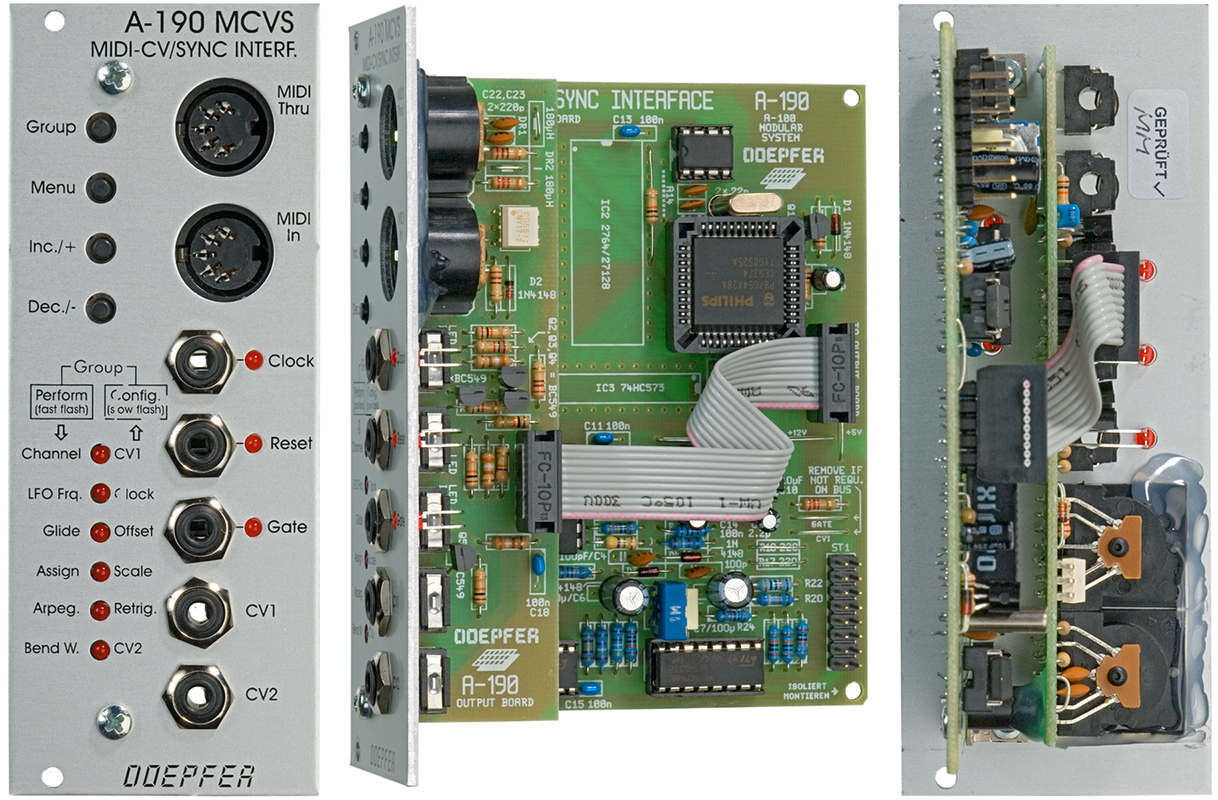
Please look at the main pc board of the module. Above the 16 pin bus connector there is a note "REMOVE IF NOT REQU. ON BUS" that
refers to two jumpers labelled GATE and CV1. There are 3 possibilities:

a blank wire is installed for GATE: then it's the old version of the A-190-1
a resistor (220 Ohm) is installed for GATE: then it's the new version of the A-190-1 (with protection resistor)
the GATE jumper is missing or interrupted: then there is no connection to the Bus

Best wishes
Dieter Doepfer

Re: AW: AW: [Doepfer_a100] help for starter needed

2015-11-24 by omega_images2000@yahoo.it

hi Dieter! thank you from my heart for taking the time to answer to me.
i followed your intructions and checked the board; i can't see the labels for gate/cv, but i compared my module to this photo
http://www.doepfer.de/A100_pictures/doepfer_a190.jpg
[how great is that you have photos of the boards on the doepfer site!]
and it seems that in my module, there is a resistor at the right place.

i posted a photo of my module so you can verify that i'm not mistaken:
https://groups.yahoo.com/neo/groups/Doepfer_a100/photos/photostream/lightbox/1058788174?orderBy=mtime&sortOrder=desc&photoFilter=ALL#zax/1058788174

so, as not to bother you again with the subject, if my module is indeed a later model, i can send midi data through the A190-1 and at the same time send gates from LFO, or cv/gate from external units [for example, a Roland MC202 sequencer] with no fear of damage

again thanks + respect
Yiannis.

AW: AW: AW: [Doepfer_a100] help for starter needed

2015-11-25 by yahoo@doepfer.de

> hi Dieter! thank you from my heart for taking the time to answer to me.
> i followed your intructions and checked the board; i can't see the labels for gate/cv, but i compared my module to this photo
> http://www.doepfer.de/A100_pictures/doepfer_a190.jpg
> [how great is that you have photos of the boards on the doepfer site!]
> and it seems that in my module, there is a resistor at the right place.
>
> i posted a photo of my module so you can verify that i'm not mistaken:
> https://groups.yahoo.com/neo/groups/Doepfer_a100/photos/photostream/lightbox/1058788174?orderBy=mtime&sortOrder=desc&photo
> Filter=ALL#zax/1058788174
>
> so, as not to bother you again with the subject, if my module is indeed a later model, i can send midi data through the
> A190-1 and at the same time send gates from LFO, or cv/gate from external units [for example, a Roland MC202 sequencer]
> with no fear of damage
>
> again thanks + respect
> Yiannis.

Obviously the gate connection of your module to the bus is made already with a 220 Ohm resistor. So it's one of the newer modules.

If you want to combine gate or trigger signals the A-186-1 Gate/Trigger Combiner should be used. As a rule outputs should not be
connected because it's generally not a good idea to short outputs. In most cases nothing can be damaged within the A-100 but the
results are unpredictable. For the combination of audio or CV signals mixers (A-138) should be used, for Gate/Trigger the above
mentioned A-186-1 (or also mixers).

Best wishes
Dieter Doepfer

Move to quarantaine

This moves the raw source file on disk only. The archive index is not changed automatically, so you still need to run a manual refresh afterward.