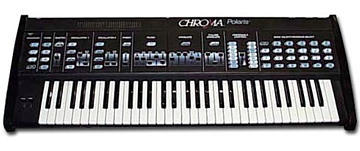
Dear Dave and Paul,

Yes, my Polaris will hold all patches and settings while the main power is on. Where I checked the battery voltage was simply at the connector to the main board. I was not sure which pin on the RAM chips would be the best to check the voltage when the main power is off. I can check that now that I know which pins are used.
I looked online and the IN34A germanium diode is easy to find. So I will get one and replace it.
Thank you both for the advice.
Once I change out the diode, I report back.Hope that is all it is!

Sincerely,

Brett


--- In chromapolaris@yahoogroups.com, "Paul D. DeRocco"  wrote:
>
> > From: David Clarke
> >
> > Brett - the batteries are going to be used to power the RAM, but only
> > when the unit is shut off.
> >
> > When main power is applied to the unit, the RAM will be
> > powered by the
> > on-board power supply.
> >
> > If the Polaris is fully functional when it is powered up (e.g., if
> > you're able to save patches, recall patches, etc.) then you can be
> > reasonably confident that the RAM itself is fine.
> >
> > When power goes away, (and when it comes up) there is a
> > circuit on-board
> > that switches the CMOS RAM power to/from the battery.  This
> > is shown in
> > the "Battery Back Up Power Supply" circuit in the schematics:
> >
> > http://www.rhodeschroma.com/content/polarisservicemanual/polar
> > isserviceschematics/computermemorydatapanelbuffersbattery.pdf
> >
> > If the problems only occur across a power-cycle, then the most likely
> > implication is that there's something not quite right with
> > regard to the
> > operation of that circuit.
> >
> > > I have new D-cell batteries in and I check with a
> > > voltmeter that indeed 3.1V is getting to the main board when
> > > the power is off.
> >
> > It's not exactly clear from this note where the voltage was
> > measured -
> > but you'll want to measure it at the +5V Batt location on the
> > CMOS RAM
> > chips themselves (e.g., pin 26 or 28 of those devices) to
> > confirm that
> > it is making it to where it is needed.
> >
> > If it is there, you'll want to watch that voltage location with an
> > 'scope to confirm that during the power on/power off the
> > voltage doesn't
> > glitch low.
> >
> > If it isn't there, then it's just a matter of tracing back to
> > find where
> > where the battery volage is 'lost' from the batteries (e.g., CR1 bad).
> >
> > Good luck, and let us know how you make out,
>
> CR1 is the most likely culprit. If anything even momentarily shorts the
> memory power line to ground, that will blow out. That could be diagnosed
> easily enough with a meter. If it's bad, it should be replaced with either
> an equivalent germanium diode, or perhaps a Schottky diode. A regular
> silicon diode can be used in a pinch, but will not tolerate as low a battery
> voltage before the RAMs lose their data.
>
> --
>
> Ciao,               Paul D. DeRocco
> Paul                mailto:pderocco@...
>
Message
Re: Resurrected Polaris will not hold memory
2013-02-05 by stanleykenton59
Attachments
- No local attachments were found for this message.