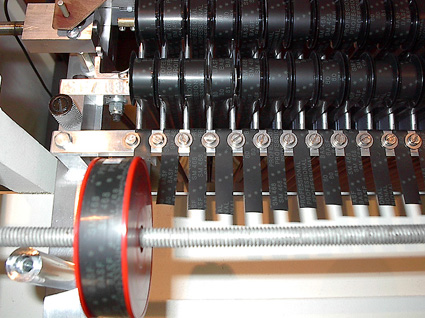
Nice!

In a message dated 6/30/2014 12:10:44 P.M. Eastern Daylight Time,
newmellotrongroup@yahoogroups.com writes:


I would like to address a small part of Rich's post.

"No benefit in  the studio either. NONE."

A quick personal history. I own a recording  studio that specializes in
vintage keyboards. Our inventory includes one of  Markus' M4000D's, and an
original M400. I've also owned a number of additional  M400's, a MkV, and a
Chamberlin.

Some observations on the M4000D.  Well-made, great sounding, reliable, nice
keyboard. Does it sound like our  particular M400? No. And this M400
doesn't sound like our other M400's. The  M4000D sounds like a combination of a
couple of the M400's we've had. But it  sounds NOTHING like our current M400,
and again....neither did our past Trons.  Not better or worse, just
different. Radically different. We use the M4000D  for "almost" everything, but
occasionally it's simply "Not The Right  Mellotron". Just like the M400 is often
not the right Mellotron. They are  different sounding Mellotrons.

Studio benefits: Many of our inventoried  instruments are essentially
handmade. Therefore, each will have it's own  quirks and personality. OUR Rhodes
doesn't sound like YOUR Rhodes. OUR  Minimoog doesn't sound like YOUR
Minimoog. And that, in itself, gives value to  having the hardware.

However, the point that I consider most important,  and often overlooked,
is "how does that PARTICULAR instrument influence the  performer's music?".
Here's how it plays out, in EVERY session. I'm not  kidding.

Player arrives. He/she has been using vsti's and hardware sims  for years.
Has never even SEEN most of the authentic instruments. They have  all their
parts carefully written and rehearsed, based on their vsti's, and on  the
sims in their workstations.

They see the C3 and 122. "Holy shit".  Yep. This is serious.

I show them how to turn on the C3. The starter  motor grinds up to speed,
then the run motor wobbles a bit, and kicks the  machine into gear. "Holy
shit".

They feel the vibrations from the  tonewheel generator. They feel the wind
from the Leslie. I coach them through  the speed switch, drawbars,
percussion, and vibrato. I show them how to  control the distortion by using the
volume pedal. "Holy shit".

They  play the parts that they had planned. Then....they start modifying
the parts,  based on the influence of the instrument. They disappear into the
experience,  and we all just shut up for a while, and let them soak it in,
and GET IT.  We've had people actually crying while playing this stuff. They
can't believe  the depth of the experience. The realization that the vsti is
THAT far from  the real instrument, comes as a profound shock.

What they eventually  record ends up sounding like the REAL version of what
they had originally  intended. With far more emotion and power, but it's
because of THE WAY THEY  PLAY IT, not just the way it sounds.

So I do think that "No benefit in  the studio either. NONE." may be an
unfair assumption.

Cheers,

Jim Blair
Ape Island Sound
Canada
Message
Re: [newmellotrongroup] Mellotron, shmellotron
2014-06-30 by lsf5275@aol.com
Attachments
- No local attachments were found for this message.