In a message dated 11/16/2009 6:30:53 P.M. Eastern Standard Time,
pocotron@yahoo.com writes:

Very nice, Frank.  It's a clean machine.
   Here's a few nosey questions-
-Is that bar that the tapes pass over made of nylon?  Is the  friction it
induces due to static build-up?
-What circuit is in the box in back of the control  panel?
-Was the flywheel pulley belt standard sized?

  Thanks
  -Bruce Daily


Bruce,

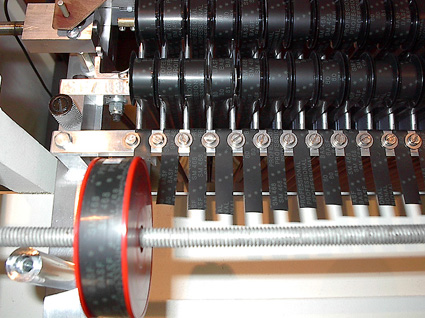
The roller guides on the tape frame were all difficult to spin. I fixed
that. The roller guides that the tape return springs pass over were the same
way. I fixed them. The nylon bars across the front and rear of the guides
that  the tapes pass through at the head block are very smooth and cause
little if any  friction. Whether or not they impart static electricity to the
tapes remains to  be seen. I have not experienced any signs of that yet.

The flywheel appears to have the same diameter as any other at the point
where the belt passes over it, but the diameter of the capstan is smaller
than  that of a M-400. The M-400 capstan has a 20mm diameter and used 6004
bearings while the 4-Track capstan has a 3/4" diameter and takes R-12
bearings. The belt is stock and the drive pulley and timing sprocket are  stock.

If you look at the photos in the album I posted on the Yahoo site, you can
see one of the 4 pre-amp boards. The pots are connected to the boards
themselves. Here is a photo of what's inside. The preamp boards for each track
plug into these edge connector sockets.


That's all that is up top except for the on/off switch and the pitch
control pot. In the box below where the power supply is there is a SMS-3, a
transformer, two capacitors and a few other components. Not a Bulgin anything to
 be seen. It looks like all connectors are Molex connectors. Even in a
standard  power supply, if you have an SMS 2, 3 or 5, you really only need the
large 4000  microfarad capacitor and the 1600 microfarad capacitor next to
it. The rest of  them can be used to make neat devices to shock the shit out
of your friends or  even total strangers. Handle with care. The swell pedal
connector is a DIN  connector.  All four tracks run to it and then to the
lines out, much like  a M-400.

Notice the scientifically designed, human engineered, user friendly piece
of Velcro to the right. This is the hook side; the loop side is attached to
the  lid. This is to keep the lid closed if you happen to be playing
outdoors in  heavy wind.

The 4-Track appears to have been designed and built by the Gilbert Company.
 It is constructed very much like something one might build with an Erector
 Set.

One last thing. There are seven 1/4" output sockets on the back of the
cabinet. Three above four. As near as I can tell, they are configured as
follows.

                    Left channel out.        Line out (normal  mono)
 Right channel out


          Track A  (clean)         Track B  (clean)          Tack C
(clean)          Track D  (clean)

By clean, I mean that the signal from the head stack does not run through
the preamp and therefore the player has no control over volume or panning. I
 suppose you could run the lines out through 4 separate volume pedals
though. I  think the intent is to run the dry signal directly to a recording desk.

The left and right channels can be used for live performances and go
through the swell pedal and allow panning of the separate tracks by the player
during recording or live performance. The mono line out is for the guy who
just  wants to plug it into his amp and make some noise.

I like it!

FrankMessage
Re: [newmellotrongroup] Re: Another 4-Track update (she's nearly done)
2009-11-17 by lsf5275@aol.com
Attachments
- No local attachments were found for this message.