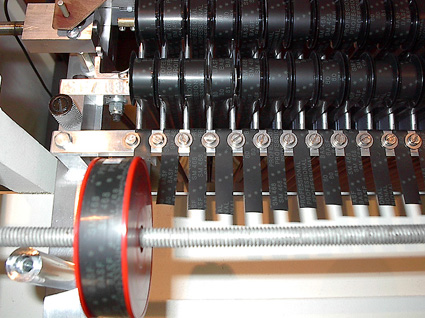
In a message dated 2/17/2010 1:11:10 A.M. Eastern Standard Time,
fourtytwominds@yahoo.com writes:


Hi everybody.

Busy semester, as per usual. Last of 'em too. I've got  a really BS class
about "The World's Music" with is sort of a watered-down  ethnomusicology
class that I've been required to take, even though for what it  applies to
helping little kids become musicians, I could've just spent a  couple evenings
in the local public library.

Any case, there's an essay  requirement about examining, from sort of an
ethnomusicology perspective, a  music that we are already familiar with,
because apparently..Any case, there's an essaynot be ..a.. research paper? (And I
thought I was getting  an education.)

So I'm posting the prompt for the essay, followed by  what I wrote, which
is 3 times as long as the meager 1000 words he was asking  for and not
expecting to get from anyone. I'm asking that you correct where I  may be off
base, saying things about prog that sound right but aren't, or  where I over
simplified, entirely missed the point, or whatnot. Even though  the professor
expects shit for an essay I'm going to give him a damned  good one in any
case, because that's how I roll.

PS. Oh damn, I  forgot a few content areas, but I can correct that later.
So now it will be 4  times as long...
_________

Music 171: Introduction to the World's  Music
Donald A. Henriques, Ph.D.
Questions

Writing Assignment #1  (1000 words)

Write an essay of 1000 words on a type of music that you  are familiar
with.  This music may be for instruments, vocals or both.  The purpose of this
assignment is to create your own narrative that addresses  the following
categories.  You may address these in the order of your  choosing.  However
remember that this is a WRITING assignment is NOT a  research paper and that
your essay needs to be well constructed and clearly  written. Use Thinking
Musically to support your responses, however refrain  from direct quotations.
Specific guidelines will be forthcoming.

The following are questions that should be addressed in some way  within
your narrative.

In what way(s) does this music have  meaning for you?  How is that meaning
constructed? Provide the context in  which you experience the music and why
that context has special  meaning(s).

Describe the musical instruments used in the making  of the music. How does
these specific instruments contribute to the overall  sound? Do these the
instruments themselves have special significance?   (gender-specific, ritual,
spiritual associations, cultural status, etc.)

Time: How is musical time reflected in this music?  Does the beat  tend to
be "regular and constant?" In general, describe the rhythm of the  music.
What is the "feel" of the rhythm?  Does the rhythm have  regular or irregular
patterns?  Does the rhythm itself have any special  significance?

Pitch: Does this  music have an easily recognizable melody? Describe the
overall shape of the  melody in terms of pitch.  Does it cover a wide or
narrow range of  pitches? Are there expressive reasons for this?  Describe the
harmony.  Would you characterize it as generally consonant or  dissonant?
Why?

Musical Structure: Describe the overall structure  of the music.  Are there
improvised sections?  Are there dramatic  changes in tempo, rhythm or
melody that indicate sectional changes in the  music?

How is this music typically transmitted among the  musicians?  Does it have
a written tradition?


_______

Sean Lowrie
16  February 2010

Progressive rock, boiled down, and made significantly less  interesting
than it actually can be, at certain times, that  is.


The music referred to as "progressive  rock" is a music near and dear to
me, one that I grew up with and became  intimately familiar with, never mind
the fact the records of the music were  recorded anywhere from twenty to ten
years before I was born. Since I've taken  up music and as I've become a
musician in my own right I've gained more and  more insight into what is
progressive rock, what it meant, and what its legacy  is.
First off, the term itself is fuzzy as fuzzy  can be(ditch this). What I
will be  specifically examining is the "prog" of the 60s and 70s, which was
mainly an  English phenomenon, but it did not bar Canadians and Americans,
though to my  knowledge the phenomenon was at the time limited to those three
nations (don't forget the Italians, Swedes, Germans, Japanese, at least  one
or two Canadians and nearly all of the countries below the equator,
especially nearly every country in South America.  Progressive rock was a
sub-culture of the very dominant rock culture at the  time, and during the early 70s
achieved something of hegemony in the rock  world, if only for a brief
moment. I will not be talking about other  experimental rock music styles that
were contemporary, not the folk-rock, not  the avant garde rock acts, nor
jazz-rock fusions where they evolved from a  jazz idiom first. Of course, the
edge of what is and isn't prog will always  remain very fuzzy (you should
avoid, "fuzzy" if at all  possible. Perhaps you could exchange, "fuzzy," for,
"subject to  debate," or something like that), for reasons soon to be
revealed.
Again, note that prog evolved from the  psychedelic music of 1966-1969 (and
perhaps a bit of  classical, neo-classical music and jazz.  Think, Miles
Davis.


Sean, this is a broader topic that you can really begin  to cover in a
thousand words. Good luck,

Frank

Being that the rock culture was highly individualistic there was  no
consensus and no one way to push the psychedelic fad beyond the norm and  into
something else, there was only consensus that something else was very
desirable. This individualist culture is one of the social givens that shaped  the
progressive genre for the musicians, the audiences, the consumers at the
record stores, and the perceptions of the genre by the general public, they
who were probably wondering Oh God, what drugs've these lads taken this  time?
This individualism enabled a very wide range of  music influences to
coexist and inform the performances of differing bands,  and the same goes with
life views and all the other baggage of the progressive  rock era. There was
Yes and their many imitators with their extremely  intricate metrical
madness, their love of choral harmonies, and their penchant  for strange
Indian-flavored metaphysics. There was Rush with their much  heavier near-metal sound
and their penchant for Libertarian politics and Ayn  Rand's objectivist
philosophy. (And outright lifting of her novels into  rock-album format.) There
were entirely symphonic outfits such as Renaissance  who created all
original romantic-era compositions for orchestra and rock  band. There were even
such organizations as my personal favorite, the ever  schizophrenic and
unstable King Crimson whom ranged from electrified Gustav  Holst, to jazz-rock
compositions (with a strange medieval fairy-tale quality  to it), to African
music and the occult, and finally to proto-metal before  disappearing off the
face of the Earth for seven years, before re-emerging as  a rock-gamelan,
and disappearing off the face of the Earth this time for over  a decade,
before re-emerging as something almost, but not quite,  alternative-idualism
enabled a very wide range of  music influences to coexist and inform the
performances of differing bands,  and the same goes with life views and all the
idualism enabled a very wide range of  music influences to coexist and inform
the performances of differing bands,  and the same goes with life views an
This is the reason why  prog has such fuzzy edges. How would one exactly
say that King Crimson is in  (well, I guess they did start the whole shindig)
while Frank Zappa and the  Mothers along with Captain Beefheart are out? Is
Pink Floyd progressive, or  space-rock, or just plain old psychedelia? These
doubts mean, at least to  suspend disbelief of the entire premise, we've
got to examine what united the  disparate acts of progressive rock.
They all can be said  to share similar instrumentation. At first this seems
like one big "duh." If  they all descended from mainstream rock of the 60s
then they should all have  rock instrumentation, and lo! there it is, they
all have an electric guitar or  two, an electric bassist, and a drummer!
Well, it should be also noted that  almost all prog bands relied on keyboards to
a degree never before heard of in  rock music and certainly not shared by
contemporary rock music. Rick Wakeman  of Yes and Keith Emerson of Emerson,
Lake, and Palmer made their keyboard  skills the heart of the "sound" of
their respective bands. Hammond Organs,  pianos, and Mellotrons popped out of
every possible musical corner, and I must  confess, the bands with lesser
discretion usually included these instruments  even in the places where they
harmed the musical content of the moment. The  Mellotron especially, and
especially the bloody "three-violins" sound on it  (my all time favorite sound in
the world) became the sound of progressive  rock, that is, when mixed with
inordinate gobs of reverb. In its the day the  instrument was despised for
its unreliability (which resulted from these dudes  not wanting to do any
maintenance at all on the contraption) and has since  outlived the progressive
rock era and achieved cult status amongst some.  (Yours truly gives
supplications and gentle praise at the Temple of the `Tron  every Saturday evening,
and has joined a Yahoo! group full of people who were  young when the `Tron
was young, are now old, haven't gotten rid of their  `Trons, and still act as
if they are somehow relevant in the year 2010. Some  members actually are
still building them in the original factory in England,  and from all these
people who were there in that progressive moment I've  gotten much insider's
illumination into what was progressive  rock.)
Prog attempted to leave behind traditional rhythm  and meter to as great as
extent as they could get away with, and still sell  records. Asymmetric
meter was definitely in, and incidental polyrhythm was not  uncommon in certain
passages. Deliberate polyrhythm was a bit more rare, at  least until King
Crimson returns in 1981 with Robert Fripp and Adrian Belew  playing the part
of a gamelan ensemble on their guitars, but that's after the  death of prog
in any case. There usually is no good musical reason why  differing metrical
patterns were used by these acts, only that anything that  was difficult to
perform right and not normally heard in rock circles was a  great thing,
whereby a band could show off just how "liberated" they are from  the
restraints of conventional thought. As base as this sounds this summation
accurately describes the metrical reason to be for a good two-thirds of the  prog
music one can run across on record. There is that other third that may  have
actually gone weird for musical or philosophical sake, and they should  not be
discounted, but they are equally the exception to the rule. Also  remember
that prog rock is still rock, and as such you just can't escape the
"tyranny" (as one guitar idol of mine put it) of four-on-the- Prog attempted to
leave behind traditional rhythm  and meter to as great as extent as they could
get away with
Progressive rock is also unified by  almost all the musicians being of the
highest skill. Virtuoso ability on your,  one, two, or six, different
instruments is not really an option in progressive  rock, it is a demand. Virtuoso
ability became the common vehicle for very  exciting musical moments, which
was more or less the point of progressive rock  in the first place. There
was often absolutely no distinction between what  would otherwise be
considered "normal" and "extended" techniques. If you could  make your guitar sound
like an enraged elephant, and then could find a way to  musically use it,
then you could assure your next album and tour would be a  smash hit. Don't
get me wrong, the virtuoso aspect was also commonly abused as  the interesting
thing in and of itself, but "fret-wanking" has always been  present in rock
music, and in that regard it doesn't serve as a distinction  between what
is and isn't progressive rock. It should be noted though, that I  mentioned
instruments and not voices. The vocalist (or vocalists) for any  mythically
average progressive outfit would be of no greater skill than any  non-prog
rock outfit, and the deviation from wretched to sublime was  comparable to
that of regular rock music. Why there was never much premium  placed on singing
I have never rightfully known, but safe to say, in prog, one  will
encounter 10-12 instrumental tracks for every a cappella  piece.
The structure of most of the tunes is alien to  the rock world but should
be very familiar to any fan of romantic  compositions. An awful lot of
progressive rock came in movements as opposed to  three-minute ditties one would
expect out of a rock band. The vinyl record  itself became something of a
storybook, and concepts, storylines, and motivic  material would appear,
reappear, and recombine throughout the length of an LP  in very much a romantic
idiom. This was rightfully viewed by most outsiders,  and a lot of fans on the
inside, as quite a bit pretentious, but it fit in so  very well with the
entire world of prog rock. For the mother of all examples,  one has to listen
to Jethro Tull's "Thick as a Brick" album, erm I meant song,  erm I meant…
The one song on the album fills both sides of the LP! Granted,  band leader
Ian Anderson meant for the entire thing to be a bit ridiculous as  he was
taking the piss on the music critics of the time, but it still is  mighty fine
music with excellent classically- The structure of most of the tunenation of
the various motives and feels of the epic tune. This is the  nature of
progressive rock.
This fascination for the  Wagnerian concept album, and most everything else
these people did resulted  from a philosophy of what they were doing.
Almost all of the bands and people  involved in prog-rock doggedly ensured that
everything they did would have a  unified approach about it. Their music,
their stage demeanor, their creative  process, their cover art, and their
interviews all had to spring from a single  source. Quite often this source would
be some half-baked philosophy that  everyone but the band members
themselves thought was quite kooky, but that's  okay, everyone had their own brand of
kooky. In this regard progressive rock  is not an insular thing but a
direct product of the societies in which these  people were living. As the common
narrative goes, the 60s were a time of great  doubt in all
Western/democratic social institutions, and young people  especially (that's the rock crowd)
were trying to find alternatives, any  alternative to a Western tradition
that had totally failed them. As exoticism  has long been a trait of the
West, many looked towards India and towards the  teachings of the Hindu and
Buddhist faiths. Many, of course looked elsewhere,  or flat out invented their
own, but everyone was fairly adamant that they were  going to take stance
against the insanity of the West by behaving very  self-consistently once
they'd found their wellspring. (In this regard I have  to look admiringly towards
the members of Rush, those crazy Canucks, who said  The West has failed
you? Hell, you don't even know what Western civilization  would taste like, so
completely has modern society left behind the classical  liberalism of our
grandfathers. This fascination for the  Wagnerian concept album, and most
everything else these people did resu
This leads to the ultimate synthesis point for  prog-rock, one that
wouldn't seem all that spectacular at all had I mentioned  it right off the bat.
Prog-rock was meant to be exceptional art for art's  sake. This is not to say
that rock is not an artform, but rock had an entirely  different aesthetic,
did not hold itself to ridiculously high expectations,  and to speak basely,
still had a lot of room left for plain old fun. Not so  with prog-rock,
which is not to say that prog-rock was meant to be dull and  dreary and
entirely cereberal. Instead prog-rock is intellectually fun, it is  fun in the same
manner as many people get a kick out of going to the Lourve to  look at the
paintings. Prog-rock must be recognized as an elitist phenomenon,  and yes
that brought out all the typical pompousness in some participants that  any
elitist phenomenon does, but there were many in the prog world as
performers or listeners that weren't going to take their own selves that  seriously,
even if it seemed like everyone else was. Prog-rock was meant to be
challenging, stimulating, emotional, and self-consistent, in a way that rock  music
never had been before. It was, to date at least, the ultimate marriage  of
romantic sensibilities and rock-n-roll aggression. As has been stated on a
page dedicated to telling the history of prog in as crude and humorous of a
way as possible, "Progressive rock is all about seeing how many musical
orgasms can be achieved in a thirty-minute period." Vulgar? YES! Still, it is
quite possibly the best truism about prog-rock I've ever run  across.
By circuiticious route all this examination and  mincing of words leads
back to me. Prog was dead and rotting by the time I was  born in 1987,
certainly nothing remained of it by the time I was capable of  remembering anything,
that being around 1995. (Excepting of course King  Crimson, the band
curiously infamous for never holding together and never  going away either. Oh
that, and they're the hacks responsible for launching  the prog era with their
1969 debut In the Court of the Crimson King.) My  father has very eclectic
musical tastes, ranging from hard-bop to blues to  Wagner to spirituals to
the Beatles to contemporary- By circuiticious route all this examination and
mincing of words leads back to me. Prog was dead and rotting by the time I
was  born in 1987, certainly nothing remained of it by the time I was capable
of  remembering anything, that being around 1995. (Excepting of course King
 Crimson, the band curiously infamous for never holding together and never
going away either. Oh that, and they're the hacks responsible for launching
 the prog era with their 1969 debut In the Court of the Crimson King.) My
father has very eclectic musical tastes, ranging from hard-bop to blues to
Wagner to spirituals to the Beatles to contemporary-<WBR>jazz. Progressive
rock was at its zenith during his jr. high school years, those being the mid
 70s. It was th
Rather it was The Moody Blues  that eased me into a true love affair with
prog-rock. The Moodies have always  been on the very edge of what might be
prog, but they're more of a proto-prog  outfit. In `68 and `69 they were
making such lush and symphonic noises with  their very mellow British R&B
sensibility and the spacious and dark sounds  of Mike Pinder's self-modified MkII
Mellotron. (He was a quality control  person in the Mellotron factory before
he joined The Moody Blues in 1965.)  That's what got me hooked on "the
sound" in my jr. high years, and as I went  through all the emotionality of my
teen years the strong emotionality of The  Moodies seemed ever the perfect
fit, and so my early romances, my growing  sense of pride as I could do more
and more things, and my transformation into  a man is all wrapped up in the
wistful beauty of The Moodies. (It should also  be noted that the same beauty
of the Moodies seems to have spoke to the  members of the commercial-flop
outfit Giles, Giles & Fripp in 1969, as  they replaced a bassist, got a
multi-instrumentali Fripp in 1969, as  they replaced a bassist, got a
multi-instrumentali<WBR>st with MkII Mellotron,  got a very bizarre lyricist, and
changed music forever under the band name  King Crimson.) Showing that the
universe is a very ironical place, in my 2nd  year of high school, while I was
hunting for more Moodies CDs I temporarily  exhausted the supply of Moodies in
Tower Records Fresno, and had money enough  to purchase one more CD. Well,
there was King Crimson's 2nd album In the Wake  of Poseidon which had a cover
painting very much like those of Moody Blues  albums, and I (correctly)
figured if the artwork is similar then the music is  similar. (I was already
learning the unwritten rules of progressive rock.)  I've been on a downward
spiral in
Inside of what I means to  be, me, prog is special as it feeds so many of
my interests. I'm a musician by  trade, and have spent twelve years learning
to play in the Western classical  tradition. Prog rock speaks to this very
well, while at the same time being  undeniably rock music, whereby I never am
too far from my personal roots. It  is also very situated in my life, as I
go through the momentous years of my  teens and my now my 20s, as I have
seen incredible history, as I have studied  to come to know our forgotten
classical liberal heritage, as I fear the  current Marxist-lite worldview, and in
general have come of age, prog-rock is  the bulk of the music I've been
listening to in my free time. Granted, there  is not much ideological
similarity between the prog-rockers and me, (with the  exception of Rush) but I can
still accept their music and their kooky ideas  for what they are and enjoy,
as Ian Anderson would say, the gift of  song.
I'm also becoming friends with some of the people  who were there during
that time through that Yahoo! list I mentioned earlier,  the one with the
aging Mellotron-fogeys. I can listen to their stories and  their banter and get
an inside feel for what to me looked like a very  pretentious, yet cool, era
in music. I've learned that these people don't  bite, they're not so kooky
as they once seemed, and that many got into those  pretensions by the same
means that anyone gets into anything. Pretense wasn't  so much a deficiency
of character but a historical phenomenon, as the youth of  1970 didn't have a
lot of quality information floating about by which to  inform their
worldview. (I am not saying that somehow I am superior to them  for my worldviews,
but exactly the opposite, that my worldviews are a result  of happy
historical accident in exactly the same manner as the pretenses of  1970 were
historical accident.) All of this learning and bonding only further  cements the
central role of prog-rock in my life, and that in a nutshell is  the same
individualist story that informed the creation of prog-rock. Every  prog-rocker
of necessity will have their own unique take on what it meant. The  story
of progressive rock is the story of the individual, no stronger  statement
can be made about the context of prog. All we've left to do then, is  throw
the first Matching Mole album on the turntable and wonder, what were  they
snorting?

_____

Thanks everyone! FYI, the 1st draft is due  next Tuesday. Next Wednesday is
my clearance hearing for my flute senior  recital, which, I am going to
smoke. Doing the 2nd half of Bartok's Suite  Paysanne Hongroise, Bach's Sonata
in Eb (BWV 1031), Chaminade's Concertino,  and finishing out with Robert
Dick's Lookout! which I just performed for him  last Saturday as part of a
masterclass, complete with Ian Anderson antics as  it is afterall, electric
guitar music for the regular flute.
Message
Re: [newmellotrongroup] Essay assigned, did it on prog rock, correct my factu...
2010-02-17 by lsf5275@aol.com
Attachments
- No local attachments were found for this message.