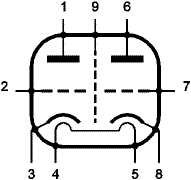
more CGS 65 tube VCA modifications and results
2008-05-20 by Mark
I made a few more changes to my CGS 65 tube VCA.

To summarize my previous post:  I left off all of the diodes so the
heater goes directly from -Ve to a 1.2K resistor to ground, added a
large cathode bypass cap, increased the 220nF coupling caps to 470nF,
and replaced the TL072 with an OP275 changing things accordingly.


Firstly, considering the range of the gain pot,  I decreased the CV
input resistor to 50K.  So now with a 0-5V EG it has about the same
range as the Gain knob.


Secondly, I changed both bias settings.

For the "clean" setting, I wired a 1M pot as a rheostat to -Ve, then
adjusted it by ear.  After I found the appropriate range, I
added a 20K multi-turn trimmer to the board.  There is an area with
some writing without any traces to the right of the -Ve hole for the
stock 330K resistor, where I drilled two extra holes.

With a roughly 10Vpp source, such that there is about 3.4 VAC RMS on
pin one of the OP275, with the gain and input knobs at maximum, the
adjusting the trimpot for almost no distortion resulted in around 1K.
Although knowing that, I wouldn't use a fixed resistor as setting it
just right requires a trimmer, imho.  Three things are happening as
resistor value becomes lower:  the grid becomes more negative, the
level of the AC signal decreases, and the frequency of the high-pass
filter increases.  As such, there is some  loss of bass, which rolls off
gently at low frequencies.  With or without a signal, the grid bias
is equal to -15V, due to the low impedance.

For the "distortion" setting, I found that a smaller resistor to
ground produced more distortion, but was far less interesting with
feedback.  Having a rheostat on the panel (for either setting)
wouldn't be a bad idea for those of you building this in a format
that has the extra panel space.  So I arrived at a compromised
setting of 475K.  It produces obvious distortion, and still produces
oscillations at various input and feedback settings.  The low
frequency response is well below the audio range.  The AC voltage on the
grid is about 3.3 RMS.  With a signal the grid measures around -17.6
VDC (it varies with its frequency), and without a signal the bias is
around -14.1V.

Regardless of the signal level on the grid, or the bias switch
setting, the output of the tube, and therefore the module, is a bit
below 1V RMS, as it seems that is the saturation limit of the tube.
So while the signal on the grid is much higher for the distortion
setting, the difference results in just that -- distortion.  In fact,
the "clean" setting measures just a bit more, although the
"distortion" setting sounds louder to to the additional harmonics.
Now 1V RMS is only about 2.8Vpp.  Although it is enough on the
board, I might change the gain and feedback resistors to 2K
(resulting in about 5.6Vpp) if it seems too low to work well with my
other modules.


While I could build a a voltage divider to raise the cathode voltage
(ie. lower the negative voltage) all the desoldering required would
risk damaging the PCB and I don't have the proper 1/2W resistors on
hand.  Also, I doubt that being able to bias the grid more negative
to the cathode would help the clean setting since the current clean
setting is already at the saturation limit of the tube, which will
only decrease  with the difference between the cathode and plate.  So
the only advantage might be increased bandwidth from being able to
increase the grid resistor.


In doing all this, I seem to have altered the CV response of the VCA
(even when I set the knob halfway to compensate for the change in CV
input resistor).  There is now noticeable "bleed" with a fast
envelope and the "clean" setting.  Although  it is not any worse than
most solid-state VCA's.   There is also a slight increase in
distortion -- like a tearing sound -- with fast CV changes.  Both of
these effects are largely unnoticeable with the "distortion" setting.


While it likely varies from 1SH24B to 1SH24B, the tube I have
installed is more than a bit microphonic.  Clicking the bias switch
is enough to produce ringing on the "clean" setting.  I'll probably
stuff some foam or something in between the tube and the board to
minimize vibration.


So at this point, I think I'm finally done building this module,
although I am open to questions and comments.