Thanks PeWe

Actually all of this is quite useful and I' want to try these myself.

It would be great If we could consolidate snippets like into a wiki or
simple database on the web.
Does anyone have enough experience / time to look into this?


On 1/24/09, PeWe <ha-pewe@...> wrote:
>
>    Hi !
>
> Try to look at the "track generator" device as a tool to manipulate values
> of outputs of other devices you select as an input for the tracking
> generator.
> The input device can be nearly anything available in the Xpander and the
> results can be very obvious or subtle in dependence of what the input device
> is.
> You see 5 values in the TG, 0 / 15 / 31 / 47 / 63 which represent a linear
> curve which means there´s no manipulation of the input value at all.
> In fact a TG "re-scales" any modulation scale appearing at the input of the
> TG.
>
> Example:
> Input is keyboard ( the keyboard of a Matrix 12 is 5 octaves keyspan )
> Each value ( see above) of the TG represents one of the octaves of a 61-key
> keyboard ( lowest note pitch is 0 and highest note is 63 ),- so, if you
> would reverse the values in the TG ( 63 / 47 / 31 / 15 / 0 ) as a result the
> keyboard is reversed.
>
> There are more examples,- use a LFO for pulse width modulation of an
> oscillators square waveform by selecting the desired LFO as input for the TG
> and the TGs output as a modulation source of the modulation destination OSC1
> (and or 2) pulse width. This can be done by selecting the TGs output as a
> (+) positive modulator of PW in Osc1 and (if you like) as a (-) negative
> modulator of PW in OSC2.
> Normally in this case, you adjust the pulse widh of OSC 1 and 2 to slightly
> different positive and negative values in the OSC section, let´s say -13 in
> OSC1 (modulate this w/ the (+) pos. output of the TG) and +16 in OSC2 (
> modulate this w/ the (-) neg. output of the TG).
> By fine adjusting the LFOs frequency rate and the amount of the 2
> modulation sources ( TG pos. and TG neg.) you´ll find your desired pulse
> with modulaton effect for a specific range of the keyboard but might not be
> satisfied w/ this sound in other keyranges.
> NOW, changing the 5 values of the TG will change the amount of PWM across
> the keyboard depending on the values you adjust in the TG.
> In addition, you can do this w/ the speed of the LFO too by using a 2nd TG,
> resulting in different LFO speeds modulating PW of the OSCs across the
> keyboard.
> More complex is to use different LFOs to modulate PW of the OSCs separately
> and to use 1 TG for the amount of modulation across the keyboard and 2 TGs
> to control the mod speed of the 2 LFOs separately and change the speed
> across the keyboard.
> This is a great tool for pads b.t.w..
>
> You can also scale the behaviour of wheels/levers and or footpedals
> /continuous controllers, filter cutoff and/or resonance, envelope times and
> so on. It´s endless possibilities ...
>
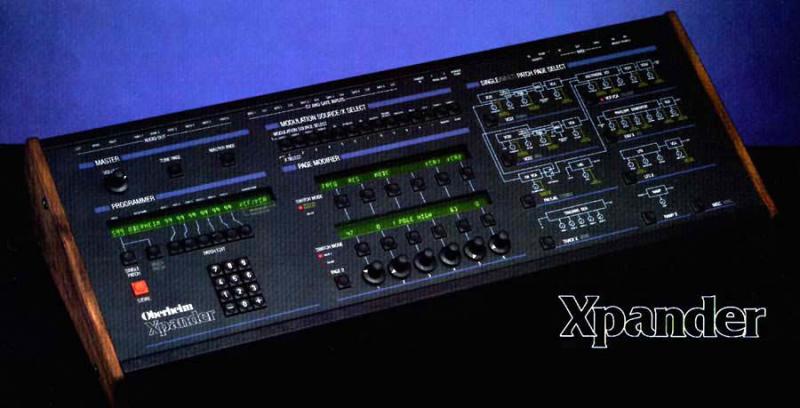
> The Xpander is a half modular complex machine and it´s very important you
> have a imagination of sound before you start programming.
> With modulation sources and destinations, their values and manipulation of
> these values, the sound of the Xpander/ Matrix12 starts to live. It´s a
> modulation monster.
> You have to know what the components in this machine do and the manual is
> sometimes too much theory.
> The only way to learn is experimentation w/ these components over a longer
> period of time as also using your ears.
> The other way around is looking for factory patches which use TGs,
> analysing the modulations routing, switching things off and on again and
> trying to find out what happens and why by listening.
>
> Do you have other synths incl. stored patches ?
> Try to reprogram these by using the Xpander.
>
> I learned programming the Xpander by reprogramming of some beloved patches
> of my former OB-8 because I didn´t want to miss these and I also
> re-programmed patches from the Matrix 1000 w/ the Xpander.
>
> But I´ve also seen people selling their Xpander shortly after purchase
> because they weren´t satisfied w/ the factory patches and because they were
> to lazy or had no time to experiment w/ this machine.
>
> Long post and eventually hard to understand, but to explain it in more
> detail would fill pages.
> I own my Xpander since ~ 20 years and I always find new possibilities up
> today.
>
>
>
> mattvrazo schrieb:
>
>  Thanks-both those examples are helpful. I have read the manual, but
> alas, they only give one or two examples and despite reading again, I
> didn't really get the big picture regarding inputs vs. sources.
>
> For the first example-LFO speed doubling via the TG: Am i using the
> LFO1 as INPUT, and the speed of LFO1 as the source?
>
>
>
>
>
Message
Re: [xpantastic] Re: Lag/Tracking Generator tips?
2009-01-25 by Tony Cappellini
Attachments
- No local attachments were found for this message.