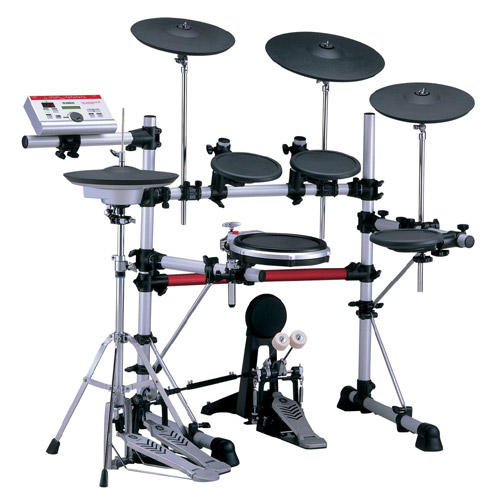
--- In DTXpress@yahoogroups.com, "vantre1" <adrianoc@d...> wrote:
> Hi folks.

Hi Adrian. Welcome to the party.

> Can I connect the kit up to cubase so that I could record every pad
> to a different track for later editing?

Yes, just give each pad its own MIDI track. The default track for e-
drums is 10, but you can depart from it manually.

> Can I use the kit to trigger seperate samples via cubase (again 1
> sample per track per pad ), so that I'm bypassing the kit's own
sounds?

Yes, just adjust MIDI notes for each pad to match the MIDI notes for
your target samples.

>How much punishment can the kit take? I have a buddy who is
> an 'aggressive' drummer & would like to know how careful you need
to
> be with it...!

e-drums are built to withstand a fair amount of punishment. We don't
receive many posts about pads failing because of mistreatment,
although occasionally it happens. The great majority of rubber kits
survive the onslaughts of converted acoustic heavy hitters without
too much trouble. That said, drummers making the transition should
keep in mind that strength is more likely to result in punishment
than reward on e-drums. Since they're hitting electronic elements
inside the pads, control rather than force dictates how they are
going to respond. Once the module is programmed for its widest
dynamic range, you'll quickly notice how easy it is to reach peak
gain. Drummers who flail away recklessly risk making sounds that they
don't intend, not making sounds that they do, hearing way too much
stick noise, and possibly damaging their components. This is not to
say the normal exuberance that drummers feel when they play is out of
place on e-drums; it isn't. But force achieves the law of diminishing
returns faster than with acoustics; let the module do the heavy
lifting. Of course, well-mic'ed acoustic drums aren't totally
dissimilar in response; they don't require much force to achieve a
big sound either.

> Thanks for the help & lastly, would anyone recommend anything other
> than the dtxpress for this sort of thing? (although I'm guessing
that
> maybe an illegal sort of question around here!!)

We're denominationally nondenominational. We have a healthy respect
for everything, though we try to remain sensitive to cost. Any kit
with a module--Yamaha, Roland, or otherwise--will mate with a
sequencer on a PC. If you intend to bypass a module's sounds for
samples on a regular basis, you might consider a used or otherwise
inexpensive module for the MIDI connection. Otherwise the tone
generator would be a waste for you.

So far as feel and robustness are concerned, the rubber pads of the
Yamaha DTXtremeIIS kit are much less jarring on the joints than those
on the DTXpress, and they feel more like acoustic heads. The mesh
kits made by Roland, Hart, Pintech, and a few other companies
arguably simulate the acoustic experience best of all, given that the
drums are shells with silent woven heads rather than mylar ones. Many
companies make cymbals intended to look and play like acoustics. The
round Yamaha rubber ones are a good option, but so are those from
Pintech, as well as the acrylic ones from Visu-lite, the metal ones
from Hart or Smartrigger, etc. Be forewarned, however, that not all
components from other companies mate perfectly with Yamaha modules.
Unless they specify otherwise, they usually have Roland's in mind,
though they will generally work with ddrum and Alesis as well.

Modules become more versatile, sensitive, user-friendly, and refined
in both sound and nuance with price. Pound for pound, Roland
equipment costs more than anything else, not necessarily because
it's "better" by all comparisons but because it is the strongest name
in the market. If you stick around, you'll get a sense of the wide
range available.

Ed
Message
Re: Help pls! basic DTXpress & computer questions
2005-05-11 by emf
Attachments
- No local attachments were found for this message.