"I don't think Jade has had any crosstalk problems between devices.
So far no word about it from UNH."

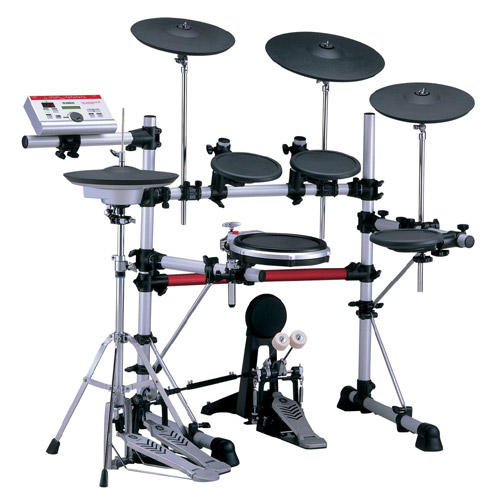
Sometimes if I hit my toms hard enough I'll get a slight faint crash
sound from a cymbal attached to the rack with my toms on it.  The
sound is only heard through headphones since its so quiet.  This is
something I did not notice before I reset my module but its very
fixable.  Also, I'm not sure if its just the cymbal I have connected
to my pm16 or the one connected to my module.  That would be
something interesting to find out though.  I also noticed when I
just place my sticks above my toms, to set them down, and I hit the
l-rods I'll get a slight cymbal sound too...weird.  Has anyone else
noticed how sensitive the pads get once your in the voice menu?  The
pads seem to be more prone to crosstalk and double triggers while in
the voice menu.


--- In DTXpress@yahoogroups.com, "liberatusvirus
<liberatusvirus@y...>" <liberatusvirus@y...> wrote:
> Hi Stephen,
>
> I knew we'd get you in the end, despite the PM-16 and midiKITI
blues
> that passed over the board for about a month. But the troubles
were
> due largely to a bug in the DTXII that prevented it from working
> smoothly with an external midi device--nothing a big fat reset
> couldn't cure, even on brand new units. That said, the cheapest
> options are obviously the two discontinuted interfaces that you
know
> about. There's also Roland's current TMC-6, another midi
interface,
> which would probably cost you $100 to $150 more, though it has a
few
> more tricks up its sleeve than the older ones, like stereo inputs.
> The drawback is that it has only 6 inputs altogether, a fact that
> makes even the Roland crowd a little irritated (the PM-16 has 16
> mono inputs and the midikiti 9). Adding another module is
definitely
> a viable option, especially since the DTXI can be had for under
$200
> these days (just ask Claudio). But you'd also need a mixer to run
> the two together (I don't recall whether you already have one).
>
> The interfaces, as opposed to the modules, don't have any sounds
of
> their own. They're completely dependent on modules, drum machines,
> etc. to generate their voices, which they access via midi note
> numbers. A note number is assigned to a voice on the module and,
one
> way or another, stored on the interface so that when a pad
connected
> to one of the interface's inputs is hit, the particular midi note
> number chosen on the interface generates the voice asscociated
with
> it in the module via a midi cable. The voices from the pads
> connected to the interface get processed through the module just
> like the voices generated by the pads connected to the module.
>
> The advantage of an interface w/o sounds of its own is basically
its
> simplicity and relative inexpensiveness. An additional module,
> unless it is the same model as the first, would increase your
range
> of sound, though if one of them is from an older generation, it
may
> have limitations in its parameters that decrease its appeal. I've
> heard of people untegrating TD-5s or TD-7s and Alesis DM4s,
however,
> as second modules very successfully. It's a matter of personal
need
> and taste.
>
> As Steve recently seems to have discovered, one of the drawbacks
to
> a second unit is the possibility of crosstalk between pads
connected
> to different devices. Devices like the midikiti and dtx can only
> isolate pads from each other (rejection, specific rejection) that
> are connected locally. There are physical and electronic ways to
> mitigate the problem, but they are not as surefire and easy as
> simply adjusting parameters in a single module. Grouping mutually
> susceptible pads on a device is always a good idea. You can also
> choose triggers for the auxiliary device that don't tend to get
> crosstalk (FSRs, like tubular pads); whether they cause it will be
a
> matter of where they are on the rack and how they get hit.
>
> Yesterday Jade complained of crosstalk between the kiti and dtxII.
> But after an hour or so of me spinning troubleshooting theories to
> counteract it, Jade discovered that the cause of the voice
> interference was something else entirely (brilliantly, I might
add).
> I don't think Jade has had any crosstalk problems between devices.
> So far no word about it from UNH.
>
> Another possible, unavoidable drawback is that changing kits on
the
> dtx will not automatically change the voices that the external
> device playing through it. You'd need to devote some of your
> resources to program changes for that. One way around it is to
group
> pads on the external device that you tend to use from kit to kit.
I,
> for example, have splashes, chinas, and various percussion effects
> coming from the kiti that I tend to retain. The external devices
> have multiple kit setups like the dtx, but they don't change from
> one to another just because you switch on the dtx.
>
> Sorry for being long-winded.
>
> Ed
>
>
> --- In DTXpress@yahoogroups.com, "brown8700 <brown8700@a...>"
> <brown8700@a...> wrote:
> > I'm at that point where now I have more triggering devices than
I
> > have inputs. The way I look at it, I have three choices:
> > 1) Purchase an additional DTX module and create a completely
> > compatible system.
> > 2) Purchase another manufacturer's module giving me additional
> sounds
> > to work with.
> > 3) Purchase some sort of MIDI device like the KITI or the PM-16.
> > Before I make any decision, I need to understand more about
these
> > MIDI devices. It was my understanding that they do not house any
> > sounds, but merely transfer them (or store them) so that they
can
> be
> > transmitted from one device to another  i.e. computer to module.
> Is
> > this correct? In other words, if I added a PM-16 alone, for
> example,
> > would I be able to trigger four or more additional pads? Where
> would
> > the voices be generated? From the PM-16 or from the DTX?
> > Any assistance to help me further understand MIDI and the
> applicable
> > devices is appreciated.
> > Thanks,
> > Stephen
Message
Re: Sound Advice?
2003-03-05 by underneathheaven
Attachments
- No local attachments were found for this message.