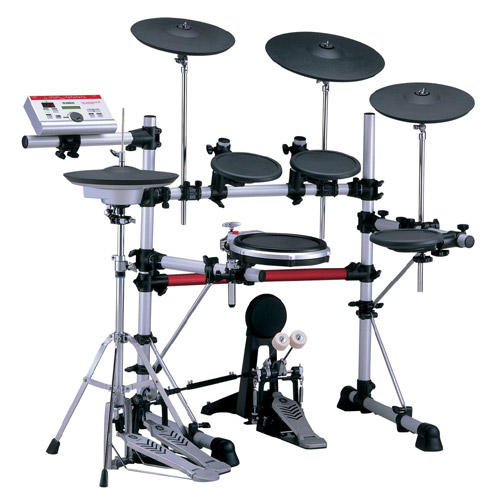
I'm having a related problem with my kick drum pad but I'm not sure
it's the same thing. The drummer in my band is a bit heavy-footed
and after about a year of no problems, it seems the pad doesn't
respond to hard kicks. A moderate kick will trigger OK, but when he
plays it hard there are random non-triggers (I would have thought
you would need increasing pressure trigger something that has been
stretched out?). I haven't taken it apart (any direction there would
be appreciated) and I'm not even sure what the warranty is on these
drums. Any help is greatly welcomed- thanks.
Mark
--- In DTXpress@yahoogroups.com, rdamon@m... wrote:
> Just to throw out a quick thought.  The KP65 piezo, unlike the
PCY/TP pads
> has a substantial amount of pading between the surface of the
rubber and the
> actual piezo.
>
> On the PCY, the piezo has a thin layer of plastic and rubber
pading between
> it and the striking surface, nothing to temp/permanantly deform to
any
> degree. On the TP the piezo has a metal plate and a thin layer of
rubber
> pading between it and the striking surface, again nothing to
> temp/permanantly deform to any degree.
>
> But on the KP65 there is a heavy rubber cover that is not bonded
to anything
> and behind it is a thick layer of foam that is bonded to the metal
plate
> that secures the piezo. After repeated heavy blows to the KP65 the
following
> could and will occur:
>
> The outer rubber cover could be pulling away from the foam as it
temp.
> stretches from repeated strikes.
> The thick foam behind the pad could be compressing and not
expanding back
> out quick enough to make contact with the outer rubber pad.
>
> I used to leave my foot on the pedal with the felt beater pressed
against
> the rubber pad between beats and would end up having similair
missed beats.
> Since I stopped leaving the beater pressed against the rubber pad,
the
> problem has disappeared for me.
>
> I wonder if putting some adhesive between the rubber pad and the
foam to
> bind them together would help?
>
> The other possibility is simply a loose connection.
>
> Other things to look at are the settings such as the curves;
normal, loud1,
> loud2, hard1, hard2 and Self rej is set to a low number.
>
>
> OGD
>
>    _____
>
> From: nugeman2004 Sent: Monday, May 03, 2004 9:49 PM
> To: DTXpress@yahoogroups.com
> Subject: [DTXpress] Re: DTXpress 1 Bass drum trigger problem
>
>
> --- In DTXpress@yahoogroups.com, "emf" <liberatusvirus@y...> wrote:
> > --- In DTXpress@yahoogroups.com, "robert_cathy"
<robert_cathy@y...>
> > wrote:
> > > Has anyone heard of this problem, sometimes but not always
when I
> > am
> > > hitting a snare, cymbal or highhat, the bass drum doesn't
trigger
> a
> > > sound even thought it is being hit? It is a intermitten
problem
> > that
> > > I have to listen closely to hear. My daughter is trying to
learn
> > and
> > > that how I found it. Any ideas? Any solutions?
> >
> > Hi Robert,
> >
> > Dropouts aren't terribly unusual. But, as Will's post indicates,
> the
> > kick pad isn't usually the victim--at least for interactive
> reasons.
> > When a pad on the rack gets hit, the rack can transmit
vibrations
> to
> > one or more of the other ones, causing a sympathetic reaction.
This
> > phenomenon is called crosstalk, and Yamaha has "rejection"
settings
> > to minimize it in the trigger menu. Rejection's remedy for a pad
> > firing unintentionally as a result of events on other pads is to
> mute
> > it unless it is hit with a certain minimum force (the rejection
> > number). "Specific rejection" protects a pad from hits on a
certain
> > other pad, normally close to it, in the same manner. "Self-
> rejection"
> > guards against a pad reacting to itself (double-triggers),
usually
> > because gain is too high. If a drummer fails to strike a pad
with
> > enough force to circumvent the muting enabled by any of these
> > rejection parameters during another offending event, it won't
make
> > any noise. Many dropouts are caused by rejection settings that
are
> > too high. By all means, if the kick drum input carries high
> rejection
> > numbers, reduce them to the point where the offending artifacts
> > disappear.
> >
> > That said, however, the fact that the kick pad isn't on the rack
> > reduces the chances that rejection as a means to defeat
crosstalk
> is
> > the culprit. A high self-rejection is still a possibility,
though
> you
> > would have known if you'd set it, right? One other possibility
is
> > that your gain and/or minimum velocity settings aren't optimal.
If
> > gain is too low and min.vel. too high, you could get false
> > triggering. It might not happen when you play the kick by
itself,
> but
> > in the heat of battle when your attention is divided, the kick
> might
> > not be getting the same impact. Try changing the gain and min.
vel.
> > settings as indicated.
> >
> > A last resort might be that the something has come loose inside
the
> > kick tower. Sometimes resoldering everything can improve
response,
> > even if you don't actually see a loose connection somewhere.
> >
> > I hope these suggestions help. Please let us know. If worst
comes
> to
> > worst, are you still under warranty? I should add that if you're
> > using the KP60 kick pad, I'd be far less surprised by your
problem
> > than if you were using the the KP65.
> >
> > Ed
> I too, have the same issue! when playing as Ed said "heat of the
> battle" and do an accent of snare and cymbbal, the kick almost
always
> will not sound, And I am certainly kicking it! I have tried it
with
> the tower yammy set up , as well as a pintech trigger,the small
> cylindrical one (scientific,no?) and the results are about the
same.
> I did have some issues with the yammy stand up trigger,and had to
> disassemble and solder the jack terminals back solidly to the pc
> board...that cured the hit/no sound, but not the no kick response
> when hitting cymbal(any) and or cymbal/snare /kick...any ideas Ed?
kb
>
>
>
>
>
*********************************************************************
*****
> The information transmitted herewith is sensitive information
intended only
> for use to the individual or entity to which it is addressed. If
the reader
> of this message is not the intended recipient, you are hereby
notified that
> any review, retransmission, dissemination, distribution, copying
or other
> use of, or taking of any action in reliance upon, this information
is
> strictly prohibited. If you have received this communication in
error,
> please contact the sender and delete the material from your
computer.
>
>
>
_____________________________________________________________________
_
> This email has been scanned by the MessageLabs Email Security
System.
> For more information please visit http://www.messagelabs.com/email
>
_____________________________________________________________________
_
Message
Re: DTXpress 1 Bass drum trigger problem
2004-05-26 by slivjakm
Attachments
- No local attachments were found for this message.