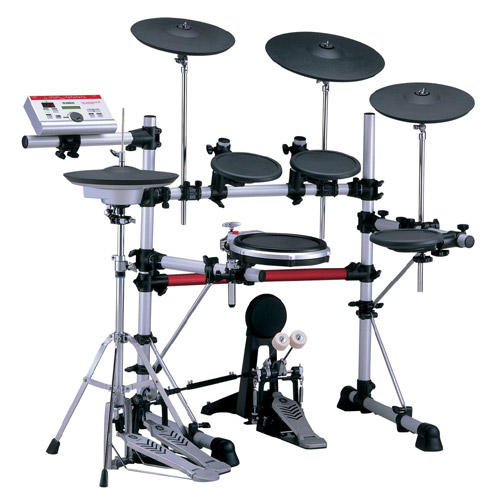
--- In DTXpress@yahoogroups.com, "rdarby1st" <richard.darby@l...>
wrote:
> I have a standard DTXpress III setup with an additional crash
cymbal
> on input 9/10. I have noticed that if I play leg strokes (heel
down,
> beater ends up well off the pad surface) as opposed to foot strokes
> (toe down, beater ends up in contact with the pad surface)the kick
> drum sound doesn't trigger - i.e. the harder, more positive stroke
> which should be less liable to cause false triggers doesn't trigger
> a sound whereas the lighter stroke does.

Here's a bit of a longshot: When you play the heavier leg strokes (I
don't know how hard heavy is for you), you are more likely to be
using more force on the rest of the kit as well. Even though the kick
would seem to be immune to activity on the rack because it isn't
directly attached to it, sympathetic vibrations are still possible
across a bare floor, at least theoretically. If any of upper pads
have high rejection or specific rejection numbers, the kick might
fail to fire intermittently. You can further mitigate any such
interference by lowering your gain and raising your minimum velocity
to de-sensitize the kick.

Another possibility is that, regardless of trigger values, you may
have a loose wire or faulty soldering in the guts of the kick
trigger, which causes it to cut out at a certain threshold of force.
If fiddling with gain/rejection, or stabilizing the kit on a less
wobbly surface, doesn't pay dividends, you might open up the kick
trigger and look for damage. Usually you can't see it unless it's a
loose wire. You might have to resolder everything in sight. Ugghh.

> Also when I play in a "live" situation with external amplification,
the kick drum sound
> occasionally fails to trigger if I play either of the crash cymbals
> in combination with the kick using either of the above kick stroke
> techniques. I have looked in the archives & it would appear that
> others have discovered similar anomalies with DTXpress kick
> triggering. What I would like to know is: has anyone managed to
> solve this riddle & if so is there anything I can adjust to resolve
> this issue?

Again, assuming that the electronics of the trigger aren't at fault,
you'll have to find trigger numbers that prevent dropouts while
guarding against serious crosstalk, or set up on as a more solid
platform.

Here's something more speculative. The module sometimes seems to have
limitations in recovery time after a pad is struck. I seem to
remember that changing pad type in the trigger setup often helped to
alleviate missed triggers, but this remedy was more relevant to non-
Yamaha components. If you set up the proper pad type for your stock
Yamahas, dropouts due to improper pad-type setting shouldn't
happen.

Ed