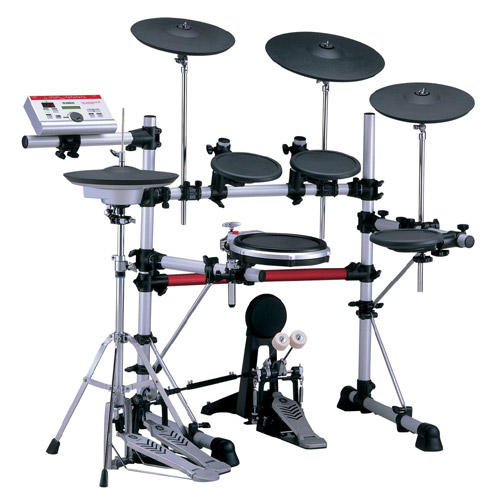
--- In DTXpress@yahoogroups.com, "plhalli" <phalli9966@a...> wrote:
>
>
> Hello group,
> I am doing some simple analog recording, playing along to CD's and
> noticing some anomalies when played back. The biggest issue is when
> playing a double stroke roll on the snare pad. It is a very
staccato
> sound and totally unnatural sounding. Anyone have any
recommendations
> to improve this? I have tried other snare sounds with minimal
> improvement but perhaps someone out there can offer some
suggestions
> with reverb, gating or whatever.
> My rig is an older DTX 2.0.
> If newer modules deal with this situation better I would also like
to
> hear about them.

Hi Plh,

What you're hearing is known as the machine-gun effect, which plagued
early e-drums and continues to plague them, especially at the lower
end. If your module has the disease, the best you can do is try to
minimize it. In your case, judicious use of reverb/delay might help,
but you'll probably have more luck with velocity-switching, that is
stacking voices to alternate according to how hard you strike the
snare. Correct me if I'm wrong, but I think the DTX 2.0 gives you
four or five layers to work with.

Newer, higher-end modules deal expressly with this problem, either
having a randomizing effect--that is, varying how each successive hit
sounds--or including something called positional sensing, which
mimics what it's like to hit different parts of an acoustic snare
head. Positional sensing is found on the expensive Roland TD-20, its
predecessor TD-10, and the TD-8. The ddrum module uses positional
sensing selectively, but depends mainly on multisampling to give
character to individual hits. The Yamaha DTXtremeIIS apparently
handles the machine-gun effect well on the snare but not as well on
the cymbals. Maybe OGD can elaborate on that point; I don't own it.
Drum software for computers tends to be more versatile in this
respect than modules.

Ed