RE: Spam:[DTXpress] Crosstalk
2005-09-16 by Damon, Rob
Welcome to the board. This may not answer your question, but here is a
response I made at the Dtxperience site. Just remember that E-drums need
to be played with a lighter touch than A-drums. Also, the Yamaha cymbal
pads historically have had a "self-choking" issue if you strike the pad
and press through the rim, as oppose to, bouncing off the edge. By
keeping pressure on the rim switch in a downward motion with the stick,
it can be interpreted by the module that you are actually holding onto
the edge of the cymbal pad and pressing down on the top surface, and
thus want the cymbal to choke. A glancing blow works better on cymbals.

:Re: no sound response intermittently
________________________________

The quick answer is "rejection".

What you must understand is that each pad has a peizo in it that detects
"vibration". They are not smart devices. They cannot tell if the
vibration is from you hitting the pad with a stick, you foot bouncing up
and down on the hihat pedal or if an adjacent pad has been struck.

There are generally three types of rejection settings to eliminate cross
talk, but these can also, if set to high can inadvertently cause a pad
not to sound.

The first rejection settings is for the pad itself. When you hit the
pad, the peizo does not vibrate one time and then stop. The signal peaks
and then dies down over a period of time. If the first peak from a real
strike is large and causes the pad to vibrate, along with the rack, then
the continued vibration is picked up by the peizo, it thinks it has been
struck again, but more lightly and thus a second sound will be produced.
This is called double triggering. By adjusting the "self rejection"
settings, you can draw a balance. If the setting is two small, the pad
will be more prone to double triggering. If it is set too high, then a
second very quick strike, would be muted out.

The second rejection settings is a general rejection. This takes into
account the general area where the kit is located and where/how the pads
are mounted. If you hit the rack, that vibration is passed through to
all the pads on the kit, but at a lower level. This rejection sets an
overall level of rejection for the pad for the local environment. Set
too low and hitting the rack with your foot could trigger the pad, set
too high and lighter hits (ghost notes) on the pad itself may not
register.

The third rejection settings is a "specific rejection". This is for when
you strike a specific pad (say tom1) and it triggers a second pad
(tome2) as well. This should be set to the lowest number necessary to
eliminate cross trigger.

Each one of these adds a level of checking to try and control when a pad
should sound and when it should not. On top of that when you add the
sensitivity adjustment knob on the pad itself, you are adding another
layer of issues the must be coordinated.

So it really is a trial and error, based on where you play and how
hard/soft you play.

When a pad does not respond, (and it is not a physical damage issue), it
is because the module is evaluating all of the signals coming in from
the pads, and based on the threshold and rejection settings it tries to
determine if that pad should sound or not.

If the rejection settings are too high, then vibration from an adjacent
pad, could be mis-interpreted and cause the module to mute that strike.

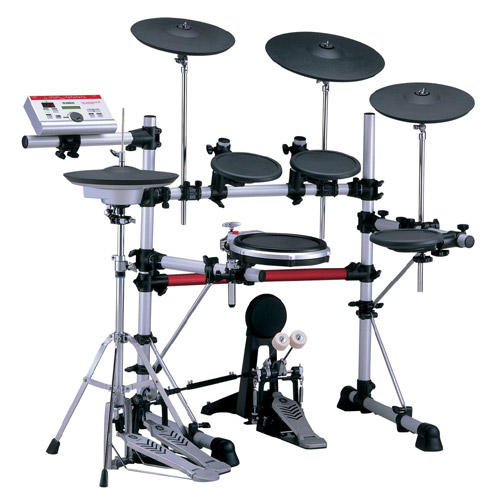
With the Dtxpress II/III std, the with the hihat pad and the snare pad
mounted on the same rack arm, the modules came from the factory with a
high rejection settings between the two, so that if you hit both pads
simultaneously, one pad would be muted.

Anybody here who has seen photos of my kit, knows there are large number
of pads, very close together. My setup started with setting the general
rejection setting. I put all of the specific rejection and self
rejections settings as low as possible. I then turned on a cd player
running through my KX1200 and KA500 amps and watched for any triggering
of the pads. At high volumes with heavy bass and zero rejection
settings, most of the pads will trigger. I then adjusted the general
rejection setting to eliminate false triggering for most pads. I also
adjusted the location of the amps and the direction they were facing to
minimized the effects on the pads. I then took a rubber mallet and began
striking the rubber feet of the rack, to simulate vibrations coming from
the floor through other sources. I then went out an purchased some
24"square interlock floor mats to put the entire kit on. Wood floors
with carpet or concrete floors with carpet I quickly learned, transmit
vibration too well.

Next, I adjusted the self rejection settings for each pad.

Then lastly, I adjusted specific rejection with all of the pads
unplugged, except the one I was adjusting. I then played an aggressive
toon, to see if striking other pads would trigger the one that was still
connected. If none triggered it falsely, I then moved on. You can also
use the meter bridge on the module to determine if a pad is trigger.
With all of the pads plugged in and the sound on, if an adjacent tom
triggers, but at a lower volume, you may not hear it, but it will show
up on the module display.

It was a long and tedious process for me, but I am good to go now. I am
sure there are many other ways of doing this, but this was how I ended
up resolving false triggering issues.
:
OldGuyDrummer - OGD

________________________________
Show quoted textHide quoted text
From: DTXpress@yahoogroups.com [mailto:DTXpress@yahoogroups.com] On
Behalf Of rhys_nataly
Sent: Friday, September 16, 2005 7:03 AM
To: DTXpress@yahoogroups.com
Subject: Spam:[DTXpress] Crosstalk


Firstly I want to say hello :). I have just recently purchased the
DTXpress, second hand, great kit. I have joined this group because it
looks very helpful and you all seem a happy bunch :).
Any way my problem:
At first all was well then (unless I didn't notice at the start) major
crosstalk(CT), when I hit the snare or crash(crash Triggers
occasionally and sometimes quietly also) they have CT with tom 1, I
changed the settings in Specific Rej and Self rej etc none of this
worked. Good plan, I moved the snare off the same rack as the tom 1
(the short one pointing up) and put it on the cross rack by its self
no more CT AT ALL hooray. Now the crash, I moved this to the rack with
the brain, it still has CT and triggers occasionally etc, I thought it
may be broken??? I have now swapped it (completly) with the ride (to
check if it is broken), NOW this is strange, it still does not trigger
all the time etc(must be broken I'm thingking) but the most amazing
thing is it still has CT with tom 1??? WHY??? If the original ride did
not have CT with anything then settings must be right and all should
be ok??. what am I missing. is the information (settings) processed at
the trigger or at the brain?? :(


Community email addresses:
  Post message: DTXpress@yahoogroups.com
  Subscribe:    DTXpress-subscribe@yahoogroups.com
  Unsubscribe:  DTXpress-unsubscribe@yahoogroups.com
  List owner:   DTXpress-owner@yahoogroups.com

Shortcut URL to this page:
  http://groups.yahoo.com/group/DTXpress

Alternate DTXpress site:
  http://www.dtxpressions.com


________________________________

YAHOO! GROUPS LINKS


*	 Visit your group "DTXpress
<http://groups.yahoo.com/group/DTXpress> " on the web.

*	 To unsubscribe from this group, send an email to:
	 DTXpress-unsubscribe@yahoogroups.com
<mailto:DTXpress-unsubscribe@yahoogroups.com?subject=Unsubscribe>

*	 Your use of Yahoo! Groups is subject to the Yahoo! Terms of
Service <http://docs.yahoo.com/info/terms/> .


________________________________


______________________________________________________________________
This email has been scanned by the MessageLabs Email Security System.
For more information please visit http://www.messagelabs.com/email
______________________________________________________________________


______________________________________________________________________
The information transmitted herewith is sensitive information intended
only for use to the individual or entity to which it is addressed. If
the reader of this message is not the intended recipient, you are hereby notified that any review, retransmission, dissemination, distribution, copying or other use of, or taking of any action in reliance upon, this information is strictly prohibited. If you have received this communication in error, please contact the sender and delete the material from your computer.
______________________________________________________________________
This email has been scanned by the MessageLabs Email Security System.
For more information please visit http://www.messagelabs.com/email
______________________________________________________________________