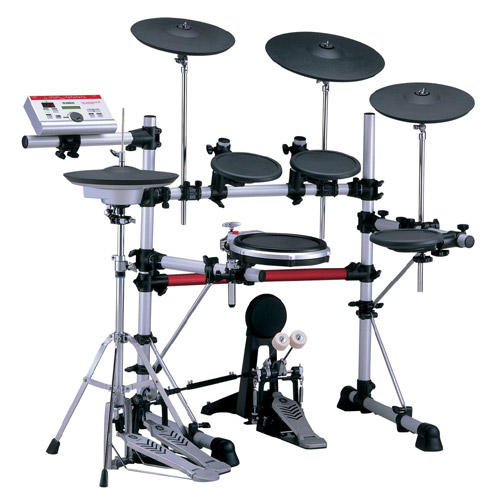
DTXpressII rejection settings info, etc.
2002-10-06 by Mike Warren Autographs
Thanks to Walt for all of the below info - hopefully
it will be of help to anyone needing more info on
rejection settings - it helped me!

On some new DTXpressII kits, there has been a problem
when hitting snare and hihat pad at the same time with
one or the other not responding properly. Change the
Specific Reject factory setting on the HH to 0 if
experiencing this problem. Note - the rejection
settings may need to be further tweaked on particular
systems to function properly.

More info on rejection settings: The SPCRej is one
that is used sparingly - usually just when you have
two pads that just don't like each other.  Of the 3
types available, self rejection is for ensuring that
when you hit a pad, you only get one trigger from it.
Then you have Rej which adjusts how much any pad
should ignore vibrations from all of the rest of the
pads. And SPCRej is how much a pad should ignore a
specific neighbor. My rule of thumb is that I only use
as much rejections as I need for any pad, as that does
diminish the pad's responsiveness a little. Adjusting
the rejection parameters is kind of a hit and miss
thing.  There are a lot of variables which makes it
impossible to predict what the should be. The pads are
most sensitive when the reject is set to zero, and
least sensitive at 8, so I try to keep them as low as
possible, without getting interference from other
pads. On my rack I have a cymbal mounted near a tom,
and if I hit the tom hard, sometimes I hear the cymbal
fire. So on the cymbal I have raised the value of the
specific rejection parameter on the cymbal, so it will
ignore what it thinks are very light hits, if they
occur at the same time that I hit the tom.  So for the
cymbal the SPCRej is something like SPCRej=3 From 5
(the trigger number for the tom). Now, if the cymbal
fired when I hit two or more other pads, it might be
better to raise the REJ instead, as that would tell
the cymbal to ignore lite hits it sensed when they
occurred at the same time I hit any other pad, instead
of a specific one.

Re: sensitivity. On the DTXpress that is mainly set
though the pad type and switches on the back, along
with the adjustment controls on the pad. The more
sensitive a trigger is, the more faithfully it can
follow what you're doing, but, it also is more likely
to do other things too - double triggering or
crosstalk. Double triggering is when you strike a pad
once, but due to harmonic vibrations or whatever, two
trigger signals are sensed.  To control this tendency
you can lower the sensitivity, or you can raise the
self rejection - both would accomplish the same thing
in different ways.   Self Rej = 0 means that no
prevention is being provided, while 8 is the max.  Try
doing a fast, soft roll with it set to zero, then
crank it to 8 and see if you get dropped notes.
Depending on how sensitive the pad is and how fast the
roll is, you may or may not get dropped notes, but
this will give you the idea. In this case with it set
to 8, the module is trying to figure out if these soft
fast notes are real or not, and it can be fooled
sometimes.  I think larger, mesh head pads and
acoustic triggers are more likely to have double
trigger issues than the rubber pads are, so usually I
run in the 0 - 1 range for this parameter on rubber
pads.

Re: crosstalk. Again, the sensitivity of the pad can
be so high that vibrations from other pads can cause
it to trigger.  To help prevent that you can use the
rej and spcrej parameters to tame its over reactions.
A setting of 0 means no prevention, while 8 means the
module will only allow (what it thinks are) very
direct, strong signals to be interpreted as a valid
triggers.  Tap a pad very lightly with the rej set to
0, just hard enough for it to trigger, then move the
setting to 8 - in most cases if you keep the velocity
of the hits steady, by the time you get to 8 at least
some of the hits are most likely being rejected.  For
rubber pads I have had them set anywhere from 0 up to
4 or 5. On your DTXpressII kit it would not be
uncommon to have to use SPCRec between the snare and
HH - they are both on the same rack arm.  Make sure
all the clamps are tight also, as loose fittings can
sometimes amplify vibrations along the tubes. On my
kit I have the snare mounted on its own stand (I think
I have somewhat recent pictures in the photos section
of the group), so I no longer have any interaction
problems between it and anything else, which allows me
to get as much sensitivity as I can out of it.

Thanks again Walt for all of this great info! - Mike

__________________________________________________
Do you Yahoo!?
Faith Hill - Exclusive Performances, Videos & More
http://faith.yahoo.com