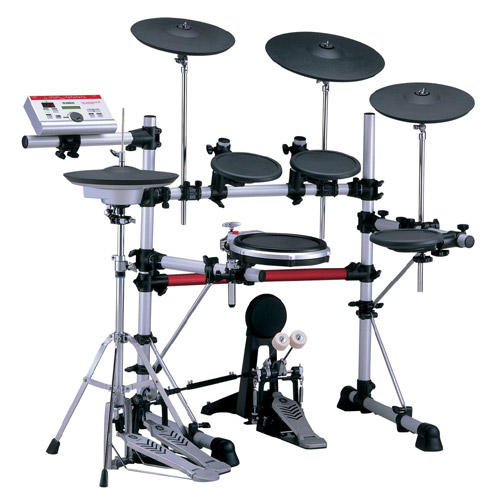
--- In DTXpress@yahoogroups.com, "steve73952003" <steve73952003@y...>
wrote:
> Hi all,
>
> Just Bought a second hand DT Xpress and am blown away by what I've
> discovered so far. Does anyone have any good tips for sounds, pads
> headphones or Amps ?
> I have heard that there is a book by a Pro Drummer called Russ
Miller
> and would be grateful if anyone could let me know how to get hold
of
> a copy...is the book just for DTX or is at mainly aimed at
begginers
> to Drumming.
> I'd be grateful for any help you could give.
> I am a 35 year old "has Been" from Cambridgeshire , England.
> Is this  JUst for USA users or for everyone....no offence meant.

Hey Steve,

Welcome. We have lots of UK members as well as members in your age
group, which isn't . . . ahem . . . the oldest by a longshot. The
site has lots of archived information about amps, sounds, pads, and
phones--so much, in fact, that without a more specific question, we
could continue on the subjects for days on end. The short answer on
monitoring, assuming some budget constraints, is to get a keyboard
amp if you're going for a single powered box for practice or live
monitoring. Keyboard amps cover the wide frequency range of an
electronic kit much better than guitar or bass amps. Roland makes a
good but outrageously priced sub/satellite drum monitoring system
called the PM-3; even used it tends to be dear. Yamaha is coming out
with two models of its own very soon, on the same principles, with
much better pricing.

On phones, the recommendation is for low-impedance (under 100 or so),
high sensitivity (over 100 or so), closed/sealed studio cans to make
sure that the signal is stronger than any extraneous stick/other
noise. Sony's MDR 7506 and Sennheiser HD 280 Pro are two options with
street prices of $80-$100, though there are many others. Studio cans
are often preferable to even audiophile open-design home phones,
incredible as they can sound, for reasons of durability and their
single coiled cord out of the left earpiece instead of a "Y"
connection around the chin, which is hard to avoid in medias res.

So far as managing sounds is concerned, go to the tips and tricks
section of dtxpressions.com to get an idea of what's possible. The
book that you're referring to is by Russ Miller. It's a bit long in
the tooth at this point. From what I recall, it has a section on the
DTXpress but is not about it exclusively; it also comes with a CD. It
isn't just for beginners either. Miller has a website where you can
order it.

But I urge you, in conjunction with exploring the kit itself, to
search the archives under various topics (like amp, headphones, Russ
Miller, etc.) for more information. Then come back and test us
mercilessly.

Later,
Ed