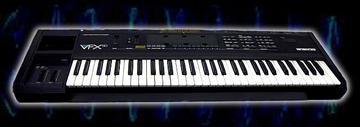
Was looking through some of my old Transonic Hacker magazines with
them talking about the secret preview of the VFX at the 1989 Winter
NAMM Show..  Wow...has it been 20 years already?   Time flys....and
the Keyboard still holds it's own up against almost anything out
there.  Been using VFX, VFXSD's and SD-1s since they all came out,
would never go on stage without one.   I've got a few great banks of
Hammond Organ programs I'll share when I get the time that I made when
I sat down with my B-3 and M-100 and tried to match the sound to some
favorite Drawbar settings.  I actually like the sound of the VFX
settings better than my Hammond organs sometimes...(I'm sure Hammond
purists are cringing at that one...but hey...I own 5 Hammonds.....and
I can get some amazing organ sounds out of my VFXsd and SD-1).... I
know it's sure a lot lighter than a PortaB!!!


Here's the mention of the VFX I transcribed from Transhacker #45 for
your reading enjoyment..............  Enjoy and Happy 20th VFX!!

A Hackerpeak at Ensoniq's New Synth - The VFX

By four who should know


Ensoniq's got a new synth that's about to be released - and it's a
monster. Several of our favorite contributors were lucky enough to be
invited to a recent "pre-release" viewing. What follows is their first
impressions.

VFX Sneak Preview

by Craig Anderton, Electronic Musician Magazine


One of the trends at the 1989 Winter NAMM show was the re-emergence of
the upscale synthesizer. The market for synths has become more and
more crowded in the $2000-and-under price point, so several
manufacturers decided it was time to put back in some of the bells and
whistles, and price their units accordingly. Ensoniq's contribution to
this trend is the VFX. Apparently, the VLSI manufacturing process was
not quite perfected in time for NAMM and there were a few crackles and
pops that made Ensoniq skittish about showing the VFX. (not to worry;
in the semiconductor biz, process problems are relatively easy to
track down and fix.)

Frankly, I'm not sure they needed to worry all that much; at a recent
sneak preview the VFX sounded huge, with a degree of "motion" to the
sound that we're just not used to expecting from a wavetable
synthesizer. The secret ingredient is the ability to modify the
sampled waveform itself in real time, in a manner reminiscent of how
changing the pulse width on analog synthesizers adds animations to the
sound, An alternate point of reference is the EPS, which by letting
you modulate the loops start point, can also provide some pretty
innovative effects (try "swelling" brass patches by moving the loop
start closer to the beginning of the waveform; the effect is far more
impressive than using a filter). In many ways, the VFX sounds like the
ultimate analog synth -- fat, animated, and rich, but with the
statability of digital technology. Of course, Ensoniq isn't the only
company trying to overcome the static nature of wavetable synthesis or
sampling, but it looks like they'll be the first to get a product that
addresses this problem to the market. And, as you might expect,
there's the usual easy-to-understand user interface and polyphonic
aftertouch.


A First Impression

By Jim Johnson, JAMOS Music

At a recent sneak preview, I had the good fortune to be one of the few
people to get a glimpse of a prototype of Ensoniq's new synthesizer,
the VFX. The best way to describe this instrument is that it is to the
ESQ-1 as the EPS is to the Mirage - sort of,

Most important it's a true synthesizer, not just a sample player or
workstation, like so many other instruments these days. The most
impressive feature, in my view, is the inclusion of the "transwaves,"
which are waves whose shapes can be modulated by any modulator in the
instrument. Ensoniq compares this to the old PPG synthesizers, because
the method used to generate them is similar to that used in those
German wonders, but when I heard it, it was more reminiscent of some
of the exotic waveshaping available in certain modular synthesizers.
Dynamic waveshaping is probably the most serious casualty of the
current trend towards sample-playing instruments; I'm glad Ensoniq
decided to include it here. Another big plus is the inclusion of two
multi-mode digital filters on each oscillator, which should allow for
the creation of plenty of spectacular and/or subtle filtering effects.
Alas, the filters don't have the variable resonance, but that is my
sole complaint about the instrument - and that's saying a lot!

Ensoniq has also added some unusual modulation features in this
instrument which are way ahead of anything found on any other digital
synths these days. While there is only one LFO per voice, the
envelopes can be made to act as complex LFO's by setting them to
loops: and the modulation processor (which I believe Ensoniq is
calling a "source mixer") is going to be a gas to play with, I've said
it before, and I'll say it again - modulation is the most important
element in any synthesizer, and Ensoniq seems to have recognized this.
And yes, they really have improved the poly-pressure keyboard; it
doesn't click at all. and still feels nice and stiff.

My overall impression: I'm dying to get my hands on the VFX got some
serious programming and playing.

Is there life in Silicon?

by Bill Lewis, MCS Magazine


You Bet! and like the food chain, it's generational AND evolutionary.
DOC gave birth to the Mirage, who begot the ESQ (and its cousin, the
Apple IIgs), giving life to DOC II and now its evolutionary sibling,
DOC II 2. Well, that's not exactly what Ensoniq is calling the grey
matter in their new synthesizer, the VFX, but that's what it is.
(actually, it's called "OTIS") This derivative VLSI wonder from
Malveerb is really twins - hence the FX in the name. FX is silicon
signal processing on a single chip called the "ESP" chip) that
interacts with the new DOC II (OTIS), opening up a world of on-board,
interactive, dynamic signal processing as part of the patch structure
for this next generation of Ensoniq synthesizer.

In a preliminary and somewhat clandestine showing of the VFX, I was
quite impressed with two things - what they left out (there's no disk
drive and no sequencer on this child) and its sound. In the past,
Ensoniq has occasionally taken it on the chin for the "fidelity", but
they've always more than made up for it in integration. The VFX
addresses sonics and synthesis as its prime directive, The prototype
unit we were privy to did not have its DSP processor implemented, but
it sounded wonderful anyway. This was likely due to the wave sources
and their origin, not to mention the synthesis structure. The VFX will
hold special appeal to those deeply into programming,

Naturally, my impressions are garnered from a controlled situation. I
therefore reserve final judgement with DSP is a integral dynamic part
of a unit I can "beat on" in the uncontrolled environment of my studio
and a Saturday night at the local bistro. However, first impressions
due tend to be lasting.

By the way, have you any idea how tough it is to name a new synthesizer?


For the First Time

By Sam Mims III, Gig Magazine


For the first time, a synth will be available with dynamic waveform
modulation and that's the big news about the VFX. The Prophet VS took
a stab at it a few years ago by providing four oscillators per voice
and giving the user a joystick or a modulator to control the mix of
these. (This is easily accomplished on the ES-1 and the SQ-80 with
three oscillators.) But these oscillators are static, providing the
same waveform, only the mix has changed, The VFX, however, is the
first synth ever to offer oscillators with which the actual waveform
can be modulated and the sound is fabulously alive, ever changing with
complexities of natural sound or of new dynamic synthesized
soundscapes. The keyboard itself is an improvement over the EPS/SQ-80;
it has all the good features but no clicking - and it feels very good.

There is no disk drive but sounds can be stored on EEPROMs, on tape or
on SysEx dumps. I can live with that, and I don't even miss the
"standard" sequencer. This synth was built for soundand it does the
job extremely well. In fact, I heard the VFX before the multiple
digital effects software was implemented. Even completely dry, D-50
type sounds were beautifully ambient. With fully programmable mutiple
effects there will be no stopping it, Here is a new breed of
synthesizer and it's sure to be a champion.
Message
20th Anniversary coming up of the VFX
2008-11-14 by johnrwhitesel
Attachments
- No local attachments were found for this message.