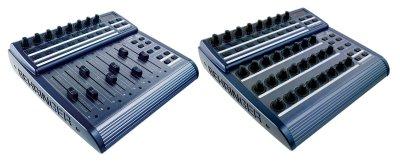
The letter sounds fine. I doubt if they'll come over to your place and beat you up, then again I doubt if much will happen unless they make the OS open source so you can change it.
The thing about packed data is that you can change one thing (arp stop/start) if you know what all the other things are and you are happy to leave them the same.
So if you are happy with
Bits 0 & 1 = 0 for a single octave 0000 0000
Bit 2 On/Off - this is what you change 0000 0n00 (you add 4 for On)
Bit 3 Key sync = 1 On = 0000 1000
Bit 4 Latch = 1 On = 0001 0000
Bit 5 & 6 Internal & external = 1& 0 = 0100 0000
Add them together = 0101 1n00
So
Arp On = 0101 1100 = $5C
Arp Off = 0101 1000 = $58
All the best
Royce
---In bc2000@yahoogroups.com, <absent@frognet.net> wrote:
Friday morning I managed to get arpeggiator on/off working from one of the knobs. I lost the setting before I saved it, and I forget what I did. :/
---In bc2000@yahoogroups.com, <rpcfender@...> wrote:The manual says that is responds to System realtime messages.
Try setting up a button with an on value of FA (start) and off of FC (stop) and see if that starts and stops the arp.
$button 52 ; Bottom right
.showvalue on
.mode toggle
.default $FC
.minmax $FA $FC
.tx val
All the best
Royce
---In bc2000@yahoogroups.com, <absent@...> wrote:re re re re re re
The BCR will still open up the A-Station plenty, but little things like inaccessible arppegiator on/off were just stupid IMHO, especially coming from a company that designs interfaces.
You have to make compromises in life, I guess.
Using a software solution for the rest is not the end of the world, I'd just rather not divide my DAW's resources further.
I mostly don't even use plug-ins unless I have to.
Then again, having the interface on my dektop already doesn't really mean the end of the world. I can re-purpose a tiny old laptop I have if I can find the right virtual control software.
There's gotta be something reasonable.I seem to remember Sound Diver being super expensive.
---In bc2000@yahoogroups.com, <rpcfender@...> wrote:There are three things that I see as shortcomings in the BC
It can't handle 14bit negative numbers - guess what Emu's Proteus and Proteus 2000 series modules use.
It can't handle 16 bit numbers - used by Morpheus synth. If it could then you could make it handle 14bit negatives. This would be what I would mod first.
And, of course, it can't handle packed bytes because you can't access the other parameter values to build the byte .
There is an extra wish and that would to be able to send a patch dump and it would re-set its values. I think that would be very difficult though. Works well with a computer in between.
In the scheme of things it is still pretty awesome.
I seem to remember there is a site where someone has reverse engineered the ROM and had an example of accessing the LED screen.
The quick(?) solution would be a program that just let everything through except the the special NRPN that you invented to cover all the switched data.
You would have to set up the current values of the switches, but you could do this by having a 'Request Patch' button programmed on the BCR that the program would know what it meant and sent a request current patch to the synth as sysex.
The patch data received could be used to set the values of all the controls and the packed data NRPN could be built by adding the incoming switch value to the one you got from the patch data.
At this point you might as well write an editor.
All the best
Royce
---In bc2000@yahoogroups.com, <absent@...> wrote:Actually, what's alarming to me is that I somehow entirely failed to notice that all of the packed paramteres are "switching" functions that don't even need to be knobbed- just switched.
Ha ha, I looked up " MIDI Packed Paramters" in the search engine I use (Duckduckgo.com), and the first hit I found was from someone trying to sort out a Novation.
: D
This is The Future. Isn't there some space age thing I can get to just put a bunch of switches on that have values assigned to them of the appropriate type?
If this future was happening in the 1950's, we'd be able to buy kits at something similar to Radio Shack. At least in my brain we would. Which might explain why I even care about any of this.
Don't these kids today have some sort of " Adreno Razzberies " that will do this? Wouldn't they need it for that "Stepping Dub" thing they do with the "Steam Punk " rock?*bangs head on floor*
---In bc2000@yahoogroups.com, <absent@...> wrote:Well, I feel less confused now.
So what the heck are they suposed to be doing with those, then?
Why are they even there?
Is that for internal control only? What is supposed to interface with those parameters?
So, now I have to research how packed parameters work in sequencing.
Man, I was really looking forward to real-time hardware control of basic things like, oh, say, maybe the oscillator controls.
*Now* the thing looks completely stupid to me.
I won't bore you with the physical interface details, but if you twiddle a lot, you're going to wear out some swtiches pretty fast.
It's an awesome thing, but I am really disappointed by this. There has to be *some* way to get hardware control for those features.
I'm going to throw a message in a bottle in Novation's general direction, just to see if they say anything interesting.
Thanks you so much. And I am *far* from done using the BCR2000.
I'll still use it with the Novation. I am just irritated at the Novation right now : D---In bc2000@yahoogroups.com, <rpcfender@...> wrote:I did type it all out. I pretend that it is a good substitute for the scales that I'm not playing enough.
Well I had a look at the Midi spec and I can't believe it.
It is an old synth but not that old and still using packed data parameters in Midi and worse than that they put it in controller messages (NRPN is an extension of CC messages).
Now the sad news for you, you can't change packed parameters, like the Osc waveforms without changing a whole lot of other parameters packed in there.
The BC does not allow you to add parameters together.
The only way you can get this machine to work properly is to write a program that will do the packing/unpacking for you.
I can understand the use of packing in the early days because of the cost memory, but now???
It can't be that there are too many parameters as they don't use a whole lot of available NRPNs
I had a look to see if you could change a parameter by sysex instead but there doesn't seem to be a command for parameter change. It just seems to use sysex for bulk dumps.
One last hope.
There is an editor on the web.
http://www.luigibianchi.com/AStatEdit/AStatEdit.htm
It only seems to have Midi In and out but perhaps you could ask him to add a controller port?
Then he could use controller values from the BC to pack the data.
The old Korg DW6000 uses packed data in its sysex for parameter change.
My solution is here .....
http://www.bwalk.com.au/DW6K/DW6k.html
(note that if you are using a browser addon 'HPPS everywhere' then you will get a warning. I don't know why - Just use http instead)Sorry
Royce
---In bc2000@yahoogroups.com, <absent@...> wrote:Royce, did you have that all written out some where and just paste it?
I hope you didn't have to write all that on my account, but it's awesome!Thank you so much for the explicit information.
I'm still early on (32 pages) in the BC Manager software manual, but I am reading it.
BTW, the MIDI utilities included in the thing are awesome!
Below, I explain exactly what I am trying to program.
I should have specified that the A-Station is a rack-mount sound module, and not a controller.
I have tried to enter the information below verbatim, but in case anyone is curious, here is a link to the actual manual.
http://us.novationmusic.com/support/product-downloads?product=A-
Station
-------------------------------
NOVATION A-Station
The manual for the Novation A-Station synthesizer provides a list of midi continuous-control numbers from 0-127.
Some of these are listed as follows:
------
71 : sound controller 2 (MIDI specified use)
A-Station use
Osc 1,2,3 octave/osc 1>2 Sync (see packed parameter 4)
----
When you see packed parameter 3, this is the information you get:
Packed Controller / NRPN parameter details -
bits 0-1 : 2 bit osc 1 waveform (sine, tri, saw,square)
bits 2-3 : osc 2
bits 4-5 : osc 3
bit 6 : osc 1 > 2 sync on
That is a 7 bit byte, correct?
There are eleven sets of packed parameters.
-----
I am now interpreting the manual differently.
This section is entitled "Packed Controller / NRPN Parameter Details
The page following the packed parameter details a "Midi NRPN list"
I'm now thinking that the packed parameters are not even NRPN's in the first place.
Although the packed parameters are my first concern, I will still need the NRPN's as well, but if I had interpreted that incorrectly, it certainly has not been simplifying the process.
"The A-Station uses a few NRPN's as detailed below.
Since less than 128 of them are used, only one NRPN bank msb is needed. Therefore only the NRPN lsb is transmitted/received and the NRPN msb is ignored and is not transmitted.
For future compatibility, assume that the NRPN msb is 0."
The NRPN's also contain some of the packed parameters (8,9,10).---In bc2000@yahoogroups.com, <rpcfender@...> wrote:Computers (this includes phones, washing machines and BC2000 etc) only talk in on/off or 0 and 1 called binary and each switch is called a bit.
We group these bits usually in blocks of 4 called a nibble.
Two of these nibbles are called a byte. So a byte has 8 bits or 8 on / off switches.
So counting in binary (that is only using 0 and 1) is
0 0
1 1
2 10 - this is the same process as when we reach 9 add 1 to it, we add a new column - start again = 10
3 11
4 100
5 101
6 110
7 111
8 1000
9 1001
10 1010
11 1011
12 1100
13 1101
14 1110
15 1111 and that is all we can count with 4 bits
So 0 to 15 is 16 values. It would be great if we could use a single character for each value.
So we make decimal...
10 = A
11 = B
12 = C
13 = D
14 = E
15 = F
When we need a bigger number we could just get another bit but lets grab an extra nibble and use a byte instead
0 = 00
1 = 01
...
14 = 0E
15 = 0F
16 = 10
17 = 11
...
124 =7C
125 =7D
126 =7E
127 =7F as Midi only uses 7 bits for data 127 is the biggest data number available as a single byte
128 =80
...
254 =FE
255 =FF biggest single byte value
256 =01 00 this is the usual display format for a 2 byte or 16 bit number right up to FF FF or 65535 in decimal.
Which do you find easier to read?
Now in Midi all the non-data stuff like 'I just pressed a note" and "change the patch to number" are all greater than 127 that is hex 80 (you see this also as 0x80 or $80 or 80h all the same thing) and bigger.
So as we need to know what channel it is, lets use the lower nibble for that.
So we can have commands or status bytes, as they are called, on any of 16 channels (0 to F)