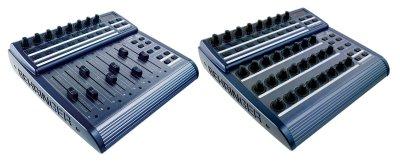
Jordache.jpeg:

I'm somewhat surprised that you describe normal MIDI volume controls
as "rough." Of course, their steps are not infinite; and granted, the
MCU does implement volume control with pitch bend data (*maybe* for
that reason; I always felt that they did this and a few other
comparable weirdnesses primarily to make the MCU difficult to
emulate!)

Nonetheless, volume control is implemented on nearly all control
surfaces, keyboards, etc., within the "normal" 0-127 controller
range. And this is the way MCU emulators basically handle it as well
(including mine) - working with the high byte of pitch bend only
(i.e., "course settings"). So I'm curious: what application do you
have that requires more that 128 levels of amplitude - assuming you
are using that full range?

Incidentally, I find Royce's solution to your problem really
ingenious. I also note that the solution is only possible with
endless encoders. Such an implementation has its own problems:
neither 0 nor max are fixed points on an encoder, so there is no
*tactile* way of determining them (though with the BCF/BCR the
red "dots" help).

Art Hunkins

--- In bc2000@yahoogroups.com, "rpcfender" <rpcfender@...> wrote:
>
> Hi
> --- In bc2000@yahoogroups.com, "jordache.jpeg" <jdutcher@> wrote:
> >
> > Hello,
> > I recently got a BCR2000 and I'm trying to set it up for use in
Adobe
> > Audition.  I've been in touch with a couple people in the BC2000
group
> > regarding programming it to work as a Mackie Control unit
equivalent.
> > I know there is already a compatible preset available for
download in
> > the files section, but the volume controls are very rough, as they
> have
> > been in my own testing as well.  From what I gather, AA needs a
> > pitchbend value between -8192 and 8192 (in 256 steps) to adjust
volume
>
>
>
> You would first think
> .easypar PB <channel> <value> #pitch bend
>
> but...
> "Note: the general MIDI Pitch Bend format is $Ec ValueLSB ValueMSB,
so
> the fact that the BC always
> sends $00 for ValueLSB means that it doesn't support 14-bit values:
> this is a bit strange, since the BC
> does support 14-bit values for several other message types." Mark
van
> den Berg
>
> That is easypar will only give you pitch bend coarse settings
> You need to use .tx to be able to get to the 14bit number
> The range -8192 to 8192 is a bit tricky as the BC units don't work
with
> negative numbers
> I'm not sure AA would really use signed integers.
>
> The range of Pitch bend is usually defined as 0 to 16383 with the
center
> (no pich shift) = $2000 or 8192
> The MIDI message is
> $E0 fine_data coarse_data
>
> Perhaps this might work for encoder 49 (bottom left) on MIDI
channel 1
> (Sorry, you can't program this from the front panel of the BCR.
You'll
> need to use my editor )
>
> .encoder 49
> .showvalue on
> .mode 1dot
> .resolution 2000 4000 8000 16000
> .minmax 0 16383
> .default 0
> .tx $E0 val0.6 val7.13
>
> You can fiddle with the .resolution 2000 4000 8000 16000  to adjust
the
> 'feel'
> The first number is "what is the value increased by if I move the
> encoder 1 turn very slowly"
> The 16000 means you should go through the range in one quick turn
> As you can see there are four rotation speeds
> You might like to use MidiOx to see what is happening
> http://www.midiox.com/ <http://www.midiox.com/>
>
> Hope this helps. Let me know how you get on.
>
> Royce
>
> > properly.  Is there any way to alter the sysex data to reflect
these
> > parameters for the BCR encoders?  I hope I'm being clear enough
here.
> >
> > Thanks!
> >
>
Message
Re: BCR2000 Mackie Emulation for Adobe Audition
2007-11-15 by abhunkin
Attachments
- No local attachments were found for this message.