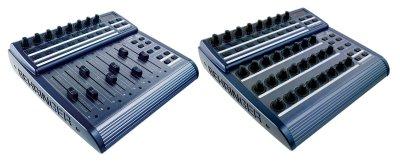
Heh, a BCR2000 specific automap! :) Heh, thats kinda cool. Actually,
it could also be used to create maps for any other controller...

On Fri, Mar 21, 2008 at 3:41 AM, goyya76 <goyya76@...> wrote:
>
>
>
>
>
>
> --- In bc2000@yahoogroups.com, "Karl Lurman" <karl.lurman@...> wrote:
>
>  The Java applet seems a good idea (though i don't know Java!) - a
>  sort of midi in - midi out cable, in which we could insert the midi
>  code (we could take it out of huskervu code)...
>
>  Going back to reality: as a first step, how about something even
>  simpler: midi in only? in
>  most hosts (cubase for sure) you can route the midi output for the
>  controller to multiple midi outs (for example, you could route the
>  feedback to MidiYoke 1, then create two midi tracks with MidiYoke 1
>  input, one outputting to BCR2000, the other outputting to the java
>  applet)...
>
>
>  > I actually think that as a first step, we look at creating a
>  > cross-platform LCD emulator to be used in conjunction with the
>  > existing emulation work found here in this group (files section).
>
>  just a few thoughts about it...
>
>  An "alpha" applet could just be able to grab selected info and
>  display them on the screen.
>
>  As a second step, since the NAME of the host active "function" (be it
>  the mixer, a plugin or an instrument) should be received by the
>  applet (if i remember correctly the Mackie HUI protocol), i'd like an
>  applet able to read a text file associated to the active function,
>  (containing the relative labels and graphics info like colour,
>  position etc) and automatically display them on a BCR/BCF background;
>  example:
>
>  mixer.txt
>  transport.txt
>  Classic Chorus.txt
>  MdspCompressor.txt
>  Asynth.txt
>  Synth1.txt
>
>  All the programming would be on the BCR/BCF side, and/or on the
>  controller setup of the host (i'm thinking about Cubase, Reaper,
>  Tracktion etc).
>
>  Third step, i'd like the applet to read .vstxml files (which AFAIK
>  are supported by cubase/nuendo and tracktion) for plugin and
>  instruments...
>
>  That done, we would have half of a freeware Automap! the tricky part
>  (midi flow between the host and the controller, setting up the
>  controller and the host) would be independent from the java applet -
>  and we face it later!
>
>  Lastly... +1 for the freeware and open-source option!
>
>
>
>  > I actually think that as a first step, we look at creating a
>  > cross-platform LCD emulator to be used in conjunction with the
>  > existing emulation work found here in this group (files section). I
>  > have tested this emulation, and I have to say I actually like it
>  > better than say the one used in LCxmu. The only thing it lacks is
>  the
>  > LCD to accompany it - at least on OSX. For PC I know there is
>  > Huskervu, but I believe we need something that is open-sourced,
>  > modular (more about this below), and platform independent. A java
>  > application seems like the best candidate here, but I am open to the
>  > idea of using something like Python too. With Java, we have access
>  to
>  > several low-level midi libraries, and we can guarantee most
>  platforms
>  > will have a JVM installed (OSX and Linux have it usually by default,
>  > Windows = a download from Microsoft of Sun).
>  >
>  > Open-sourcing the project will encourage it to be developed and
>  > maintained - Stuff Huskervu does not appear have any more.
>  >
>  > I believe the project needs to be designed as a module. By this, I
>  > mean that it provides an interface that other applications can
>  access
>  > it with. For instance, say you have made a mackie emulator
>  application
>  > for your control surface. This emulator handles the conversion of
>  your
>  > midi messages to the required mackie command messages for use in
>  your
>  > chosen DAW. So long as your emulator knows how to access the LCD
>  > emulator (via its defined interface) it can display the necessary
>  > mackie info. Heck, it doesn't even need to be mackie info, it could
>  be
>  > any standard (novation's one for instance).
>  >
>  > My initial thought was to see if I can't set up a java application
>  > that can act as a midi input and output, middleware if you will.
>  That
>  > would be a great start... Unless someone already has something like
>  > this I can have a play with already?
>  >
>  > Karl
>  >
>  > On Thu, Mar 20, 2008 at 6:57 AM, stutterbrain <stutterbrain@...>
>
>  wrote:
>  > >
>  > >
>  > >
>  > >
>  > >
>  > >
>  > > no coding ability whatsoever myself I'm afraid, but that
>  definately
>  > > doesn't go for everyone on the list.
>  > > Is the aim to provide an emulation in some form? I am quite
>  happily
>  > > emulating the functions I want just with midi presets on the
>  bcr. I
>  > > have no controllers with LCDs of much use, I think Novation are
>  > > probably the only ones I can think of, and the korg microkontrol
>  > > (which I miss)...
>  > >
>  > >
>  > >
>  > > --- In bc2000@yahoogroups.com, "k5kip_1999" <k5kip_1999@> wrote:
>  > > >
>  > > > Karl is trying to get a group together to code something cross
>  > > > platform, I think? Java perhaps???
>  > > >
>  > > > Right, Karl?
>  > > >
>  > > > He has the source from C# huskervu now and one of the old
>  mackie
>  > > > manuals.
>  > > > I am not a coder, so I can't be much help coding.
>  > > > I did however, build GenMce
>  > > > http://shoshin.110mb.com/genmce/
>  > > > with synthedit.
>  > > > It is not necessary with the bcr or bcf. The presets work
>  great for
>  > > > mackie mode. It also is not cross platform. It would be great
>  if it
>  > > > were...
>  > > >
>  > > >
>  > > >
>  > > >
>  > > >
>  > > > --- In bc2000@yahoogroups.com, "stutterbrain" <stutterbrain@>
>  > > > wrote:
>  > > > >
>  > > > > here we go:
>  > > > > http://www.mediamax.com/stutter/Hosted/old%20logic%20control%
>  > > > 20manual.pdf
>  > > > >
>  > > > > last chapter.
>  > > > >
>  > > > >
>  > > > > --- In bc2000@yahoogroups.com, "stutterbrain"
>  <stutterbrain@> wrote:
>  > > > > >
>  > > > > > hehe, I had the same idea a little while ago, posted on the
>  > > > ableton
>  > > > > > forum since I thought someone there might already have
>  thought of
>  > > > it
>  > > > > > and saved me some trouble. Didn't particularly seem to be
>  the
>  > > > case.
>  > > > > > Anyway I just came back to it while hacking my padkontrol,
>  and was
>  > > > > > looking at a load of sysex in Midi-ox last night, although
>  I
>  > > > think I'm
>  > > > > > going to steal someone else's idea and emulate parrts of
>  the
>  > > > Tranzport
>  > > > > > for that... anyways:
>  > > > > >
>  > > > > > Google for the Emagic Control Manual - quick look and I
>  can't
>  > > > find it
>  > > > > > on web or my computer, must be on the old one, I dunno. If
>  you
>  > > > cannot
>  > > > > > find it anywhere, and I do, I imagine I can upload it to
>  > > > yousendit or
>  > > > > > somewhere... anyway, the bit that I found interesting
>  looked like
>  > > > this
>  > > > > > (taken from Tranzport manual):
>  > > > > >
>  http://img.photobucket.com/albums/v440/stutter/Clipboard01.jpg
>  > > > > >
>  > > > > > a lot like that, so it might be the same - how many
>  different
>  > > > sysex to
>  > > > > > ascii conversion methods can there be?
>  > > > > > So, have a look at that, and set up midi-ox or some other
>  midi
>  > > > monitor
>  > > > > > to capture the outgoing midi from your Mackie-capable
>  host, and
>  > > > see if
>  > > > > > the sysex blocks translate into words.
>  > > > > >
>  > > > > > Also look up husker-vu and lc xmu - both prove that the
>  display
>  > > > > > amongst other things are possible (although you say you've
>  seen
>  > > > those
>  > > > > > already, so maybe you don't want to look those up).
>  > > > > >
>  > > > > > I'll have a look for that manual later on tonight.
>  > > > > >
>  > > > > > Matthew
>  > > > > >
>  > > > > >
>  > > > > > --- In bc2000@yahoogroups.com, "goyya76" <goyya76@> wrote:
>  > > > > > >
>  > > > > > > Hi all,
>  > > > > > >
>  > > > > > > i'd like to understand the sysex that are sent to the LCD
>  > > > emulation
>  > > > > > > (like huskervu), most of all when in VST inserts
>  mode....my
>  > > > idea would
>  > > > > > > be to see if it's possible to associate other actions to
>  the
>  > > > host
>  > > > > > output.
>  > > > > > >
>  > > > > > > An example: BCR 2000 in MCU emulation mode; i switch to
>  insert
>  > > > editing
>  > > > > > > mode, i choose insert 2, the virtual display updates
>  showing
>  > > > the name
>  > > > > > > of the FX, the on/off status etc - all this happens via
>  sysex -
>  > > > if i
>  > > > > > > send this sysex string to a suitable app (a modular host
>  like
>  > > > Usine)
>  > > > > > > and i'm able to grab the name of the FX among this sysex
>  string
>  > > > (here
>  > > > > > > comes the question), i could associate a different
>  program
>  > > > change to
>  > > > > > > each FX name - sending the program change to the BCR, i
>  could
>  > > > > > > automatically associate the correct preset to each FX...
>  > > > > > >
>  > > > > > > i suppose something like this is the basic principle on
>  which
>  > > > > > > Novation's Automap is based, ie using the feedback from
>  the
>  > > > host to
>  > > > > > > change the controller assignement accordingly - i have a
>  > > > feeling we
>  > > > > > > could so something similar on our BCF/BCR....
>  > > > > > >
>  > > > > > > any hint on where to look to interpret the host
>  feedback?? i've
>  > > > seen
>  > > > > > > two or three display emulation in the files section, and
>  maybe
>  > > > there's
>  > > > > > > someone who coded them or helped to code or whatever...
>  > > > > > >
>  > > > > > > Ciao,
>  > > > > > > Goyya
>  > > > > > >
>  > > > > >
>  > > > >
>  > > >
>  > >
>  > >
>  >
>
>
Message
Re: [bc2000] Re: Mackie LCD emulation
2008-03-20 by Karl Lurman
Attachments
- No local attachments were found for this message.