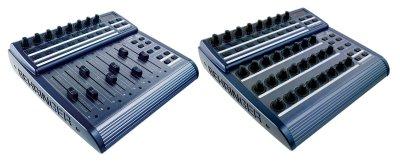
Bc2000 (for the BCF2000 & BCR2000) group photo

Yahoo Groups archive

Bc2000 (for the BCF2000 & BCR2000)

Index last updated: 2026-04-28 23:16 UTC

Thread

Programming hardware synthesizers with BCR2000

Programming hardware synthesizers with BCR2000

2008-07-29 by sexontony

I am trying to figure out if there is a possibility to program sounds/
presets for hardware synthesizers via the BCR2000 but not only to 
program, but also to manage the results/presets/.syx directly e.g. 
from BC Manager or a combination of BC Manager and MIDI-OX (in 
Windows XP) somehow?

Let me give an example:

I have here a Waldorf Pulse where I can control it's parameters via 
BCR2000, now when I create a sound I like and worth enough to save as 
a preset, externally, meaning on the computer, 

-  very fastly
-  without touching the Pulse itself

which possibilities do I have? (I also don't want to use the Pulse 
Editor which anyway can't do this as far as I could find out.)

How are you using your BCR2000 to create new sounds (on various 
hardware synthesizers) and most importantly how do you save those 
sounds on your computer for later reuse?

Kind regards,
Tony

Re: Programming hardware synthesizers with BCR2000

2008-07-29 by ivaasura

Well, I don't use hardware synths anymore since a decade and my
software synths settings are stored by the sequencer automatically.

For your purpose IMHO you have to program a button on the BCR2000,
that initiates the Pulse to dump it's edit buffer content via MIDI,
given that the Pulse is able of this.

Re: Programming hardware synthesizers with BCR2000

2008-07-29 by sexontony

I see, can BC Manager store and save this preset then, or MIDI-OX or 
would I need another extra tool? Below I paste the (partial) sysex 
info of Waldorf Pulse:


Waldorf Pulse System Exclusiev Format Version 1.1

1.) Program Dump

Byte Nr.  Value     Description
0         $F0       Start of System Exclusive
1         $3E       Waldorf Electronics GmbH Manufacturer ID
2         $0B       Pulse Machine ID
3         DEV       Entsprich dem Globalparameter Device ID, s. 5.6
4         $00       Dump Typ, Hier Program Dump 
5         PRG       Program Number 0-99 fuer P.1 bis P.99 und P.rn

6	  16-112    Oscillator 1 Transpose -48...48
7         0-127     Oscillator 1 Tune -64...63
8	  0-2       Oscillator 1 Shape 0: Pulse 1: Saw 2: Triangle
9	  0-127     Oscillator 1 Pulsewidth
10	  16-112    Oscillator 2 Transpose -48...48
11        0-127     Oscillator 2 Tune -64...63
12	  0-3       Oscillator 2 Shape 0: Pulse 1: Saw 2: Triangle 3: 
Crossmod
13	  0-127     Oscillator 2 Pulsewidth
14        0-1       Oscillator 2 Sync 0:off 1:on
15        0-1       Oscillator 2 Keytrack 0:off 1:on
16	  16-112    Oscillator 3 Transpose -48...48
17        0-127     Oscillator 3 Tune -64...63
18	  0-2       Oscillator 3 Shape 0: Pulse 1: Saw 2: Triangle
19        0-127     Osc 1 Level
20        0-127     Osc 2 Level
21        0-127     Osc 3 Level
22        0-127     Noise Level
23        0-127     LFO 1 Speed
24	  0-4       LFO 1 Shape 0:sine 1:tri 2: Saw 3: Pulse 4:Sample 
& Hold 
25        0-127     LFO 2 Speed
26        0-127     LFO 2 Delay
27        0-127     Envelope 1 Attack
28        0-127     Envelope 1 Decay
29        0-127     Envelope 1 Sustain
30        0-127     Envelope 1 Release
31        0-127     Envelope 1 Keytrack -64...63
32        0-3       Envelope 1 Trigger 0:Sg1 1:Sg2 2:rt1 3: rt2
33        0-127     Envelope 2 Attack
34        0-127     Envelope 2 Decay
35        0-127     Envelope 2 Sustain
36        0-127     Envelope 2 Release
37        0-127     Envelope 2 Keytrack -64...63
38        0-3       Envelope 2 Trigger 0:Sg1 1:Sg2 2:rt1 3: rt2
39        0-127     Pitch Mod -64...63
40	  0-15      Pitch Mod Source (see table)
41        0-127     Portamento time
42        0-1       Portamento mode 0:normal 1:fingered
43        0-24      Pitchbend Scale
44        0-15      Mod 1 Source (see table)
45        0-127     Mod 1 Amount -64...63
46        0-15      Mod 1 Destination (see table)
47        0-15      Mod 2 Source (see table)
48        0-127     Mod 2 Amount -64...63
49        0-15      Mod 2 Destination (see table)
50        0-15      Mod 3 Source (see table)
51        0-127     Mod 3 Amount -64...63
52        0-15      Mod 3 Destination (see table)
53        0-15      Mod 4 Source (see table)
54        0-127     Mod 4 Amount -64...63
55        0-15      Mod 4 Destination (see table)
56        0-1       Arpeggiator 0:off 1:on
57        0-10      Arpeggiator Range
58        0-31      Arpeggiator Tempo
59        0-127     Arpeggiator Clock 0: extern, 1-127 for 48 to 300 
BpM
60        0-3       Arpeggiator Mode   0: up 1: down 2: alternate 
3:random
61        0-127     Cutoff Frequency
62        0-127     Cutoff Keytrack -64...63
63        0-127     Cutoff Envelope 1 Sense -64...63
64        0-127     Cutoff Velo Sens  -64...63
65	  0-15      Cutoff Mod Source (See table)
66        0-127     Cutoff Mod Amount  -64...63
67        0-127     Resonance
68        0-127     Volume
69        0-127     Volume Velo Sens -64...63
70	  0-127     Panning L64..cnt..r63
71        0         reserved
72        0         reserved
73        0         reserved
74        0         reserved

75        CHK       Checksumme ueber bytes 6 bis 74, bit 7 geloescht
76        $F7       End of System Exclusive


2.) Program Bulk Dump

Byte Nr.  Value     Description
0         $F0       Start of System Exclusive
1         $3E       Waldorf Electronics GmbH Manufacturer ID
2         $0B       Pulse Machine ID
3         DEV       Entsprich dem Globalparameter Device ID, s. 5.6
4         $01       Dump Typ, Hier Program Bulk Dump 
5         PRG       Program Number 0-39 fuer P.1 bis P.40

6	  16-112    Oscillator 1 Transpose -48...48
7         0-127     Oscillator 1 Tune -64...63
8	  0-2       Oscillator 1 Shape 0: Pulse 1: Saw 2: Triangle
9	  0-127     Oscillator 1 Pulsewidth
10	  16-112    Oscillator 2 Transpose -48...48
11        0-127     Oscillator 2 Tune -64...63
12	  0-3       Oscillator 2 Shape 0: Pulse 1: Saw 2: Triangle 3: 
Crossmod
13	  0-127     Oscillator 2 Pulsewidth
14        0-1       Oscillator 2 Sync 0:off 1:on
15        0-1       Oscillator 2 Keytrack 0:off 1:on
16	  16-112    Oscillator 3 Transpose -48...48
17        0-127     Oscillator 3 Tune -64...63
18	  0-2       Oscillator 3 Shape 0: Pulse 1: Saw 2: Triangle
19        0-127     Osc 1 Level
20        0-127     Osc 2 Level
21        0-127     Osc 3 Level
22        0-127     Noise Level
23        0-127     LFO 1 Speed
24	  0-4       LFO 1 Shape 0:sine 1:tri 2: Saw 3: Pulse 4:Sample 
& Hold 
25        0-127     LFO 2 Speed
26        0-127     LFO 2 Delay
27        0-127     Envelope 1 Attack
28        0-127     Envelope 1 Decay
29        0-127     Envelope 1 Sustain
30        0-127     Envelope 1 Release
31        0-127     Envelope 1 Keytrack -64...63
32        0-3       Envelope 1 Trigger 0:Sg1 1:Sg2 2:rt1 3: rt2
33        0-127     Envelope 2 Attack
34        0-127     Envelope 2 Decay
35        0-127     Envelope 2 Sustain
36        0-127     Envelope 2 Release
37        0-127     Envelope 2 Keytrack -64...63
38        0-3       Envelope 2 Trigger 0:Sg1 1:Sg2 2:rt1 3: rt2
39        0-127     Pitch Mod -64...63
40	  0-15      Pitch Mod Source (see table)
41        0-127     Portamento time
42        0-1       Portamento mode 0:normal 1:fingered
43        0-24      Pitchbend Scale
44        0-15      Mod 1 Source (see table)
45        0-127     Mod 1 Amount -64...63
46        0-15      Mod 1 Destination (see table)
47        0-15      Mod 2 Source (see table)
48        0-127     Mod 2 Amount -64...63
49        0-15      Mod 2 Destination (see table)
50        0-15      Mod 3 Source (see table)
51        0-127     Mod 3 Amount -64...63
52        0-15      Mod 3 Destination (see table)
53        0-15      Mod 4 Source (see table)
54        0-127     Mod 4 Amount -64...63
55        0-15      Mod 4 Destination (see table)
56        0-1       Arpeggiator 0:off 1:on
57        0-10      Arpeggiator Range
58        0-31      Arpeggiator Tempo
59        0-127     Arpeggiator Clock 0: extern, 1-127 for 48 to 300 
BpM
60        0-3       Arpeggiator Mode   0: up 1: down 2: alternate 
3:random
61        0-127     Cutoff Frequency
62        0-127     Cutoff Keytrack -64...63
63        0-127     Cutoff Envelope 1 Sense -64...63
64        0-127     Cutoff Velo Sens  -64...63
65	  0-15      Cutoff Mod Source (See table)
66        0-127     Cutoff Mod Amount  -64...63
67        0-127     Resonance
68        0-127     Volume
69        0-127     Volume Velo Sens -64...63
70	  0-127     Panning L64..cnt..r63
71        0         reserved
72        0         reserved
73        0         reserved
74        0         reserved

75        CHK       Checksumme ueber bytes 6 bis 74, bit 7 geloescht
76        $F7       End of System Exclusive

3.) Global Parameter Dump
Byte Nr.  Value     Description
0         F0        Start of System Exclusive
1         3E        Waldorf Electronics GmbH Manufacturer ID
2         0B        Pulse Machine ID
3         DEV       Entsprich dem Globalparameter Device ID, s. 5.6
4         08        Dump Typ, Hier Program Bulk Dump 

5         0-99      Startup Program 1-99/random
6         54-74     Master tune 430...450 Hz
7         0-127     Control X
8         0-16      MIDI Channel 0: omni 1-16: Channel 1-16
9         0-126     Device ID

10        CHK       Checksumme ueber bytes 6 bis 9, bit 7 geloescht
11        $F7       End of System Exclusive


4.) Program Dump Request

Byte Nr.  Value     Description
0         $F0       Start of System Exclusive
1         $3E       Waldorf Electronics GmbH Manufacturer ID
2         $0B       Pulse Machine ID
3         DEV       Entsprich dem Globalparameter Device ID, s. 5.6
4         $40       Dump Typ, Hier Program Dump Request
5         PRG       Program Number 0-99 fuer P.1 bis P.99 und P.rn
6	  $F7       End of System Exclusive


5.) Program Bulk Dump Request

Byte Nr.  Value     Description
0         $F0       Start of System Exclusive
1         $3E       Waldorf Electronics GmbH Manufacturer ID
2         $0B       Pulse Machine ID
3         DEV       Entsprich dem Globalparameter Device ID, s. 5.6
4         $41       Dump Typ, Hier Program Bulk Dump Request
5         PRG       Program Number 0-99 fuer P.1 bis P.99 und P.rn
6	  $F7       End of System Exclusive


6.) Global Parameter Dump Request

Byte Nr.  Value     Description
0         $F0       Start of System Exclusive
1         $3E       Waldorf Electronics GmbH Manufacturer ID
2         $0B       Pulse Machine ID
3         DEV       Entsprich dem Globalparameter Device ID, s. 5.6
4         $48       Dump Typ, Hier Global Parameter Dump Request
5	  $F7       End of System Exclusive

Re: Programming hardware synthesizers with BCR2000

2008-07-29 by ivaasura

--- In bc2000@yahoogroups.com, "sexontony" <sexontony@...> wrote:
>
> I see, can BC Manager store and save this preset then, or MIDI-OX or 
> would I need another extra tool?

If you Use a sequencer/DAW you simply could record it on a MIDI track
- that's the way I did it 20 years ago with my Juno 106, TX81Z, JD-800
etc. You just can take any program or hardware device, that can record
MIDI sys ex data. 

As I wrote before, you will need to read the edit buffer of the Pulse,
not a single patch or a whole bank dump. You can it compare to the
BCR2000: If you edit one of the presets or send one from the computer
to the BCR2000, they are just in the edit buffer, until you store them
under any of the preset numbers.

How do you tweak your Pulse? With MIDI CC or via sys ex data?

Re: Programming hardware synthesizers with BCR2000

2008-07-29 by sexontony

1.
I downloaded the Pulse-BCR2000 file from here:
http://faq.waldorfian.info/faq-browse.php?product=pu#107

2.
I sent this .syx to BCR2000 with MIDI-OX (I also tried before with BC 
Manager, but BC Manager hangs in the middle of the transfer process.) 
The preset is stored in preset 32 of the BCR2000.

So to answer your question whether midi-cc or sysex I am not sure, 
but I would think midi sysex. At least I set in BCR2000.MIDI 
options.Method: "Select Preset (BC SysEx command)"

(
The other options are:
-  Program Change (standard MIDI)
-  $recall (BCL chain)
)

> How do you tweak your Pulse? With MIDI CC or via sys ex data?


Kind regards,
Tony

Re: [bc2000] Programming hardware synthesizers with BCR2000

2008-07-29 by Tony Cappellini

>
> I have here a Waldorf Pulse where I can control it's parameters via
> BCR2000, now when I create a sound I like and worth enough to save as
> a preset, externally, meaning on the computer,
>
> - very fastly
> - without touching the Pulse itself

You can use Midiox to send a Dump Request to the Pulse- assuming it
supports that commands (most synths do).
You can then save these files on your computer.

I have a Microwave 2, Waldorf did a great job with it's sysex
implementation, and I would assume they did similar for older boxes

Re: Programming hardware synthesizers with BCR2000

2008-07-29 by ivaasura

--- In bc2000@yahoogroups.com, "Tony Cappellini" <cappy2112@...> wrote:
> You can use Midiox to send a Dump Request to the Pulse- assuming it
> supports that commands (most synths do).
> You can then save these files on your computer.

Can't he set this request to on of the BCR's buttons? Then each time
he presses that button, the Pulse would dump his edit buffer to MIDI out.

Re: [bc2000] Re: Programming hardware synthesizers with BCR2000

2008-07-29 by Tony Cappellini

> Can't he set this request to on of the BCR's buttons? Then each time
> he presses that button, the Pulse would dump his edit buffer to MIDI out.

Probably- the Behringer BCR software sucks though and you only have
limited sysex capability in the BCR itself.
Once you send the command, what are you going to do with the patch
data? You cant save it in the BCR, you cant edit it.

You might as well use a program that will let you save it on your
computer, Midiox is free and full featured, but if you want to edit
the Pulse patches, you'll need a dedicated editor, or just edit the
bytes by hand

Re: Programming hardware synthesizers with BCR2000

2008-07-30 by sexontony

Thanks to all replies and suggestions so far.


--- In bc2000@yahoogroups.com, "Tony Cappellini" <cappy2112@...> 
wrote:
> Probably- the Behringer BCR software sucks though and you only have
> limited sysex capability in the BCR itself.
> Once you send the command, what are you going to do with the patch
> data? You cant save it in the BCR, you cant edit it.
> 
> You might as well use a program that will let you save it on your
> computer, Midiox is free and full featured, but if you want to edit
> the Pulse patches, you'll need a dedicated editor, or just edit the
> bytes by hand


Ok, the original Behringer BCR software might suck, but who uses it 
in the age of BC Manager?

If possible I would try to use the combination of BC Manager + MIDI-
OX only. For editing the sounds I don't need any (additional) 
software, I tweak anyway the Pulse sounds all the time on the BCR2000 
and if I get some "Aha" or "Wow" feeling while tweaking (e.g. in the 
context of the rest of the music) I should have the option to save 
this preset/sound on my computer for later reuse. This is mostly true 
for special bass sounds which should keep more or less constant. This 
would mean I should also be able to send this sound parameters back 
from my computer to Waldorf Pulse again. (Maybe again using MIDI-OX?)

What I don't want is having to start some bigger host just to program 
and save sounds for Waldorf Pulse. The sound programming process 
should be as independent as possible from the normal music 
composition process. I came thanks to MIDI-OX, BC Manager and the 
generous Waldorf Pulse .syx creator for BCR2000, DocT, quite far, 
only the saving of the tweaked + liked sounds is missing to have a 
"perfect" sound programming environment. I just love the sounds 
coming out of the Pulse! Having direct access to many parameters 
immediately with BCR2000 is just a bomb!

How do other people work if they use the combination hardware 
synthesizer + BCR2000? Which tools are you using? (Are you using some 
synthesizer specific sysex tools or some general software which can 
deal with 100s of synthesizers which you don't have anyway?)

My plan is to look more in detail to MIDI-OX and it's sysex handling 
features, extracting the right dump request information from the 
Waldorf Pulse manual, getting it work for one sound, testing it if 
the sound is saved really 100% correctly, then if everything is ok, 
trying to automate everything midi + key + menu use with the 
automation tool AutoHotkey (for Windows XP), writing a simple summary 
what I did to make it work, packing everything into a zip and sharing 
in the files directory of this yahoo group.

Kind regards,
Tony

Re: Programming hardware synthesizers with BCR2000

2008-07-31 by Mark van den Berg

--- In bc2000@yahoogroups.com, "sexontony" <sexontony@...> wrote:
> 1.
> I downloaded the Pulse-BCR2000 file from here:
> http://faq.waldorfian.info/faq-browse.php?product=pu#107

> 2.
> I sent this .syx to BCR2000 with MIDI-OX (I also tried before with BC 
> Manager, but BC Manager hangs in the middle of the transfer process.) 
> The preset is stored in preset 32 of the BCR2000.
> 

"BC Manager hangs"? Oops! As BC Manager's author, reports like this do
grab my attention: I immediately start worrying that there might be
something amiss with BC Manager. And they're not good for business
reputation, haha!

But seriously, I downloaded this syx file and sent it to my BCR: no
problem whatsoever. So I'm a bit curious how in your case it could
hang. Did you use the latest version of BC Manager (1.5.0)? If you
did, all I can think of is some weird feedback loop that caused BC
Manager to halt the upload process:

You should understand that when BC Manager sends SysEx data to the
BCR, it uses a handshake protocol. I.e. it sends one SysEx message,
then waits for the BCR to reply with an SysEx acknowledgement message
before sending the next message. So this may be the reason for your
problem with uploading your data from BC Manager: maybe somehow the
BCR didn't send the correct acknowledgement message back - or BC
Manager received an unexpected message back via a feedback loop or
something, upon which it couldn't continue the transfer.

This is the main difference between BC Manager and MIDI-OX: MIDI-OX
simply sends all the SysEx messages to the BCR (probably at regular
intervals), without waiting for any response from the BCR.

>> How do you tweak your Pulse? With MIDI CC or via sys ex data?
> 
> So to answer your question whether midi-cc or sysex I am not sure, 
> but I would think midi sysex. At least I set in BCR2000.MIDI 
> options.Method: "Select Preset (BC SysEx command)"

Several things are getting mixed up here:
The BC Manager setting you're referring to here has got nothing to do
with the question of how the Pulse can be tweaked. BC Manager's
"Method" setting only refers to the way in which BC Manager tells the
BCR to change from one BCR preset to another BCR preset - so basically
this is a "private affair" between BC Manager and the BCR.

Then to the protocols used to tweak the Pulse:

The Pulse spec you sent in one of your messages indeed concerns SysEx
messages. In fact, all the Pulse's parameters are sent in one long
SysEx message. As Tony has pointed out already, this SysEx message is
unsuited for use with the BCR: you could only use this type of SysEx
message effectively in a dedicated editor that allowed you to
manipulate the parameters received in the SysEx message individually,
then pack all your changes together again and send them back to the
Pulse in a similar single, long SysEx message.

However, the BCR template you found on the internet
(BCR2000WaldorfPulse.syx) assigns Control Change messages to
individual knobs on the BCR, so apparently it is possible to
manipulate individual Pulse parameters directly via these CC messages.
This is indeed exactly what you want for the BCR.

Mark.

Re: Programming hardware synthesizers with BCR2000

2008-07-31 by Mark van den Berg

--- In bc2000@yahoogroups.com, "sexontony" <sexontony@...> wrote:
 > Ok, the original Behringer BCR software might suck, but who uses it 
> in the age of BC Manager?

THAT's what I like to hear!

> If possible I would try to use the combination of BC Manager + MIDI-
> OX only. For editing the sounds I don't need any (additional) 
> software, I tweak anyway the Pulse sounds all the time on the BCR2000 
> and if I get some "Aha" or "Wow" feeling while tweaking (e.g. in the 
> context of the rest of the music) I should have the option to save 
> this preset/sound on my computer for later reuse. This is mostly true 
> for special bass sounds which should keep more or less constant. This 
> would mean I should also be able to send this sound parameters back 
> from my computer to Waldorf Pulse again. (Maybe again using MIDI-OX?)

> My plan is to look more in detail to MIDI-OX and it's sysex handling 
> features, extracting the right dump request information from the 
> Waldorf Pulse manual, getting it work for one sound, testing it if 
> the sound is saved really 100% correctly, then if everything is ok, 
> trying to automate everything midi + key + menu use with the 
> automation tool AutoHotkey (for Windows XP), writing a simple summary 
> what I did to make it work, packing everything into a zip and sharing 
> in the files directory of this yahoo group.

IMHO, in principle there is no reason why you should need MIDI-OX to
save a particular setup:

Using the BCR Pulse preset, you can save a Pulse setup from the BCR by
executing "snapshot" (press EDIT + "< PRESET" on the BCR, or press the
"Snaphot" button in BC Manager): this sends all the current positions
of the BCR knobs (at least those defining Control Change messages
etc.) to the computer (in particular: to BC Manager).

BC Manager can capture such a sequence of CC messages, and you can
then do various things with this sequence. e.g. you can save it as a
MIDI file. (Go to the "MIDI input messages" window for this.)

Even better: using BC Manager you can put such a sequence of CC
messages in the definition of one BCR button, so that you only have to
press this button to send all those settings to the Pulse. That way
you can create whole banks of favorite Pulse setups. (You could put
them under free buttons in the same preset as the one containing the
individual parameters, or dedicate separate presets to them.)

To do this via BC Manager, in the button dialog box (of a free BCR
button), go to the "Custom output" tab and press the "Record MIDI
messages" button (it's the round red button on the toolbar). This
opens a dialog box saying "Record MIDI messages". Then press the
"Snapshot" button, wait for the BCR to send the data, and press OK.
The CC messages are then assigned to the BCR button of your choice -
all you have to do is send this button definition to the BCR.

At the moment there's only one practical problem with this procedure:
I've noticed that the BCR preset for the Pulse
(BCR2000WaldorfPulse.syx) defines so many BCR encoders/buttons that
the amount of data sent in a snapshot from the BCR is too large for
inclusion in a BCR button: the maximum is 125 bytes, whereas a Pulse
snapshot contains 206 bytes.

There are two reasons for this "overflow":

Numerically the main reason is that the "Record MIDI messages" button
in the button dialog box in BC Manager currently doesn't "compact" any
received messages (by applying what's known as "MIDI running status").
I'll see if I can offer this feature in a future version of BC Manager.

For now, your way around this is to copy the recorded snapshot from BC
Manager's "MIDI input messages" window instead (because this DOES
compact the messages):
Press the "Record" button from the MIDI input messages window, then
press the "Snapshot" button in the "B-Controls" window, then in the
MIDI input messages window select all recorded messages (e.g. via
Ctrl+A), copy those to the MIDI message clipboard (e.g. via Ctrl+Ins),
and on the "Custom output" tab in the button dialog box paste these
messages via the "Paste MIDI message clipboard" button (or press
Ctrl+Shift+Ins).

However, in my experience you then still have too many bytes, so you
have to compact them further. This can be done as follows:
The BCR preset for the Pulse uses several duplicates. I.e. several
buttons use the same CC number: unfortunately the BCR's snapshot sends
ALL these buttons' values. To arrive at a number of "Custom output"
bytes under 126, you have to remove some of these duplicates. There
are several ways to do this: the best thing to do is probably to adapt
the BCR preset for the Pulse so that a snapshot from the BCR simply
doesn't include these duplicates any more. Alternatively you can
remove them manually in BC Manager (but of course that's laborsome in
the long run).

Mark.
Re: Programming hardware synthesizers with BCR2000

2008-08-05 by poser_p

'How do other people work if they use the combination hardware
synthesizer + BCR2000? Which tools are you using? (Are you using some
synthesizer specific sysex tools or some general software which can
deal with 100s of synthesizers which you don't have anyway?)'


I use BC Manager (with a BCR2000) and MIDIOX to control patches that I
program on a Kurzweil K2000. The Kurzweil is nice because you can
create with it an almost infinite variety of "synths" that respond to
CC messages. I currently use an M-Audio Keystation Pro 88 keyboard as
my master keyboard. This particular keyboard has a "snapshot" feature;
you press two buttons simultaneously and the current state of all
knobs/sliders/buttons that are assigned to CCs is transmitted on the
MIDI out port. The snapshot can be recorded using BC Manager or MIDIOX
(with its excellent "MIDI Snapshot" window/editor) and then resent
later to recall the "preset". In my case the state of the KSP 88
happens to be under 125 bytes, so I can also assign all of that data
to a button on the BCR2000. 


For example, I have a "synth" that I programmed which uses four voices
with variable wave shape (between sawtooth and sine) and detuning, a
global ASR envelope, a "mix" level knob for each voice along with an
enable/disable button and a global modulation envelope that consists
of the ASR and an LFO which can be independently assigned to each
voice (to control volume). The CC mapping is as follows:

CC Num	Function
------  --------
3	Voice 1 waveshape
9	Voice 2 waveshape
12	Voice 3 waveshape
13	Voice 4 waveshape
14	Voice 1 Volume
15	Voice 2 Volume
16	Voice 3 Volume
17	Voice 4 Volume
18	Voice 1 Detuning
19	Voice 2 Detuning
20	Voice 3 Detuning
21	Voice 4 Detuning
72	Attack
73	Decay
74	Release
76	LFO Speed
77	ADR Env Amt (global mod source)
78	LFO Amt (global mod source)
82	Voice 1 global mod assign
83	Voice 2 global mod assign
84	Voice 3 global mod assign
85	Voice 4 global mod assign
86	Voice 1 Enable
87	Voice 2 Enable
88	Voice 3 Enable
89	Voice 4 Enable

So I can go to the K2000, load up this "synth" (which is just another
patch on the K2000) and fire up MIDIOX and open the "snapshot" window.
I can tweak the controls that I've assigned to these various CCs until
I find a sound I like, then hit "send snapshot" on the KSP 88. I can
store the snapshot in MIDIOX and resend it later to the K2000 to
recall it.

Further, I can capture the same snapshot via BC Manager and create a
new BCR preset that a.) has knobs assigned to control all of these
parameters, and b.) uses the push knobs or buttons to recall the
"presets" I stored previously in MIDIOX. One neat trick you can do to
speed up importing presets from MIDIOX to BC Manager is to send the
MIDIOX snapshot to the BCR (which has previously been set up with
knobs assigned to these CCs) and then use BC Manager to request a
"snapshot" from the BCR. This isn't necessary, of course, if you
capture MIDI snapshots in BC Manager in the first place.

I own MidiQuest but don't use it very much for patch editing on the
K2000  -- for some reason it doesn't work very well with my K2000. I
like the concept, though, and plan on using it as I expand my setup to
control other things. One useful thing it does is provide all the
sysex data you need to understand how other pieces of gear work. I
just bought an Ensoniq DP/4 effects processor, for instance, and I
plan on creating some BCR2000 presets for it. Among other things I'll
use MidiQuest and MIDIOX to figure out its sysex data format so I can
do those presets since I didn't get a manual with the DP/4 (and the
DP/4+ manual that's available online just happens to be missing most
of that info).

Re: [bc2000] Re: Programming hardware synthesizers with BCR2000

2008-08-05 by Tony Cappellini

> I own MidiQuest but don't use it very much for patch editing on the
> K2000 -- for some reason it doesn't work very well with my K2000. I
A bit off topic- but I bought Midi Quest recently.

I've found about 5 or so errors in the profiles for the Xpander & Matrix12.
Sound Quest reacted very quickly and updated these instrument profiles
within the hour, each time I found a problem.

If you're having problems with Midi Quest with the  K2000 you may want
to contact Sound Quest tech support.
They are very responsive. You may want to do some basic
troubleshooting first- like eliminate
everything between Midi Quest and the K2000.

Move to quarantaine

This moves the raw source file on disk only. The archive index is not changed automatically, so you still need to run a manual refresh afterward.