I won't hold it against you if you (or anybody else here) is wrong. This
helps tremendously towards my understanding of these circuits.
The voltage at the freq wiper goes from 0 to +15.
Otherwise the BCE readings are the same as previously. Sigh.
ryan williams wrote:
helps tremendously towards my understanding of these circuits.
The voltage at the freq wiper goes from 0 to +15.
Otherwise the BCE readings are the same as previously. Sigh.
ryan williams wrote:
> Hi,[Non-text portions of this message have been removed]
>
> please, note that I could be wrong about any of this, but if I had this
> problem, this is what I would be doing. I know troubleshooting is
> frustrating. Reccently, I spent a week searching a filter circuit for a
> very simple problem.
>
> I think we should look at this area a bit more. The reason, is that you
> get sort of the opposite results that I expect. If you are measuring
> left and right transistor as shown in the schematic, then the right side
> should be at a higher voltage than the left side as the pot is
> increased, for atleast most of the pot range. At minimum pot position,
> the left side might be a little higher than the right, depending on
> transistor matching. The diodes go from the right side to the left, to
> forward bias them, the voltage on the right has to be greater. This
> allows an adjustable current flow through the diodes, which causes them
> to act like variable resistors.
>
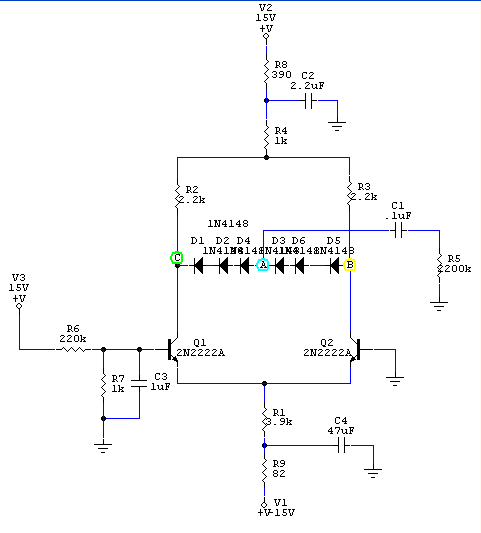
> I ran a simulation of the biasing section only. The results matched
> pretty well with my analysis on paper. here is some screen shots as the
> voltage 'V3' (basically pot setting) is changed from 0V to +15V:
>
> simulation circuit:
> http://www.sdiy.org/destrukto/temp/steiner-biasing.gif
>
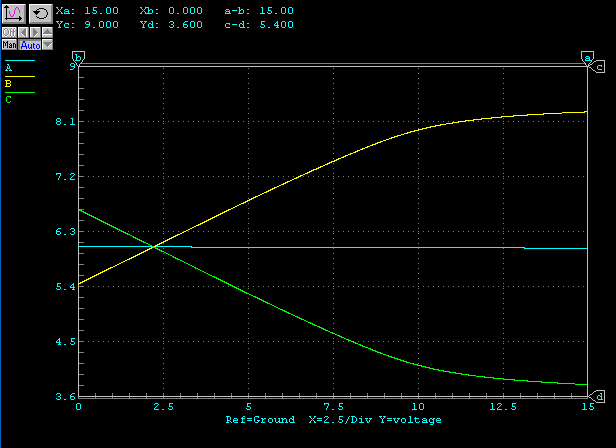
> diode string voltage:
> http://www.sdiy.org/destrukto/temp/steiner-biasing_plot.gif
>
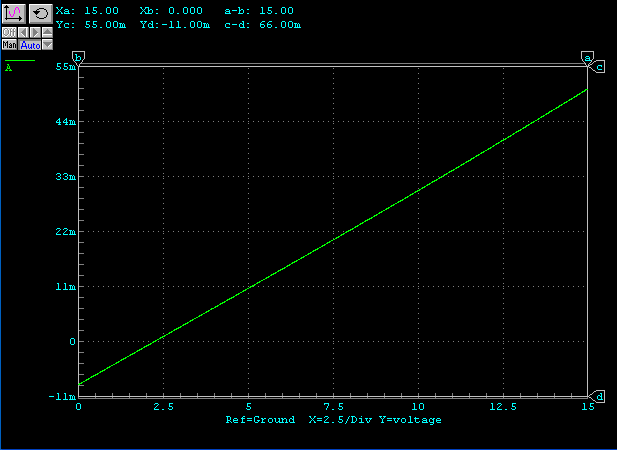
> left diff pair transistor base voltage:
> http://www.sdiy.org/destrukto/temp/steiner-base_voltage_plot.gif
>
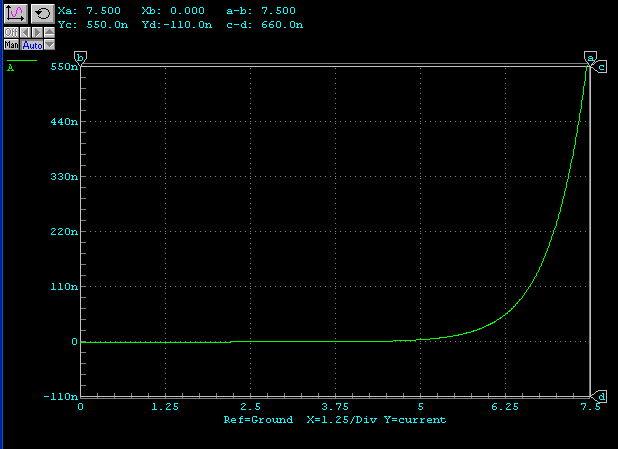
> diode current (CV pot from 0 to +7.5V)
> http://www.sdiy.org/destrukto/temp/steiner-diode_current.gif
>
> that last plot shows the current through the diodes. only half the pot
> range is used, because beyond that, the biasing is no longer linear,
> which causes the diode current to no longer increase exponentially
> (exponential is what we want). On the diode string voltage plot; You can
> see the two voltage curves intersect, the point of intersection seems
> fairly dependent on the transistors and thier matching. There is a part
> where the diodes are not forward biased. My diode current plot shows
> that it still behaves mostly exponentially in that range, but I don't
> really understand how it does.
>
> now, on to your results. I didn't think before, but you measuring could
> effect the circuit behavior. not sure what the impedance of the volt
> meter is. anyway, I think there still might be a problem here.
>
> ken johnston wrote:
> > Near as I can tell those all check out fine. These are the readings I
> > got on the meter w/common connected to ground:
> >
> > Left transistor collector: 7.04 to 7.32 (freq pot low to high)
> > Left transistor emitter: -.64
> > Left transistor base: -22.6 to -.33
>
> the left transistor base doesn't seem right. the pot should go from 0V
> to +15V. My simulation shows that at 0V, the base voltage will be
> slightly negative, but for most of the pot range, it won't be. the
> collector voltage should be decreasing as the pot in increased.
>
> >
> > Right transistor collector: 5.60 to 5.80
> > Right transistor emitter: -.64
>
> this collector current increases as it should, but I expect a much
> larger change in the voltage. the emitter voltage looks good, so your
> transistors are turned on.
>
> > Center diode string: 4.86 to 5.06
>
> a little lower than I expect, but possibly there is a reason for that.
> maybe the volt meter effects it?
>
> ok, so make sure your CV pot is connected correctly (0V and +15v), and
> make sure the voltage at the pot wiper goes from 0 to 15v. sure that
> sound obvious, but I would double check it.
>
> I'll try to think of other possible problems, nothing comes to mind
> right now, but I'll think about it.
>
> -ryan