Yahoo Groups archive

Cgs synth

Index last updated: 2026-04-28 23:16 UTC

Thread

steiner filter flummox

steiner filter flummox

2005-12-08 by betweenpie

I have built the kit but is not yet functioning 100% - more like 10%.

An audio signal does come through each input, with a very low output,
with the LP being the lowest (barely audible), BP the loudest. Freq
pot has no effect. Res appears to be functioning. TL071 is doing it's
job, there's just not much coming to it to actually amplify. I have
double checked all component values and orientations, tracks, etc.
Transistors check OK on diode tester. Note that removing the two
non-output 2222 transistors has no effect on sound moving through the
circuit, so I suspect that my problem is in that area.

Any clues or ideas would be greatly appreciated! Thanks.
Re: steiner filter flummox

2005-12-08 by ryan williams

the two non-output 2n2222s would be the differential pair. Those two
transistors set the cutoff frequency. what happens if you connect a volt
meter across the colloectors of these two transistors, then adjust the
frequency pot. The voltage difference between the collectors (also
across the diode string) should increase as the pot is increased.

also, check the voltage at the center of the diode string. This should
be around +6V and will only change a small amount as the cutoff
frequency changes.

check that the emitters of the 2n2222s (differential pair) are about
-0.65V. make sure that the voltage at base of the 2n2222 on the left
side increases a small amount as the frequency pot is increased.

you can do all these tests with no audio input. These just check the
biasing of the diode string. so, what results do you get?

-ryan


betweenpie wrote:
Show quoted textHide quoted text
> I have built the kit but is not yet functioning 100% - more like 10%.
>
> An audio signal does come through each input, with a very low output,
> with the LP being the lowest (barely audible), BP the loudest. Freq
> pot has no effect. Res appears to be functioning. TL071 is doing it's
> job, there's just not much coming to it to actually amplify. I have
> double checked all component values and orientations, tracks, etc.
> Transistors check OK on diode tester. Note that removing the two
> non-output 2222 transistors has no effect on sound moving through the
> circuit, so I suspect that my problem is in that area.
>
> Any clues or ideas would be greatly appreciated! Thanks.
Re: steiner filter flummox

2005-12-08 by ken johnston

I will give it a try and let you know. Thanks.

ryan williams wrote:
Show quoted textHide quoted text
> the two non-output 2n2222s would be the differential pair. Those two
> transistors set the cutoff frequency. what happens if you connect a volt
> meter across the colloectors of these two transistors, then adjust the
> frequency pot. The voltage difference between the collectors (also
> across the diode string) should increase as the pot is increased.
>
> also, check the voltage at the center of the diode string. This should
> be around +6V and will only change a small amount as the cutoff
> frequency changes.
>
> check that the emitters of the 2n2222s (differential pair) are about
> -0.65V. make sure that the voltage at base of the 2n2222 on the left
> side increases a small amount as the frequency pot is increased.
>
> you can do all these tests with no audio input. These just check the
> biasing of the diode string. so, what results do you get?
>
> -ryan
>
>

Re: steiner filter flummox

2005-12-10 by ken johnston

Near as I can tell those all check out fine. These are the readings I
got on the meter w/common connected to ground:

Left transistor collector: 7.04 to 7.32 (freq pot low to high)
Left transistor emitter: -.64
Left transistor base: -22.6 to -.33

Right transistor collector: 5.60 to 5.80
Right transistor emitter: -.64

Center diode string: 4.86 to 5.06

So my suspicion was wrong methinks...what else might cause very little
signal to pass through the filter? Further clues:
If I switch off the power while a signal is still present, I get a good
spike of loud, clear sound through for a couple seconds as the power
fades. It's like the power supresses the output when it's on, and when
switched off allows a capacitor to briefly bleed out the correct amount
of power. Also, the res pot currently acts like a hiss control,
suggesting it is functioning, just not getting enough signal. The output
transistors test good...

Probably something very simple...again I'm new to this. Ryan, I really
appreciate your help. Little by little, I learn as I go. Thanks.


ryan williams wrote:
Show quoted textHide quoted text
> the two non-output 2n2222s would be the differential pair. Those two
> transistors set the cutoff frequency. what happens if you connect a volt
> meter across the colloectors of these two transistors, then adjust the
> frequency pot. The voltage difference between the collectors (also
> across the diode string) should increase as the pot is increased.
>
> also, check the voltage at the center of the diode string. This should
> be around +6V and will only change a small amount as the cutoff
> frequency changes.
>
> check that the emitters of the 2n2222s (differential pair) are about
> -0.65V. make sure that the voltage at base of the 2n2222 on the left
> side increases a small amount as the frequency pot is increased.
>
> you can do all these tests with no audio input. These just check the
> biasing of the diode string. so, what results do you get?
>
> -ryan
>
>
>
> betweenpie wrote:
> > I have built the kit but is not yet functioning 100% - more like 10%.
> >
> > An audio signal does come through each input, with a very low output,
> > with the LP being the lowest (barely audible), BP the loudest. Freq
> > pot has no effect. Res appears to be functioning. TL071 is doing it's
> > job, there's just not much coming to it to actually amplify. I have
> > double checked all component values and orientations, tracks, etc.
> > Transistors check OK on diode tester. Note that removing the two
> > non-output 2222 transistors has no effect on sound moving through the
> > circuit, so I suspect that my problem is in that area.
> >
> > Any clues or ideas would be greatly appreciated! Thanks.
>
>
> The CGS Modular Synth home page: http://www.cgs.synth.net/
>
>
>
>
> SPONSORED LINKS
> Sampler
> <http://groups.yahoo.com/gads?t=ms&k=Sampler&w1=Sampler&w2=Electronic+instrument&w3=Synthesizer&w4=Music+synthesizers&w5=Synthesizer+music&w6=Electronic+music&c=6&s=126&.sig=6-YBiR9iChO1p8LQBqKw8A>
> Electronic instrument
> <http://groups.yahoo.com/gads?t=ms&k=Electronic+instrument&w1=Sampler&w2=Electronic+instrument&w3=Synthesizer&w4=Music+synthesizers&w5=Synthesizer+music&w6=Electronic+music&c=6&s=126&.sig=UBMCYUngUDCBsNxu0fUeYQ>
> Synthesizer
> <http://groups.yahoo.com/gads?t=ms&k=Synthesizer&w1=Sampler&w2=Electronic+instrument&w3=Synthesizer&w4=Music+synthesizers&w5=Synthesizer+music&w6=Electronic+music&c=6&s=126&.sig=vVz17vm9hMxMQHaONykNmg>
>
> Music synthesizers
> <http://groups.yahoo.com/gads?t=ms&k=Music+synthesizers&w1=Sampler&w2=Electronic+instrument&w3=Synthesizer&w4=Music+synthesizers&w5=Synthesizer+music&w6=Electronic+music&c=6&s=126&.sig=mcuT67LI-JL1y-0c3VrI0Q>
> Synthesizer music
> <http://groups.yahoo.com/gads?t=ms&k=Synthesizer+music&w1=Sampler&w2=Electronic+instrument&w3=Synthesizer&w4=Music+synthesizers&w5=Synthesizer+music&w6=Electronic+music&c=6&s=126&.sig=r81wNLPLvWjKps4Wb8IG1g>
> Electronic music
> <http://groups.yahoo.com/gads?t=ms&k=Electronic+music&w1=Sampler&w2=Electronic+instrument&w3=Synthesizer&w4=Music+synthesizers&w5=Synthesizer+music&w6=Electronic+music&c=6&s=126&.sig=LvxPkgDi1yP885ySfW_M9Q>
>
>
>
> ------------------------------------------------------------------------
> YAHOO! GROUPS LINKS
>
> * Visit your group "cgs_synth
> <http://groups.yahoo.com/group/cgs_synth>" on the web.
>
> * To unsubscribe from this group, send an email to:
> cgs_synth-unsubscribe@yahoogroups.com
> <mailto:cgs_synth-unsubscribe@yahoogroups.com?subject=Unsubscribe>
>
> * Your use of Yahoo! Groups is subject to the Yahoo! Terms of
> Service <http://docs.yahoo.com/info/terms/>.
>
>
> ------------------------------------------------------------------------
>


[Non-text portions of this message have been removed]

Re: steiner filter flummox

2005-12-10 by ryan williams

Hi,

please, note that I could be wrong about any of this, but if I had this
problem, this is what I would be doing. I know troubleshooting is
frustrating. Reccently, I spent a week searching a filter circuit for a
very simple problem.

I think we should look at this area a bit more. The reason, is that you
get sort of the opposite results that I expect. If you are measuring
left and right transistor as shown in the schematic, then the right side
should be at a higher voltage than the left side as the pot is
increased, for atleast most of the pot range. At minimum pot position,
the left side might be a little higher than the right, depending on
transistor matching. The diodes go from the right side to the left, to
forward bias them, the voltage on the right has to be greater. This
allows an adjustable current flow through the diodes, which causes them
to act like variable resistors.

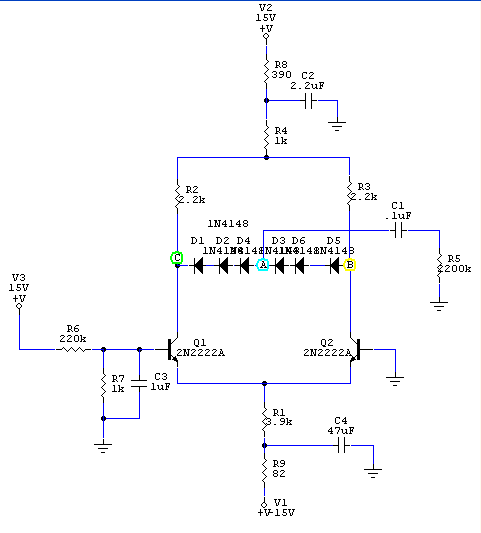
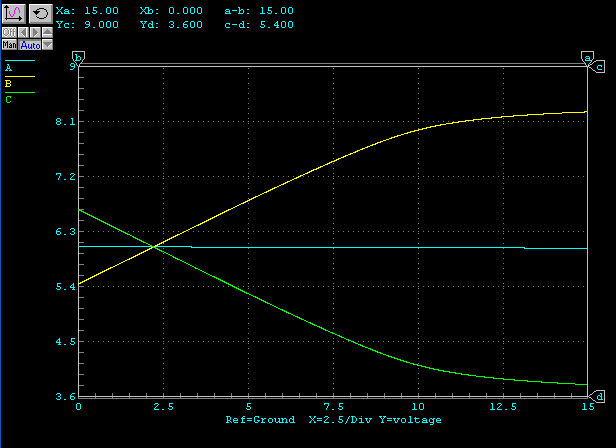
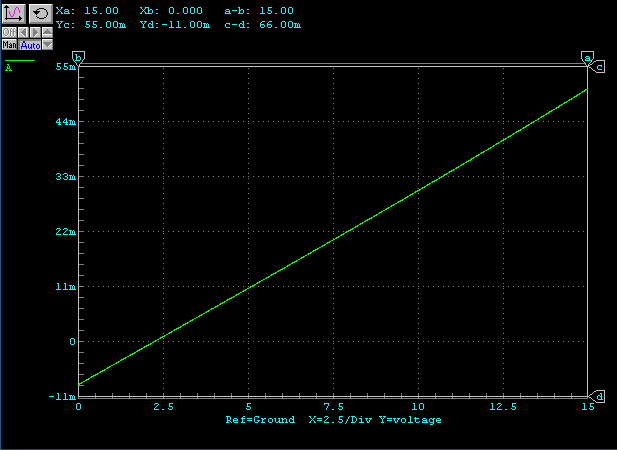
I ran a simulation of the biasing section only. The results matched
pretty well with my analysis on paper. here is some screen shots as the
voltage 'V3' (basically pot setting) is changed from 0V to +15V:

simulation circuit:
http://www.sdiy.org/destrukto/temp/steiner-biasing.gif

diode string voltage:
http://www.sdiy.org/destrukto/temp/steiner-biasing_plot.gif

left diff pair transistor base voltage:
http://www.sdiy.org/destrukto/temp/steiner-base_voltage_plot.gif

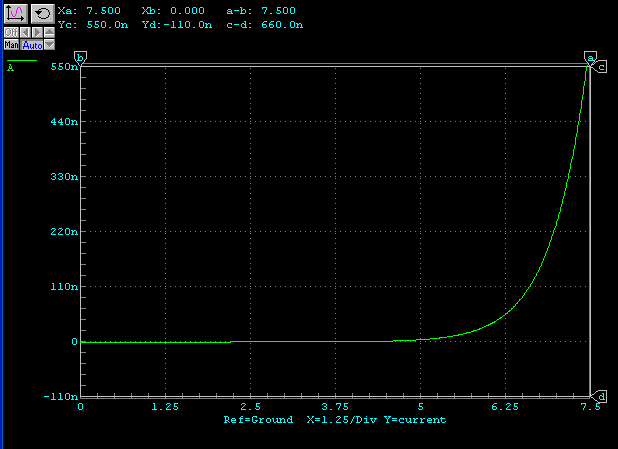
diode current (CV pot from 0 to +7.5V)
http://www.sdiy.org/destrukto/temp/steiner-diode_current.gif

that last plot shows the current through the diodes. only half the pot
range is used, because beyond that, the biasing is no longer linear,
which causes the diode current to no longer increase exponentially
(exponential is what we want). On the diode string voltage plot; You can
see the two voltage curves intersect, the point of intersection seems
fairly dependent on the transistors and thier matching. There is a part
where the diodes are not forward biased. My diode current plot shows
that it still behaves mostly exponentially in that range, but I don't
really understand how it does.

now, on to your results. I didn't think before, but you measuring could
effect the circuit behavior. not sure what the impedance of the volt
meter is. anyway, I think there still might be a problem here.

ken johnston wrote:
Show quoted textHide quoted text
> Near as I can tell those all check out fine. These are the readings I
> got on the meter w/common connected to ground:
>
> Left transistor collector: 7.04 to 7.32 (freq pot low to high)
> Left transistor emitter: -.64
> Left transistor base: -22.6 to -.33

the left transistor base doesn't seem right. the pot should go from 0V
to +15V. My simulation shows that at 0V, the base voltage will be
slightly negative, but for most of the pot range, it won't be. the
collector voltage should be decreasing as the pot in increased.

>
> Right transistor collector: 5.60 to 5.80
> Right transistor emitter: -.64

this collector current increases as it should, but I expect a much
larger change in the voltage. the emitter voltage looks good, so your
transistors are turned on.

> Center diode string: 4.86 to 5.06

a little lower than I expect, but possibly there is a reason for that.
maybe the volt meter effects it?

ok, so make sure your CV pot is connected correctly (0V and +15v), and
make sure the voltage at the pot wiper goes from 0 to 15v. sure that
sound obvious, but I would double check it.

I'll try to think of other possible problems, nothing comes to mind
right now, but I'll think about it.

-ryan

Re: steiner filter flummox

2005-12-10 by sasami@hotkey.net.au

Are you using metal can or plastic transistors? If plastic, they may be in
backwards.

As for the surge when you power down. It means absolutely nothing - the
whole circuit is "unstable" at the point and anything could be happening.

Ken
_______________________________________________________________________
Ken Stone sasami@... or sasami@...
Modular Synth PCBs for sale <http://www.blaze.net.au/~sasami/synth/>
Australian Miniature Horses & Ponies <http://www.blaze.net.au/~sasami/>

Re: steiner filter flummox

2005-12-11 by ken johnston

Plastic. I tried reversing them earlier - I'll give it another shot,
more scientifically this time around. They are currently in following
the generic pinout for these types.

Rats, no hope in surges.

I haven't yet had a chance to check out Ryan William's second
suggestions. I play with it later today...

Thanks again.

sasami@... wrote:
Show quoted textHide quoted text
> Are you using metal can or plastic transistors? If plastic, they may be in
> backwards.
>
> As for the surge when you power down. It means absolutely nothing - the
> whole circuit is "unstable" at the point and anything could be happening.
>
> Ken
> _______________________________________________________________________
> Ken Stone sasami@... or sasami@...
> Modular Synth PCBs for sale <http://www.blaze.net.au/~sasami/synth/
> <http://www.blaze.net.au/%7Esasami/synth/>>
> Australian Miniature Horses & Ponies <http://www.blaze.net.au/~sasami/
> <http://www.blaze.net.au/%7Esasami/>>
>
>


[Non-text portions of this message have been removed]

Re: steiner filter flummox

2005-12-11 by ken johnston

I won't hold it against you if you (or anybody else here) is wrong. This
helps tremendously towards my understanding of these circuits.

The voltage at the freq wiper goes from 0 to +15.

Otherwise the BCE readings are the same as previously. Sigh.

ryan williams wrote:
Show quoted textHide quoted text
> Hi,
>
> please, note that I could be wrong about any of this, but if I had this
> problem, this is what I would be doing. I know troubleshooting is
> frustrating. Reccently, I spent a week searching a filter circuit for a
> very simple problem.
>
> I think we should look at this area a bit more. The reason, is that you
> get sort of the opposite results that I expect. If you are measuring
> left and right transistor as shown in the schematic, then the right side
> should be at a higher voltage than the left side as the pot is
> increased, for atleast most of the pot range. At minimum pot position,
> the left side might be a little higher than the right, depending on
> transistor matching. The diodes go from the right side to the left, to
> forward bias them, the voltage on the right has to be greater. This
> allows an adjustable current flow through the diodes, which causes them
> to act like variable resistors.
>
> I ran a simulation of the biasing section only. The results matched
> pretty well with my analysis on paper. here is some screen shots as the
> voltage 'V3' (basically pot setting) is changed from 0V to +15V:
>
> simulation circuit:
> http://www.sdiy.org/destrukto/temp/steiner-biasing.gif
>
> diode string voltage:
> http://www.sdiy.org/destrukto/temp/steiner-biasing_plot.gif
>
> left diff pair transistor base voltage:
> http://www.sdiy.org/destrukto/temp/steiner-base_voltage_plot.gif
>
> diode current (CV pot from 0 to +7.5V)
> http://www.sdiy.org/destrukto/temp/steiner-diode_current.gif
>
> that last plot shows the current through the diodes. only half the pot
> range is used, because beyond that, the biasing is no longer linear,
> which causes the diode current to no longer increase exponentially
> (exponential is what we want). On the diode string voltage plot; You can
> see the two voltage curves intersect, the point of intersection seems
> fairly dependent on the transistors and thier matching. There is a part
> where the diodes are not forward biased. My diode current plot shows
> that it still behaves mostly exponentially in that range, but I don't
> really understand how it does.
>
> now, on to your results. I didn't think before, but you measuring could
> effect the circuit behavior. not sure what the impedance of the volt
> meter is. anyway, I think there still might be a problem here.
>
> ken johnston wrote:
> > Near as I can tell those all check out fine. These are the readings I
> > got on the meter w/common connected to ground:
> >
> > Left transistor collector: 7.04 to 7.32 (freq pot low to high)
> > Left transistor emitter: -.64
> > Left transistor base: -22.6 to -.33
>
> the left transistor base doesn't seem right. the pot should go from 0V
> to +15V. My simulation shows that at 0V, the base voltage will be
> slightly negative, but for most of the pot range, it won't be. the
> collector voltage should be decreasing as the pot in increased.
>
> >
> > Right transistor collector: 5.60 to 5.80
> > Right transistor emitter: -.64
>
> this collector current increases as it should, but I expect a much
> larger change in the voltage. the emitter voltage looks good, so your
> transistors are turned on.
>
> > Center diode string: 4.86 to 5.06
>
> a little lower than I expect, but possibly there is a reason for that.
> maybe the volt meter effects it?
>
> ok, so make sure your CV pot is connected correctly (0V and +15v), and
> make sure the voltage at the pot wiper goes from 0 to 15v. sure that
> sound obvious, but I would double check it.
>
> I'll try to think of other possible problems, nothing comes to mind
> right now, but I'll think about it.
>
> -ryan


[Non-text portions of this message have been removed]

Move to quarantaine

This moves the raw source file on disk only. The archive index is not changed automatically, so you still need to run a manual refresh afterward.