hey,

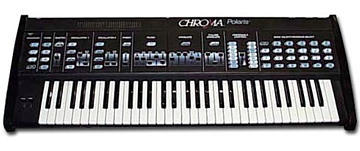
im a touring musician and i like the sound of the chroma polaris.  i
recently purchased one off ebay only to find out that there seems to
be reliabiliy issues with the buttons.  i was wondering if you
thought it was a bad idea to take a polaris on tour, and if so what
other synth you would recommend.  thanks.

-justin
--- In chromapolaris@yahoogroups.com, "bkuris" <benjamin.kuris@h...>
wrote:
>
> I wanted to report that I sucessfully replaced the membrane
buttons
> on one of my CPs with panel mounted push buttons.  I expect that
> keyboard (which also has this replaced DAC and new s/h caps) to
run
> until the EPROMS fail.
>
> The whole proceedure took at least 14hrs and should be done only
as a
> least resort for cases of damaged flex wires, or when you discover
> that the actual switch membrane has worn out.  Sooner or later the
> control panels will fail on most CPs-- here is how you fix them:
>
> 1) Remove control panel PCBs (Chroma Polaris must be open see
service
> manual).  Cut off or tape down the flex ribbon.
>
> 2) Drill holes for every button.  I recommend using the upper
right
> corner to preserve as much text as possible.  I drilled from the
> outside in, several of the labels (eg. "A") ripped free, but I
glued
> them back down.  Use a large bit to clean the hole on the backside
to
> provide a flush or bevelled edge for the switches.
>
> 2) Switches.  You will need around 60 and the best deal I found
was
> at www.all-electronics.com for surplus sub-miniature SPDTs.
Solder
> leads will be very helpful (there are about 140 wires that need to
be
> soldered so anything helps!).  I bend the leads prior to mounting
so
> have as much clearance as possible.
>
> 3a) There was still a clearance problem with many buttons hitting
a
> half dozen or so ICs on the control panel.  I solved this by
removing
> the offending ICs, desoldering the sockets (requires decent
soldering
> skills), and then soldering them back down.  I was able to just
bend
> the PCB to make up the remaining difference.
>
> 3b) (optional) desolder old flex connectors
>
> 4) Put the PCBs away for a while.  Print out the last few pages of
> the service manual with the button wiring chart.  I color
highlighted
> to save time.  wwww.rhodeschroma.com is hosting the service manual.
>
> 5) I used 2 different colors of thin solid-core wire (eg. wire
wrap
> wire).  One for strobes, one for switch signals.  Wire them all
up,
> it will take a very long time, be careful with how you run the
wires,
> try to bend into right angles and run them against the panel to
keep
> things neat.
> 6) Don't forget to add a wires that will eventually get solder to
the
> PCBs and *label them*.  If you look at where they will be going,
the
> switches you should use as the source of these wires will be
> obvious.  Remember that STB0-STB2 go to a different place then the
SW
> lines.
>
> 7) install PCBS and solder the STB and SW lines.  Test it all out--

> good luck.  I'm a skilled tech and I had 1 bad solder joint out of
> the nearly 200 solder joints but its easy to use a multimeter to
> troubleshoot as long as you don't scramble up the connection
diagram
> (in which case the LEDs will provide some clue).
>
> I will post a picture eventually...
> Due to the time this proceedure takes, I don't think it is
feasible
> to pay someone to do it for you as it would cost at least $400
which
> is close to the price of a used Polaris.  I would charge $500
(more
> if it needs to be done in less then a month).  Another option is
to
> have PCBs manufactured, but that also means machining a new panel
so
> that switches line up.  Given the size of the panel and expected
> volume, it would probably also end up in the $500 range.  A final
> option is to use MIDI which has performance disadvantages.
>
> -Ben
Message
Re: Panel repair
2005-06-24 by jhawky8
Attachments
- No local attachments were found for this message.