Apple loops can be useful, but so far I've had a lot of trouble using them.

I might add that my main Logic computer (iBook G4, 256 MB RAM, 1GHz, 30GB HD) has
just been fitted with a new logic board (no pun intended) and new battery, so I'm out of a
machine until I pick it up tomorrow.  I apologize in advance if this seems vague...

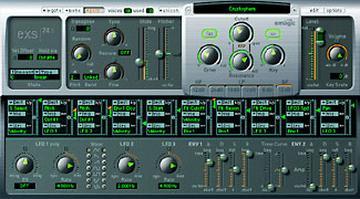
If you MUST use tempo-synced loops (like Apple Loops) in EXS24, you might also load the
sample in question into the editor and use the time/pitch function to adjust it to the
tempo you want.  I would then suggest creating a new EXS24 instrument and assign that
sample to whatever note you want.

My usual approach involves taking loops from other software instruments, usually
Cameleon5000, FM7, or Logic's ES2, and only sampling the few notes I really need at
whatever tempo.  Sometimes, especially if layering with existing samples, I'll bounce all
instruments/loops to a single file and assign it to an EXS24 instrument--it keeps the
above-spec'ed laptop from frequent crashes, a not uncommon peril when running
CA5000.

The disadvantages are fairly obvious, I think.  This only works at a set, continuous tempo.
Change the tempo, and the samples are immediately out-of-sync.  You also are restricted
to only the notes you want to use since otherwise means the tempo will speed up/slow
down as you move away from the original pitch and thus bring your loops out-of-sync
with Logic's tempo.  If you are pretty sure about what you are doing in a song, using
EXS24 as a loop player can be your best bet.  Otherwise, it's pretty inflexible and may
actually be inconvenient for some people.

I've only used pre-existing loops in one big project.  In that case, I copied that audio file
from an EXS24 instrument, adjusted it to the correct tempo, and simply inserted it into an
audio track where I could loop it to my heart's delight.  For the most part, I try to keep my
stuff in the sampler.
Message
Re: Samples in ESX to be in song tempo ??
2007-07-03 by angelrho202
Attachments
- No local attachments were found for this message.