From: Matt Miller <mandcmiller@...>:

>> I'm having problems programming attack via velocity settings for
>> creating realistic snare drum grace notes and buzz rolls.. ..I've tried
>> a whole bunch of different snare samples and even multi-samples using
>> different velocity ranges but to no avail.. ..Any suuggestions?

From: Sascha Franck <saschafranck@...>:

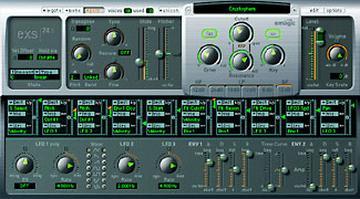
> You could try the velocity to attack function of the EXS's amp ADSR.
> In case you only need it for snares, setup some ADSR offset in all other
> groups. Very light settings should do a good job. However, a great method
> to usually achieve such an effect is to alter the sample start as well,
> following your velocity. Unfortunately the EXS only has that as a global
> option and you usually don't want cymbal samples to have a later start...

Hi guys -

I agree, though with EXS the best results I've gotten are with
velocity->Attack Time rather than with velocity->Sample Start.. EXS's v->SS
parameter is a bit tweaky IMO because it's based on percentage of total
sample length with no option for a setting in actual milliseconds, so a
value that might work on one sample would be unrelated to what might work
on another sample (unless all your snare samples are the same length),
requiring a lot more trial and error if you do a lot of programming. In
general though, I've never found that v->SS worked as well for me (on
drums) as envelope modulation, even on other samplers..

With EXS, I usually get ok results on various instruments with v->AT at
about 15-20 ms to soften up a loud sample's attack transient decently for
lower velocity notes. With kick and toms, a little v->Filer Cutoff also
helps, but filter is no good for snare (or cymbals). With a loud snare
sample, v->AT at about 30-60 ms allowed for a sort-of press roll effect at
lower velocities (assuming the sample is really a pure snare hit, with no
rimshot component, that should be a separate sample either on a separate
key or velocity-switched). It wasn't great but certainly much better than
without it, and much smoother for swells and dynamic builds than
v->sample-switching.

In general, the method I've found that works best is to set attack time to
about 20-40 ms (with a linear or curved slope), and then apply velocity to
envelope _amount_  with a _negative_ logic, ie the envelope is applied with
the greatest depth at the lowest velocities and less at higher velocities.
This is similar to v->AT, but gives you better control and allows you to
soften the attack a _lot_ more without slowing down the response of the
sound (ie without making very-low-velocity notes sound like they're "fading
in"). Using somewhat longer attack time settings and greater depths on
snare samples, you can get a very convincing soft-note sound for ghost
notes and press rolls. If the attack time setting only has a linear slope,
then a multi-stage envelope would be preferred.

This approach really works _very_ well, and has the added bonus of cutting
down on RAM usage (you really only need "loud" samples, the v->Env
transient control (along with v->Filter when appropriate) can do an
excellent job of creating realistic soft hits, with smooth playing
dynamics. Unfortunately, though EXS does have v->Filter Envelope Amount, it
doesn't have any way for velocity to modulate Amplitude Envelope Amount
(depth of transient control), and even if it did, the exact envelope and
"depth" settings would have to be different for each different drum and
cymbal in a kit, which would require more than the ADSR offsets per-group
provided; a multitimbral (ie 16-channel) EXS could do it, if they add the
appropriate controls (suitable envelope modulation routings are, I think,
already implemented in ES2, though multi-stage user-defined envelopes ala
Kontakt would be much better).

Anyway, I've been hoping for a long time that Emagic will boost EXS's power
in these (and other) ways, so I can transfer some of my drumkits from K2500
to it with all the playability intact.. I guess I'm not the only one..  ;-)

Cheers,
Joe Albano
ROOFTOP PRODUCTIONS
NYC, NY
Message
Re: Realistic HiHat Tip
2002-11-01 by Joe Albano
Attachments
- No local attachments were found for this message.