Re: [EXS] Newbie question: Thrown by zones
2005-11-02 by Sascha Franck
Mark Bradford wrote:
> I'm trying to figure out how to set up a drum kit by replacing samples
> in a factory kit (Rock Kit) with samples from my Alesis DM5. I'm
> discovering, for example, that there are 16 (!) zones dedicated to the
> same kick sample.

That's not all that unusual for a detailed sampled drum kit.
What's confusing me is that you are saying the "same" sample is used for 16 zones. Are you absolutely sure? Unless you wanted
something like, say, a different tuning on different velocity zones that'd just make close to no sense.
Or are you only saying the kick is using 16 zones (each loading a different sample)? In that case, as said, it'd be nothing special.

> When I replace the kick sample in Zone 1, my new
> sample only plays at the highest velocity. So I obviously need to
> change the sample in each zone that points to the kick group. Having
> only used outboard drum machines and modules in the past, this seems
> overly laborious to me.

Well. It all depends on the samples you plan to use. Have your kick sampled at 5 velocities? Fine, use 5 zones. Only have one kick
sample? Fine again, use 1 zone and set the velocity range parameter to respond from 0 to 127.

> Is this the only way to achieve velocity sensitivity in a sampler
> instrument, by having that many zones that point to one group?

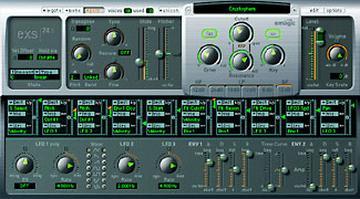
No. The main velocity response of an instrument is defined straight on the EXS GUI. The slider almost all the way at the right is
defining the velocity to output volume response, the lower half being responsible for the volume at lowest velocity, the upper half
being responsible for the volume at highest velocity. Drag them all the way up/down and you'll get maximum velocity response, put
both "halfs" at one value and you'll get no velocity response.

Now, in some samplesets (and drums might be a good example), different volumes are achieved by using samples of different levels,
all stacked in multi-velocity zones. In that scenario, when you hit something with low velocity, a sample with low output volume
will be selected (as defined in the velocity range for the used zones).
In such a case it might make less sense to use the aforementioned velocity slider in addition, as the sample switching would
allready do the job.
If you however have less (or only one sample) per key, you may want to use the velocity slider for a more realistically sounding
patch.
Oh well, and there's further methods to add to the realism when using few samples only, such as setting up some velocity to
samplestart modulation. That way, on lower velocities the first attack of the samples would be left out, quite a useful trick for
drums.

Hope that helps a bit,
Sascha