At 08:57 AM 5/23/2006, you wrote:

> > However, you're asking whether a hard drive is a substitute for RAM
> > access, and it clearly isn't. If EXS forces OS X to start pretending
> > the hard drive is a RAM buffer for loading sample starts, you're
> > going to get crashes while the machine swaps that data into RAM.

>understood. Just wondering why a dual G5 1.8 with only 512M Ram (it
>was a store loaner) was able to run tons of EXS with so little
>RAM...and no audio glitching. OSX was obviously in a low RAM
>situation...

Nick's overview was absolutely excellent, let me add a response...

It's all about efficiency.

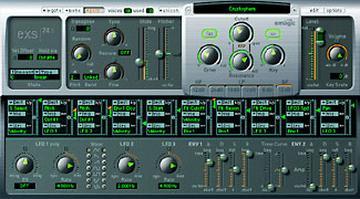
The over-simplistic/basic concept of the EXS's playback (and
basically all "streaming" samplers) is that the first part of the
sound is loaded into memory, thus creating as small as possible
memory footprint for the instrument. Since memory is instantly
accessible, your initial sounds can be played. The program is
continually checking if it needs to load stuff off disk if the
playing "threatens" accessing sound data that isn't in memory yet.
Also, the program may elect to dump things out that were loaded
post-load that hadn't been accessed for awhile.

It's not that different than when RealPlayer first came out and you'd
constantly look at that little "buffer meter" and you could see when
RP would have to download more data off the Net, or even have to stop
playback because it didn't have the data yet.

Think of a non-streaming sampler like Reason NN-XT and think of the
memory that never gets used, or even the memory that isn't used in
2-3 seconds of time and you see how inefficient that is.

The ultimate sampler would always have the sound data in RAM that's
needed for playback AT THAT MOMENT and ONLY that data. How many mb's
of data is actually being sounded at any particular time? Perhaps
only 5mb per second, on average, I don't really know, but it can't be
too huge. Certainly not even close to 32mb.

It's efficiency that is the crucial thing, not the sheer amount of
memory. Lots of memory just covers high stress situations and
less-then optimally efficient samplers. You can have a 5-lane
freeway, but they get completely jammed when there's cars driving in
parallel at 45mph.

So, regarding the 1.8 dual with 512mb, perhaps that it was playing
was efficient - no piano sprawls with pedal, spread out sparse
orchestrations, and of course the efficiency of EXS24 in general.

Garth Hjelte
Sampler User