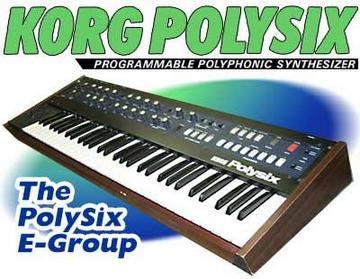
Discussion about the Korg PolySix synthesizer group photo

Yahoo Groups archive

Discussion about the Korg PolySix synthesizer

Index last updated: 2026-04-28 23:40 UTC

Thread

Polysix pricing getting out of hand?

Polysix pricing getting out of hand?

2010-04-24 by rob_ocelot

I've noticed a disturbing trend on Craigslist and ebay lately.  The asking prices for a working Polysix have skyrocketed to the point where it's starting to make the Jupiter 6 an alternative option.

So far the most outrageous price I've seen is $1200 for a nice looking Polysix with synthwood replacement case (perhaps $200 extra?  I've never priced out a synthwood case).  Another example was $1050 for a good condition P6 with the midi ARP clock add on (not real midi, and the kit is very inexpensive).  Average asking prices seem to be in the $500-1000 territory.

Are we seeing an adjustment of the P6 price based on the number of surviving units after the battery massacres and lack of general interest in Analogs during the 90's?  Are we starting to see an appreciation for the P6 sound after years and years of Junos getting all the attention?  Are we starting to see a price escalation like the TB-303 because because of collectors and speculators?  Is the KLM 367 revival project and a good solution to the keyboard contact problem echoing the solution to the Juno 106 chip problems last year?  Could it be that because every other analog seems to be going through the roof the overlooked ones are getting their due (if so, shouldn't the JX-3P, AKAI AX's, Kawai SX's and SCI Sixtrak be getting some love too?).  Maybe all of these factors are contributing in some way.

All I know is that it wasn't too long ago when P6's were like hot potatoes.  People didn't want them and in some cases gave them away for cheap or free.  Not to mention the number of heavily abused units I've seen.  We all know how easily the P6 is to cosmetically damage (those darn laminated wood sides) but I've seen some that were so trashed the only way I knew it was P6 was because of the power cord wraps on the back panel.  Remember when Johann's full midi option was considered too expensive because it was 3x the price of a P6 (and at that point you were better off with a Jupiter 6)?

I never thought I'd see the day when a Polysix was priced higher than a Mono/Poly.  Not bad for what was once called "Poor Man's Prophet 5".

Re: Polysix pricing getting out of hand?

2010-04-25 by psicraft_designs

I agree with you here - I have seen the value of 'core' Polysixes (i.e. damaged and neglected non-functional units) go from $100 up to $500 in some cases. 

Aside from the fact that vintage Analog Polys are trendy right now, the Polysix has become a holy grail synth for a lot of people because while it's hard to find one that's fully operational, there are lots of units available in 'fixer-upper' condition: The result is that many younger users don't actually know first-hand what a Polysix sounds like in person. Those of us who WERE teenagers back when the Polysix was released only think we remember how it sounds - And let's be honest, nostalgia works wonders for those memories. Ever go back and hear an obscure song you loved as a kid for its brilliant composition, meaningful lyrics and excellent production for the very first time in decades only to discover that it's ... well ... kinda crap to your adult ears? Because most Polysixes we encounter are broken, the nostalgia can live on... That is until we fix what is broken, which brings me to the single most powerful reason Polysix prices are still climbing... I call it 'The Old Crow Effect'. ;-)

Before I say anything - Don't get me wrong: I think the Old Crow is a great man for sharing his Polysix rebuilding secrets with the world - That website is almost certainly the reason I took an interest in the Polysix again (My first synth was a Mono/Poly and I really wanted a Polysix to go with it). When I saw Old Crow's site instructions for resurrecting a battery damaged polysix, that was it - I had to try it for myself and a new hobby project was born. I could almost hear Magnus Pyke yelling 'Science!' as I dusted off all my soldering and circuit repair tools: It was great! Not only was I going to get to be all Bob Moog-like (in my mind) and rebuild a synth from scrap, I was going to finally get that Polysix I missed out on when I was a teenager, and it was going to be cheap! Or so I thought at the time... :)

The first Polysix core I got on eBay cost me $278, and boy... it was a CORE: Only fit for salvage, not repair. Back to eBay I went and grabbed another one for $250. This one was a lot better: It was in much nicer shape but had already been 'Old Crowed' by the seller... Uh oh... I've been an ELP fan for many years but never knew the meaning of 'Brain Salad Surgery' until I opened the lid on that Polysix... The battery damage was minor compared to what had been done since then by the valiant ex-owner. Just to be safe, I hit ebay again and ordered another core for the bargain price of $150. Unfortunately this one popped out of existence while in the FedEx system and since they had no trace of it (it was lost, after all) I was eventually told to forget about it and any renumeration in a letter from FedEx several months later... My advice to you should you choose to ship a synth in the USA? USPS, friends.

The point I am making by relating all this is a simple truth known to all home improvement, hobbycraft and sewing supply shop owners: Doing it yourself is FAR more expensive than just buying new. When your granny knits you a fabulous sweater, the whole materials cost to her is likely to be many times the cost of a factory made sweater... If you factor in gran's time at your local legal minimum wage you'd probably find it retailing at $600, so remember to thank her profusely even if orange and green stripes aren't your bag.

Anyhow, the Old Crow effect applies to the market like this:

1. Core Polysixes are now fought over by people from all around the world, each of them cheered on by a local copy of Magnus Pyke (or Tim the Tool Man Tailor if they are a tougher breed of musician). This drives up the price for a wrecked unit on eBay - 'Just imagine how coveted and expensive a WORKING one would be?' think the bystanders and bidders who fail to win the battle royale for the broken old box.

2. When someone successfully completes their rebuilding project they fire up the unit in triumph and go... "Yeahhhhhh!!!! ummmm....Meh. Sounds cool, but is it really what I need for my music?" For those who decide 'no', eBay comes back into play... Only this time the seller wants to recoup their investment in parts and labor, so the starting bid is set to $700 or more.

3. Meanwhile, for every victory story there are many other would-be synth builders who have learned to their dismay that Magnus Pyke is actually lousy with a soldering iron, and that a new Dremel tool's main feature is that it can grind/saw/chew up things extremely fast. They try avoiding the room with the Polysix corpse in it for a few months and eventually decide it's time to hit eBay and cash in on the growing demand for Polysix cores... Return to step 1 of the cycle, only this time it's listed as 'reconditioned but non-functional' with the appropriate bump in starting price.

Now, if you thought the 'Old Crow' effect was something to behold, just wait till you see the 'HyperJed-Jury' effect hit the market... :) :) :)

... I'll save those predictions for another post. In the meantime I'll sign off with an encouraging yell of "Science!"

Cheers,

Tony

--- In PolySix@yahoogroups.com, "rob_ocelot" <rob.ocelot@...> wrote:
Show quoted textHide quoted text
>
> I've noticed a disturbing trend on Craigslist and ebay lately.  The asking prices for a working Polysix have skyrocketed to the point where it's starting to make the Jupiter 6 an alternative option.
> 
> So far the most outrageous price I've seen is $1200 for a nice looking Polysix with synthwood replacement case (perhaps $200 extra?  I've never priced out a synthwood case).  Another example was $1050 for a good condition P6 with the midi ARP clock add on (not real midi, and the kit is very inexpensive).  Average asking prices seem to be in the $500-1000 territory.
> 
> Are we seeing an adjustment of the P6 price based on the number of surviving units after the battery massacres and lack of general interest in Analogs during the 90's?  Are we starting to see an appreciation for the P6 sound after years and years of Junos getting all the attention?  Are we starting to see a price escalation like the TB-303 because because of collectors and speculators?  Is the KLM 367 revival project and a good solution to the keyboard contact problem echoing the solution to the Juno 106 chip problems last year?  Could it be that because every other analog seems to be going through the roof the overlooked ones are getting their due (if so, shouldn't the JX-3P, AKAI AX's, Kawai SX's and SCI Sixtrak be getting some love too?).  Maybe all of these factors are contributing in some way.
> 
> All I know is that it wasn't too long ago when P6's were like hot potatoes.  People didn't want them and in some cases gave them away for cheap or free.  Not to mention the number of heavily abused units I've seen.  We all know how easily the P6 is to cosmetically damage (those darn laminated wood sides) but I've seen some that were so trashed the only way I knew it was P6 was because of the power cord wraps on the back panel.  Remember when Johann's full midi option was considered too expensive because it was 3x the price of a P6 (and at that point you were better off with a Jupiter 6)?
> 
> I never thought I'd see the day when a Polysix was priced higher than a Mono/Poly.  Not bad for what was once called "Poor Man's Prophet 5".
>

Re: Polysix pricing getting out of hand?

2010-04-25 by kb_cheapmods

I think it will be interesting to see the effect of the Hyperjed KLM367 update, but I wonder if it will drive prices up or stabilize them?

I'm the guy who posted the Juno-106 acetone fix on Youtube last year (and once again, all credit to synth technician ramcur for sharing that trick with me).   After I posted it, I wondered:

1. what the general response would be, since the 80017a issue was becoming a serious handicap for aging 106's.

2. how it would affect 106 resale prices.

On the first item, I think the trick has saved a lot of 106's so I'm happy that's happening.  On the second item, though, I don't think 106 prices have changed all that much since I posted it.  It seemed maybe you could get a bargain from sellers who knew that their 106 had a bad voice; maybe now those bargains have dried up because there's a cheap DIY fix that could rescue the synth.

On the Hyperjed P6 fix, it may be that there could be no effect on price?  Either way, it's a lot of effort, as Tony describes, to get the p6 back up and running:  that time is either redoing traces and debugging OR stuffing the new KLM367a.  I'd much rather do the latter, since you end up with a reliable, nearly new motherboard in the end, but it still took a few evenings with the soldering iron.

and I agree with Tony:  _ALL_ vintage analog synths are going up in price now.  I think one reason p6 and 106s have led the way is they have knobby interfaces, where the Kawai SX, Roland JX, Sixtrak, etc are single-knob/slider UI's.  If this is true, then I guess the Akai AX-60 would be next synth to elevate in price...


--- In PolySix@yahoogroups.com, "psicraft_designs" <tony@...> wrote:
Show quoted textHide quoted text
>
> 
> 
> I agree with you here - I have seen the value of 'core' Polysixes (i.e. damaged and neglected non-functional units) go from $100 up to $500 in some cases. 
> 
> Aside from the fact that vintage Analog Polys are trendy right now, the Polysix has become a holy grail synth for a lot of people because while it's hard to find one that's fully operational, there are lots of units available in 'fixer-upper' condition: The result is that many younger users don't actually know first-hand what a Polysix sounds like in person. Those of us who WERE teenagers back when the Polysix was released only think we remember how it sounds - And let's be honest, nostalgia works wonders for those memories. Ever go back and hear an obscure song you loved as a kid for its brilliant composition, meaningful lyrics and excellent production for the very first time in decades only to discover that it's ... well ... kinda crap to your adult ears? Because most Polysixes we encounter are broken, the nostalgia can live on... That is until we fix what is broken, which brings me to the single most powerful reason Polysix prices are still climbing... I call it 'The Old Crow Effect'. ;-)
> 
> Before I say anything - Don't get me wrong: I think the Old Crow is a great man for sharing his Polysix rebuilding secrets with the world - That website is almost certainly the reason I took an interest in the Polysix again (My first synth was a Mono/Poly and I really wanted a Polysix to go with it). When I saw Old Crow's site instructions for resurrecting a battery damaged polysix, that was it - I had to try it for myself and a new hobby project was born. I could almost hear Magnus Pyke yelling 'Science!' as I dusted off all my soldering and circuit repair tools: It was great! Not only was I going to get to be all Bob Moog-like (in my mind) and rebuild a synth from scrap, I was going to finally get that Polysix I missed out on when I was a teenager, and it was going to be cheap! Or so I thought at the time... :)
> 
> The first Polysix core I got on eBay cost me $278, and boy... it was a CORE: Only fit for salvage, not repair. Back to eBay I went and grabbed another one for $250. This one was a lot better: It was in much nicer shape but had already been 'Old Crowed' by the seller... Uh oh... I've been an ELP fan for many years but never knew the meaning of 'Brain Salad Surgery' until I opened the lid on that Polysix... The battery damage was minor compared to what had been done since then by the valiant ex-owner. Just to be safe, I hit ebay again and ordered another core for the bargain price of $150. Unfortunately this one popped out of existence while in the FedEx system and since they had no trace of it (it was lost, after all) I was eventually told to forget about it and any renumeration in a letter from FedEx several months later... My advice to you should you choose to ship a synth in the USA? USPS, friends.
> 
> The point I am making by relating all this is a simple truth known to all home improvement, hobbycraft and sewing supply shop owners: Doing it yourself is FAR more expensive than just buying new. When your granny knits you a fabulous sweater, the whole materials cost to her is likely to be many times the cost of a factory made sweater... If you factor in gran's time at your local legal minimum wage you'd probably find it retailing at $600, so remember to thank her profusely even if orange and green stripes aren't your bag.
> 
> Anyhow, the Old Crow effect applies to the market like this:
> 
> 1. Core Polysixes are now fought over by people from all around the world, each of them cheered on by a local copy of Magnus Pyke (or Tim the Tool Man Tailor if they are a tougher breed of musician). This drives up the price for a wrecked unit on eBay - 'Just imagine how coveted and expensive a WORKING one would be?' think the bystanders and bidders who fail to win the battle royale for the broken old box.
> 
> 2. When someone successfully completes their rebuilding project they fire up the unit in triumph and go... "Yeahhhhhh!!!! ummmm....Meh. Sounds cool, but is it really what I need for my music?" For those who decide 'no', eBay comes back into play... Only this time the seller wants to recoup their investment in parts and labor, so the starting bid is set to $700 or more.
> 
> 3. Meanwhile, for every victory story there are many other would-be synth builders who have learned to their dismay that Magnus Pyke is actually lousy with a soldering iron, and that a new Dremel tool's main feature is that it can grind/saw/chew up things extremely fast. They try avoiding the room with the Polysix corpse in it for a few months and eventually decide it's time to hit eBay and cash in on the growing demand for Polysix cores... Return to step 1 of the cycle, only this time it's listed as 'reconditioned but non-functional' with the appropriate bump in starting price.
> 
> Now, if you thought the 'Old Crow' effect was something to behold, just wait till you see the 'HyperJed-Jury' effect hit the market... :) :) :)
> 
> ... I'll save those predictions for another post. In the meantime I'll sign off with an encouraging yell of "Science!"
> 
> Cheers,
> 
> Tony
> 
> --- In PolySix@yahoogroups.com, "rob_ocelot" <rob.ocelot@> wrote:
> >
> > I've noticed a disturbing trend on Craigslist and ebay lately.  The asking prices for a working Polysix have skyrocketed to the point where it's starting to make the Jupiter 6 an alternative option.
> > 
> > So far the most outrageous price I've seen is $1200 for a nice looking Polysix with synthwood replacement case (perhaps $200 extra?  I've never priced out a synthwood case).  Another example was $1050 for a good condition P6 with the midi ARP clock add on (not real midi, and the kit is very inexpensive).  Average asking prices seem to be in the $500-1000 territory.
> > 
> > Are we seeing an adjustment of the P6 price based on the number of surviving units after the battery massacres and lack of general interest in Analogs during the 90's?  Are we starting to see an appreciation for the P6 sound after years and years of Junos getting all the attention?  Are we starting to see a price escalation like the TB-303 because because of collectors and speculators?  Is the KLM 367 revival project and a good solution to the keyboard contact problem echoing the solution to the Juno 106 chip problems last year?  Could it be that because every other analog seems to be going through the roof the overlooked ones are getting their due (if so, shouldn't the JX-3P, AKAI AX's, Kawai SX's and SCI Sixtrak be getting some love too?).  Maybe all of these factors are contributing in some way.
> > 
> > All I know is that it wasn't too long ago when P6's were like hot potatoes.  People didn't want them and in some cases gave them away for cheap or free.  Not to mention the number of heavily abused units I've seen.  We all know how easily the P6 is to cosmetically damage (those darn laminated wood sides) but I've seen some that were so trashed the only way I knew it was P6 was because of the power cord wraps on the back panel.  Remember when Johann's full midi option was considered too expensive because it was 3x the price of a P6 (and at that point you were better off with a Jupiter 6)?
> > 
> > I never thought I'd see the day when a Polysix was priced higher than a Mono/Poly.  Not bad for what was once called "Poor Man's Prophet 5".
> >
>

Re: Polysix pricing getting out of hand?

2010-04-25 by psicraft_designs

Hi Kerry,

What a distinct pleasure it is to actually have a chance to thank you in person! You and Ramcur are also heroes along with the Old Crow, Jed and Andrew as far as I am concerned: The acetone fix for conductive JX-3P/MKS-30/Juno-106 voice chips was a breakthrough sharing of vintage synth-tech know how. Actually, I think you single-handedly stopped Junos and other Roland classics from being 'binned' like the poor Polysix was for so many years - Imagine how tragic it would be to see Junos and their brethren broken and covered in dust, mold and fungus like so many of the Polysixes we have seen offered on eBay these last few years...

I am a little biased of course - I owned a Juno 106 from their release until 1992, and recently bought a MKS-30 with a bad voice and your fix totally worked to put it right. Thanks so much for sharing the wealth, as it were!

Here's a totally unrelated but coincidental fact for you: Roland's first products were electric organs marketed under the name 'Ace Tone' ... only the logo had the two words connected to spell 'Acetone'... How's that for mystical foreshadowing ;-)

Tony

--- In PolySix@yahoogroups.com, "kb_cheapmods" <kerrybradley@...> wrote:
Show quoted textHide quoted text
>
> 
> 
> I think it will be interesting to see the effect of the Hyperjed KLM367 update, but I wonder if it will drive prices up or stabilize them?
> 
> I'm the guy who posted the Juno-106 acetone fix on Youtube last year (and once again, all credit to synth technician ramcur for sharing that trick with me).   After I posted it, I wondered:
> 
> 1. what the general response would be, since the 80017a issue was becoming a serious handicap for aging 106's.
> 
> 2. how it would affect 106 resale prices.
> 
> On the first item, I think the trick has saved a lot of 106's so I'm happy that's happening.  On the second item, though, I don't think 106 prices have changed all that much since I posted it.  It seemed maybe you could get a bargain from sellers who knew that their 106 had a bad voice; maybe now those bargains have dried up because there's a cheap DIY fix that could rescue the synth.
> 
> On the Hyperjed P6 fix, it may be that there could be no effect on price?  Either way, it's a lot of effort, as Tony describes, to get the p6 back up and running:  that time is either redoing traces and debugging OR stuffing the new KLM367a.  I'd much rather do the latter, since you end up with a reliable, nearly new motherboard in the end, but it still took a few evenings with the soldering iron.
> 
> and I agree with Tony:  _ALL_ vintage analog synths are going up in price now.  I think one reason p6 and 106s have led the way is they have knobby interfaces, where the Kawai SX, Roland JX, Sixtrak, etc are single-knob/slider UI's.  If this is true, then I guess the Akai AX-60 would be next synth to elevate in price...
> 
> 
> 
> --- In PolySix@yahoogroups.com, "psicraft_designs" <tony@> wrote:
> >
> > 
> > 
> > I agree with you here - I have seen the value of 'core' Polysixes (i.e. damaged and neglected non-functional units) go from $100 up to $500 in some cases. 
> > 
> > Aside from the fact that vintage Analog Polys are trendy right now, the Polysix has become a holy grail synth for a lot of people because while it's hard to find one that's fully operational, there are lots of units available in 'fixer-upper' condition: The result is that many younger users don't actually know first-hand what a Polysix sounds like in person. Those of us who WERE teenagers back when the Polysix was released only think we remember how it sounds - And let's be honest, nostalgia works wonders for those memories. Ever go back and hear an obscure song you loved as a kid for its brilliant composition, meaningful lyrics and excellent production for the very first time in decades only to discover that it's ... well ... kinda crap to your adult ears? Because most Polysixes we encounter are broken, the nostalgia can live on... That is until we fix what is broken, which brings me to the single most powerful reason Polysix prices are still climbing... I call it 'The Old Crow Effect'. ;-)
> > 
> > Before I say anything - Don't get me wrong: I think the Old Crow is a great man for sharing his Polysix rebuilding secrets with the world - That website is almost certainly the reason I took an interest in the Polysix again (My first synth was a Mono/Poly and I really wanted a Polysix to go with it). When I saw Old Crow's site instructions for resurrecting a battery damaged polysix, that was it - I had to try it for myself and a new hobby project was born. I could almost hear Magnus Pyke yelling 'Science!' as I dusted off all my soldering and circuit repair tools: It was great! Not only was I going to get to be all Bob Moog-like (in my mind) and rebuild a synth from scrap, I was going to finally get that Polysix I missed out on when I was a teenager, and it was going to be cheap! Or so I thought at the time... :)
> > 
> > The first Polysix core I got on eBay cost me $278, and boy... it was a CORE: Only fit for salvage, not repair. Back to eBay I went and grabbed another one for $250. This one was a lot better: It was in much nicer shape but had already been 'Old Crowed' by the seller... Uh oh... I've been an ELP fan for many years but never knew the meaning of 'Brain Salad Surgery' until I opened the lid on that Polysix... The battery damage was minor compared to what had been done since then by the valiant ex-owner. Just to be safe, I hit ebay again and ordered another core for the bargain price of $150. Unfortunately this one popped out of existence while in the FedEx system and since they had no trace of it (it was lost, after all) I was eventually told to forget about it and any renumeration in a letter from FedEx several months later... My advice to you should you choose to ship a synth in the USA? USPS, friends.
> > 
> > The point I am making by relating all this is a simple truth known to all home improvement, hobbycraft and sewing supply shop owners: Doing it yourself is FAR more expensive than just buying new. When your granny knits you a fabulous sweater, the whole materials cost to her is likely to be many times the cost of a factory made sweater... If you factor in gran's time at your local legal minimum wage you'd probably find it retailing at $600, so remember to thank her profusely even if orange and green stripes aren't your bag.
> > 
> > Anyhow, the Old Crow effect applies to the market like this:
> > 
> > 1. Core Polysixes are now fought over by people from all around the world, each of them cheered on by a local copy of Magnus Pyke (or Tim the Tool Man Tailor if they are a tougher breed of musician). This drives up the price for a wrecked unit on eBay - 'Just imagine how coveted and expensive a WORKING one would be?' think the bystanders and bidders who fail to win the battle royale for the broken old box.
> > 
> > 2. When someone successfully completes their rebuilding project they fire up the unit in triumph and go... "Yeahhhhhh!!!! ummmm....Meh. Sounds cool, but is it really what I need for my music?" For those who decide 'no', eBay comes back into play... Only this time the seller wants to recoup their investment in parts and labor, so the starting bid is set to $700 or more.
> > 
> > 3. Meanwhile, for every victory story there are many other would-be synth builders who have learned to their dismay that Magnus Pyke is actually lousy with a soldering iron, and that a new Dremel tool's main feature is that it can grind/saw/chew up things extremely fast. They try avoiding the room with the Polysix corpse in it for a few months and eventually decide it's time to hit eBay and cash in on the growing demand for Polysix cores... Return to step 1 of the cycle, only this time it's listed as 'reconditioned but non-functional' with the appropriate bump in starting price.
> > 
> > Now, if you thought the 'Old Crow' effect was something to behold, just wait till you see the 'HyperJed-Jury' effect hit the market... :) :) :)
> > 
> > ... I'll save those predictions for another post. In the meantime I'll sign off with an encouraging yell of "Science!"
> > 
> > Cheers,
> > 
> > Tony
> > 
> > --- In PolySix@yahoogroups.com, "rob_ocelot" <rob.ocelot@> wrote:
> > >
> > > I've noticed a disturbing trend on Craigslist and ebay lately.  The asking prices for a working Polysix have skyrocketed to the point where it's starting to make the Jupiter 6 an alternative option.
> > > 
> > > So far the most outrageous price I've seen is $1200 for a nice looking Polysix with synthwood replacement case (perhaps $200 extra?  I've never priced out a synthwood case).  Another example was $1050 for a good condition P6 with the midi ARP clock add on (not real midi, and the kit is very inexpensive).  Average asking prices seem to be in the $500-1000 territory.
> > > 
> > > Are we seeing an adjustment of the P6 price based on the number of surviving units after the battery massacres and lack of general interest in Analogs during the 90's?  Are we starting to see an appreciation for the P6 sound after years and years of Junos getting all the attention?  Are we starting to see a price escalation like the TB-303 because because of collectors and speculators?  Is the KLM 367 revival project and a good solution to the keyboard contact problem echoing the solution to the Juno 106 chip problems last year?  Could it be that because every other analog seems to be going through the roof the overlooked ones are getting their due (if so, shouldn't the JX-3P, AKAI AX's, Kawai SX's and SCI Sixtrak be getting some love too?).  Maybe all of these factors are contributing in some way.
> > > 
> > > All I know is that it wasn't too long ago when P6's were like hot potatoes.  People didn't want them and in some cases gave them away for cheap or free.  Not to mention the number of heavily abused units I've seen.  We all know how easily the P6 is to cosmetically damage (those darn laminated wood sides) but I've seen some that were so trashed the only way I knew it was P6 was because of the power cord wraps on the back panel.  Remember when Johann's full midi option was considered too expensive because it was 3x the price of a P6 (and at that point you were better off with a Jupiter 6)?
> > > 
> > > I never thought I'd see the day when a Polysix was priced higher than a Mono/Poly.  Not bad for what was once called "Poor Man's Prophet 5".
> > >
> >
>

RE: [PolySix] Re: Polysix pricing getting out of hand?

2010-04-25 by Paul T

I have a JX-3P (as well as a polysix) the 3P didn't share the same chips/problem as it's rackmount version (or Juno 106) as far as I recall.


To: PolySix@yahoogroups.com
Show quoted textHide quoted text
From: tony@vyzor.com
Date: Sun, 25 Apr 2010 08:04:24 +0000
Subject: [PolySix] Re: Polysix pricing getting out of hand?


Hi Kerry,


What a distinct pleasure it is to actually have a chance to thank you in person! You and Ramcur are also heroes along with the Old Crow, Jed and Andrew as far as I am concerned: The acetone fix for conductive JX-3P/MKS-30/Juno-106 voice chips was a breakthrough sharing of vintage synth-tech know how. Actually, I think you single-handedly stopped Junos and other Roland classics from being 'binned' like the poor Polysix was for so many years - Imagine how tragic it would be to see Junos and their brethren broken and covered in dust, mold and fungus like so many of the Polysixes we have seen offered on eBay these last few years...


I am a little biased of course - I owned a Juno 106 from their release until 1992, and recently bought a MKS-30 with a bad voice and your fix totally worked to put it right. Thanks so much for sharing the wealth, as it were!


Here's a totally unrelated but coincidental fact for you: Roland's first products were electric organs marketed under the name 'Ace Tone' ... only the logo had the two words connected to spell 'Acetone'... How's that for mystical foreshadowing ;-)


Tony


--- In PolySix@yahoogroups.com, "kb_cheapmods" <kerrybradley@...> wrote:

>

> 

> 

> I think it will be interesting to see the effect of the Hyperjed KLM367 update, but I wonder if it will drive prices up or stabilize them?

> 

> I'm the guy who posted the Juno-106 acetone fix on Youtube last year (and once again, all credit to synth technician ramcur for sharing that trick with me).   After I posted it, I wondered:

> 

> 1. what the general response would be, since the 80017a issue was becoming a serious handicap for aging 106's.

> 

> 2. how it would affect 106 resale prices.

> 

> On the first item, I think the trick has saved a lot of 106's so I'm happy that's happening.  On the second item, though, I don't think 106 prices have changed all that much since I posted it.  It seemed maybe you could get a bargain from sellers who knew that their 106 had a bad voice; maybe now those bargains have dried up because there's a cheap DIY fix that could rescue the synth.

> 

> On the Hyperjed P6 fix, it may be that there could be no effect on price?  Either way, it's a lot of effort, as Tony describes, to get the p6 back up and running:  that time is either redoing traces and debugging OR stuffing the new KLM367a.  I'd much rather do the latter, since you end up with a reliable, nearly new motherboard in the end, but it still took a few evenings with the soldering iron.

> 

> and I agree with Tony:  _ALL_ vintage analog synths are going up in price now.  I think one reason p6 and 106s have led the way is they have knobby interfaces, where the Kawai SX, Roland JX, Sixtrak, etc are single-knob/slider UI's.  If this is true, then I guess the Akai AX-60 would be next synth to elevate in price...

> 

> 

> 

> --- In PolySix@yahoogroups.com, "psicraft_designs" <tony@> wrote:

> >

> > 

> > 

> > I agree with you here - I have seen the value of 'core' Polysixes (i.e. damaged and neglected non-functional units) go from $100 up to $500 in some cases. 

> > 

> > Aside from the fact that vintage Analog Polys are trendy right now, the Polysix has become a holy grail synth for a lot of people because while it's hard to find one that's fully operational, there are lots of units available in 'fixer-upper' condition: The result is that many younger users don't actually know first-hand what a Polysix sounds like in person. Those of us who WERE teenagers back when the Polysix was released only think we remember how it sounds - And let's be honest, nostalgia works wonders for those memories. Ever go back and hear an obscure song you loved as a kid for its brilliant composition, meaningful lyrics and excellent production for the very first time in decades only to discover that it's ... well ... kinda crap to your adult ears? Because most Polysixes we encounter are broken, the nostalgia can live on... That is until we fix what is broken, which brings me to the single most powerful reason Polysix prices are still climbing... I call it 'The Old Crow Effect'. ;-)

> > 

> > Before I say anything - Don't get me wrong: I think the Old Crow is a great man for sharing his Polysix rebuilding secrets with the world - That website is almost certainly the reason I took an interest in the Polysix again (My first synth was a Mono/Poly and I really wanted a Polysix to go with it). When I saw Old Crow's site instructions for resurrecting a battery damaged polysix, that was it - I had to try it for myself and a new hobby project was born. I could almost hear Magnus Pyke yelling 'Science!' as I dusted off all my soldering and circuit repair tools: It was great! Not only was I going to get to be all Bob Moog-like (in my mind) and rebuild a synth from scrap, I was going to finally get that Polysix I missed out on when I was a teenager, and it was going to be cheap! Or so I thought at the time... :)

> > 

> > The first Polysix core I got on eBay cost me $278, and boy... it was a CORE: Only fit for salvage, not repair. Back to eBay I went and grabbed another one for $250. This one was a lot better: It was in much nicer shape but had already been 'Old Crowed' by the seller... Uh oh... I've been an ELP fan for many years but never knew the meaning of 'Brain Salad Surgery' until I opened the lid on that Polysix... The battery damage was minor compared to what had been done since then by the valiant ex-owner. Just to be safe, I hit ebay again and ordered another core for the bargain price of $150. Unfortunately this one popped out of existence while in the FedEx system and since they had no trace of it (it was lost, after all) I was eventually told to forget about it and any renumeration in a letter from FedEx several months later... My advice to you should you choose to ship a synth in the USA? USPS, friends.

> > 

> > The point I am making by relating all this is a simple truth known to all home improvement, hobbycraft and sewing supply shop owners: Doing it yourself is FAR more expensive than just buying new. When your granny knits you a fabulous sweater, the whole materials cost to her is likely to be many times the cost of a factory made sweater... If you factor in gran's time at your local legal minimum wage you'd probably find it retailing at $600, so remember to thank her profusely even if orange and green stripes aren't your bag.

> > 

> > Anyhow, the Old Crow effect applies to the market like this:

> > 

> > 1. Core Polysixes are now fought over by people from all around the world, each of them cheered on by a local copy of Magnus Pyke (or Tim the Tool Man Tailor if they are a tougher breed of musician). This drives up the price for a wrecked unit on eBay - 'Just imagine how coveted and expensive a WORKING one would be?' think the bystanders and bidders who fail to win the battle royale for the broken old box.

> > 

> > 2. When someone successfully completes their rebuilding project they fire up the unit in triumph and go... "Yeahhhhhh!!!! ummmm....Meh. Sounds cool, but is it really what I need for my music?" For those who decide 'no', eBay comes back into play... Only this time the seller wants to recoup their investment in parts and labor, so the starting bid is set to $700 or more.

> > 

> > 3. Meanwhile, for every victory story there are many other would-be synth builders who have learned to their dismay that Magnus Pyke is actually lousy with a soldering iron, and that a new Dremel tool's main feature is that it can grind/saw/chew up things extremely fast. They try avoiding the room with the Polysix corpse in it for a few months and eventually decide it's time to hit eBay and cash in on the growing demand for Polysix cores... Return to step 1 of the cycle, only this time it's listed as 'reconditioned but non-functional' with the appropriate bump in starting price.

> > 

> > Now, if you thought the 'Old Crow' effect was something to behold, just wait till you see the 'HyperJed-Jury' effect hit the market... :) :) :)

> > 

> > ... I'll save those predictions for another post. In the meantime I'll sign off with an encouraging yell of "Science!"

> > 

> > Cheers,

> > 

> > Tony

> > 

> > --- In PolySix@yahoogroups.com, "rob_ocelot" <rob.ocelot@> wrote:

> > >

> > > I've noticed a disturbing trend on Craigslist and ebay lately.  The asking prices for a working Polysix have skyrocketed to the point where it's starting to make the Jupiter 6 an alternative option.

> > > 

> > > So far the most outrageous price I've seen is $1200 for a nice looking Polysix with synthwood replacement case (perhaps $200 extra?  I've never priced out a synthwood case).  Another example was $1050 for a good condition P6 with the midi ARP clock add on (not real midi, and the kit is very inexpensive).  Average asking prices seem to be in the $500-1000 territory.

> > > 

> > > Are we seeing an adjustment of the P6 price based on the number of surviving units after the battery massacres and lack of general interest in Analogs during the 90's?  Are we starting to see an appreciation for the P6 sound after years and years of Junos getting all the attention?  Are we starting to see a price escalation like the TB-303 because because of collectors and speculators?  Is the KLM 367 revival project and a good solution to the keyboard contact problem echoing the solution to the Juno 106 chip problems last year?  Could it be that because every other analog seems to be going through the roof the overlooked ones are getting their due (if so, shouldn't the JX-3P, AKAI AX's, Kawai SX's and SCI Sixtrak be getting some love too?).  Maybe all of these factors are contributing in some way.

> > > 

> > > All I know is that it wasn't too long ago when P6's were like hot potatoes.  People didn't want them and in some cases gave them away for cheap or free.  Not to mention the number of heavily abused units I've seen.  We all know how easily the P6 is to cosmetically damage (those darn laminated wood sides) but I've seen some that were so trashed the only way I knew it was P6 was because of the power cord wraps on the back panel.  Remember when Johann's full midi option was considered too expensive because it was 3x the price of a P6 (and at that point you were better off with a Jupiter 6)?

> > > 

> > > I never thought I'd see the day when a Polysix was priced higher than a Mono/Poly.  Not bad for what was once called "Poor Man's Prophet 5".

> > >

> >

>


_________________________________________________________________
http://clk.atdmt.com/UKM/go/195013117/direct/01/


[Non-text portions of this message have been removed]
Re: Polysix pricing getting out of hand?

2010-04-25 by psicraft_designs

-- In PolySix@yahoogroups.com, Paul T <sharpfish@...> wrote:
> I have a JX-3P (as well as a polysix) the 3P didn't share the same chips/problem as it's rackmount version (or Juno 106) as far as I recall.

Right you are - The JX-3P does not use the dreaded resin-coated chip used by its sister and close cousins - That's what I get for presenting facts from memory!

Here's a quote from (http://www.joness.com/gr300/GR-700.htm) that actually credits Kerry with his YouTube video and fix: 

-------------------------------------------------------------------
If you are familiar with the eighties Roland synthesizers, then you have likely heard about the dreaded 80017a VCF/VCA chip failure issue. Many synthesizers built by Roland in this period used the 80017a chip: the Juno 106, MKS-30, HS-60 and of course the GR-700. The 80017a is basically a voltage-controlled filter and a voltage-controller amplifier on a single, customized chip made for Roland. The actual components in the 80017a were found as individual elements in the earlier Juno 60 synthesizer: an IR3109 and two BA662 chips. The IR3109 was also used as the heart of the excellent -24 dB low-pass filter in the Roland GR-300. 

Why exactly Roland chose to consolidate those three chips (and some surface mounted resistors and capacitors) onto a single ceramic chip dipped in plastic remains a mystery. Arp did something similar with its 4034 filter module, perhaps to (unsuccessfully) dodge a lawsuit from Moog. In any case, early in the process there were failures with the chips, and Roland issued a service bulletin and replaced lots of chips. Then, as the chips aged, problems started to show up with again. Third party suppliers started making clones of the original chips using modern equivalents. And I sold quite a few working chips on ebay after gutting GR-700s for parts. I extensively tested these chips, and no one had a subsequent failure from the chips I pulled. But this bothered me: would it be possible to modify a GR-700 in some way that would guarantee against a future 80017a chip failure? 

As it turns out, the answer is to remove the problematic resin coating around the components. And this was not my idea, someone sent me a link to a YouTube clip showing how to get the job done. I happened to be working on a GR-700 that needed five (!) 80017a chips. I had five failed chips on hand, and used the Acetone procedure to remove the resin. Each chip was then individually tested in a special socket, running continuously for 12 hours with no failure. As each chip passed the test, I labeled it and replaced it in the GR-700. 

The result is flawless operation. I do not know why the resin causes problems, but I am guessing that with aging the resin builds up electronic capacitance, causing the chip to fail once the temperature in the synthesizer warms up. This is the best possible solution to the 80017a problem. You keep the original chips that Roland designed, maintaining the sound of the instrument, and you protect against future failures as well. 
-------------------------------------------------------------------

Once again Kerry - Thanks from all of us! One important consideration is that there are sensitive resistive components built into the ceramic substrate of the 80017a chip, so it is a wise precaution to coat the acetone-stripped chip with a conformant silicone or polyurethane material prior to reinstallation in order to ensure stable operation over the years.

Tony

Re: Polysix pricing getting out of hand?

2010-04-25 by rob_ocelot

Kerry,

Where I see the effects of the acetone fix are in the prices for MKS-30's and HS-60's since people used to buy them cheap to strip them for parts.  Even when the cloned chips became available they would still gut MKS-30's and put the 'real thing' into their beloved 106's.  (Strangely the GR-700 doesn't usually suffer this fate)

I'm going to digress for a moment:

Recently the MKS-30/Planet S has come out from under the shadow of the Junos and the JX-3P to be considered a distinct synth in it's own right.  I specifically mention the JX-3P because more often than not it gets called a 'rack 3p' which is a bit of a misnomer.  Nowadays hardly anyone refers to the MKS-80 as a Jupiter 8 or 6 in rack form (unless they are reading old websites or forums).  It's got that Jupiter sound but it's neither an 8 nor a 6 -- it's something else.  Same deal with the MKS-30 -- I've listened to the same patches side by side in a JX-3P and a Planet S and even taking into account that two analog synths of the same model and vintage may not sound similar there is a distinct difference between the MKS-30 and the 3p. (I tested this with multiple units of each).  

In addition to the acetone fix there's also our good Polysix friend Johannes (who improved on a great MIDI kit for the P6) who also sells an updated firmware for the MKS-30 that eliminates the need for a PG-200 programmer to get those all important knobs (any midi knob controller will do).  Yet another reason why the MKS-30's star is on the rise.

So I definitely agree that the availability of services and free information to fix these old analog synths has helped them increase in value.  There are other far reaching effects too.  The Kawai SX series also suffers from the same battery problems as the Polysix (and are far more likely to be found in non working condition, though the damage is usually less catastrophic than a P6 since the battery isn't as close to critical IC's).  There's also renewed interest in the Poly-61, which was even more ignored than the Polysix for years.  Have you seen Chroma Polaris prices recently? -- there's another synth that people avoided for years because of 'unfixable' problems.

It's a good time to be an electronics hobbyist.  I have a feeling once the kids who cut their teeth circuit bending get tired of that a few of them will be curious enough to keep going in electronics.  One more 'Old Crow' out there is a good thing.

Now that the low end polysynth prices are creeping up into the zone of the cheap monosynths there's going to be a period of catchup until prices settle down again.  

Here's what I think the current undervalued monos are:  

-Mono/Poly (I don't see it being priced less than some Polysix machines for very long.  Minis and ARP's are so expensive now that the lesser multi oscillator monos are going to be picked more often than not.  What usually gets picked first is the Pro-One and P1 prices are through the roof at the moment)

-Yamaha CS monos, especially the CS-10 (these have the advantage of not being overexposed in recordings like the Roland SH's and the MS Korgs.  The CS-10 is already getting the 'more phat' spin in various forums because of its filters so prices may already be starting to get out of whack)

Modern monos (Studio Electronics, Waldorf Pulse, DSI mopho and evolver,  Neptune I/II -- while these will never command the prices the vintage gear does, I've seen a renewed interest in these because everything else is transitioning from musicians prices to collectors prices.  It'll be interesting to see if the Mopho keyboard does anything to Pro-One prices -- chain that with a DSI Tetra and you effectively have a modern Prophet-5 for the price of a Pro-One)

Re: Polysix pricing getting out of hand?

2010-04-25 by psicraft_designs

--- In PolySix@yahoogroups.com, "rob_ocelot" <rob.ocelot@...> wrote:
> In addition to the acetone fix there's also our good Polysix friend Johannes (who improved on a great MIDI kit for the P6) who also sells an updated firmware for the MKS-30 that eliminates the need for a PG-200 programmer to get those all important knobs (any midi knob controller will do).  Yet another reason why the MKS-30's star is on the rise.

I completely agree with you Rob - Johannes Hausensteiner's MIDI upgrade is the reason I purchased the MKS-30 in the first place, and then Kerry's acetone fix put it back into shape for recording: Taken together these two mods transformed that MKS-30 from a junk shop item into a fully functional studio tool. 

Back to the Polysix: in my view, Johannes Hausensteiner is another key member of the legion of vintage synth rebuilding superheroes. His Polysix MIDI mod (the Mark II version of Ricard Wolf's original mod) is the best ever made since it also makes the Polysix editable via MIDI control, and is a truly professional design. Johannes should be working in the music products industry as a hardware designer in my opinion - He's simply that good.

I believe Jed and Andy's KLM replacement board is going to kick-start quite a bit of demand for the Hausensteiner Polysix MIDI upgrade - It's going to be an interesting few years as the market sees more and more modernized and fully functional Polysix units up for sale (and more importantly) being used to make new music. 

Cheers,

Tony

Re: Polysix pricing getting out of hand?

2010-04-26 by rob_ocelot

--- In PolySix@yahoogroups.com, "psicraft_designs" <tony@...> wrote:


> Back to the Polysix: in my view, Johannes Hausensteiner is another key member of the legion of vintage synth rebuilding superheroes. His Polysix MIDI mod (the Mark II version of Ricard Wolf's original mod) is the best ever made since it also makes the Polysix editable via MIDI control, and is a truly professional design. Johannes should be working in the music products industry as a hardware designer in my opinion - He's simply that good.

I'd give Ricard his due as well.  I'm currently building Ricard's original Midi upgrade from scratch and he's been immensely helpful.  

Yes, I could have paid more and did Johannes' upgrade.  

Yes, I've had a few people point out to me that you could now easily recreate Ricard's mod using an FPGA but it's not the destination I'm seeking here -- it's the journey.  This project has taken more than a year because I'd rather learn fundamentally what I'm doing rather than take a shortcut. 
 
> I believe Jed and Andy's KLM replacement board is going to kick-start quite a bit of demand for the Hausensteiner Polysix MIDI upgrade - It's going to be an interesting few years as the market sees more and more modernized and fully functional Polysix units up for sale (and more importantly) being used to make new music. 

It will be interesting to see if people take things even further and add stuff that was never there in first place - things like portamento and S&H.  I'd like to see someone create an expander out of the remains of a dead P6 (part of the reason why I'm working through the nuts and bolts of how the P6 allocates voices).  Just seeing what the Hawk upgrade has done for the Poly 800 is astounding and there's a lot of potential in the P6 just waiting to get out.

One other thing just occurred to me, the Polysix emulation in the Korg Legacy collection has likely contributed to people wanting the real thing.  Just seeing where Korg has taken their MS-20 emulation lately (DS-10 and now the Monotron) has me wondering if the Polysix emulator might pop up in the future where we might not expect it.

Re: [PolySix] Re: Polysix pricing getting out of hand?

2010-04-28 by M Ll

Jumping in late into this thread but I thought I'd comment too. JP-6's are regularly hitting $2500 without the Europa upgrade these days and prices hovering under $3K haven't been that unusual either. I don't think it's any real surprise that Polysixes are around $900 on average. The Monopoly is already floating around $1300. I'm quite certain that the days of $200-400 Polys are over unless they need all those repairs. Sure the odd deal will come up but musicians selling between musicians aren't giving these things away anymore. I recently put one of mine up for sale and some old gearheads I spoke to were really shocked that it was worth that much. Since Korg also did a so-so job with their VSTi, users are making comparisons and are hearing the benefits of those chips in action on the original instrument. 303s? A whole other matter. That should be interesting when x0xb0xes are doing as a good a job with all the modern perks for about $800. I think the TB
 prices will settle down since it's tough to compete with the open source models on a such a revered sound, and since the x0x achieves that, $2K + is a really tough sell.


________________________________
Show quoted textHide quoted text
From: rob_ocelot <rob.ocelot@gmail.com>
To: PolySix@yahoogroups.com
Sent: Mon, April 26, 2010 1:04:58 AM
Subject: [PolySix] Re: Polysix pricing getting out of hand?


--- In PolySix@yahoogroups .com, "psicraft_designs" <tony@...> wrote:

> Back to the Polysix: in my view, Johannes Hausensteiner is another key member of the legion of vintage synth rebuilding superheroes. His Polysix MIDI mod (the Mark II version of Ricard Wolf's original mod) is the best ever made since it also makes the Polysix editable via MIDI control, and is a truly professional design. Johannes should be working in the music products industry as a hardware designer in my opinion - He's simply that good.

I'd give Ricard his due as well.  I'm currently building Ricard's original Midi upgrade from scratch and he's been immensely helpful. 

Yes, I could have paid more and did Johannes' upgrade. 

Yes, I've had a few people point out to me that you could now easily recreate Ricard's mod using an FPGA but it's not the destination I'm seeking here -- it's the journey.  This project has taken more than a year because I'd rather learn fundamentally what I'm doing rather than take a shortcut. 

> I believe Jed and Andy's KLM replacement board is going to kick-start quite a bit of demand for the Hausensteiner Polysix MIDI upgrade - It's going to be an interesting few years as the market sees more and more modernized and fully functional Polysix units up for sale (and more importantly) being used to make new music. 

It will be interesting to see if people take things even further and add stuff that was never there in first place - things like portamento and S&H.  I'd like to see someone create an expander out of the remains of a dead P6 (part of the reason why I'm working through the nuts and bolts of how the P6 allocates voices).  Just seeing what the Hawk upgrade has done for the Poly 800 is astounding and there's a lot of potential in the P6 just waiting to get out.

One other thing just occurred to me, the Polysix emulation in the Korg Legacy collection has likely contributed to people wanting the real thing.  Just seeing where Korg has taken their MS-20 emulation lately (DS-10 and now the Monotron) has me wondering if the Polysix emulator might pop up in the future where we might not expect it. 


[Non-text portions of this message have been removed]

Move to quarantaine

This moves the raw source file on disk only. The archive index is not changed automatically, so you still need to run a manual refresh afterward.