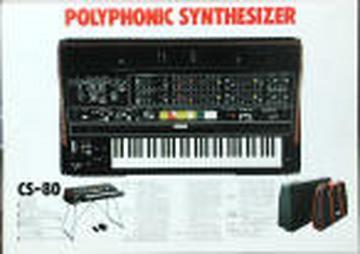
Yamaha CS80 group photo

Yahoo Groups archive

Yamaha CS80

Index last updated: 2026-04-28 23:44 UTC

Thread

R: Re: [yamahacs80] Unique keyboard features

R: Re: [yamahacs80] Unique keyboard features

2011-02-07 by faxiomas@virgilio.it

Hi David
You should look at a previous step than the SH, which is KAS 
itself:  basically you should look at the processing of pitch CV as 
serial and monophonic; the polyphony is helped by the gates straight 
into the SH, while the KAS internally makes possible to distinguish 
between the busy and the avaliable voices; this lets you have polyphony 
and mono unison according to the avaliable notes while in S-2...
truncating notes...well it is a myth: you actually don't truncate 
anything but if you set long release for the envelope and at the same 
time you have *all* the gates in the SH open, you will definitely 
"hear" the monophonic allocation of the pitch, because the envelopes 
are still running...
Basic explaination but I guess it's what you need.
M

----Messaggio originale----
Da: david@...
Data: 7-feb-
2011 7.07 AM
A: <yamahacs80@yahoogroups.com>
Ogg: Re: [yamahacs80] 
Unique keyboard features

>
> 	
>
>
> I just put in a couple of 
comments there, including about the (as far 
> as I know) unique 
Sustain I/II modes. Does anyone know of any other 
> keyboards, besides 
the CS50/60/80 that have this ability to have a 
> long release time 
but have new notes cut off old ones? I think it's an 
> amazing feature 
of the CS80 and have never seen it anywhere else.
>
I realized a little 
bit ago that I didn't know how the CS80 did the 
Sustain I/II trick. 
So, I've been looking through the schematics - and 
I'm still 
confused!  I only see the Sus I/II switch going to the SH 
board.  This 
explains the Sus I/II behavior of glide continuing after 
letting go of 
keys in Sus I but freezing pitch in the middle of a glide 
in Sus II 
(or is it the other way around??).  However, it doesn't 
explain how 
notes get cut off.  I thought I was onto something, but it 
was just 
the mixing of the Sustain slider on the left-hand panel (PN3) 
with the 
programed VCA and VCF release voltage going to the M cards.  
This 
circuit is on the Sub board.  Where did I get lost (which is easy 
to 
do on the giant schematic)?  I don't see the Sus I/II switch 
connecting anywhere else.

By the way, I wish the CS80 didn't freeze 
the glide in Sus II mode.  I 
think I might temporarily disconnect that 
wire to hear how it sounds 
with glides finishing in that mode.

  
David


[Non-text portions of this message have been removed]

Re: R: Re: [yamahacs80] Unique keyboard features

2011-02-07 by David Rogoff

> 	faxiomas@... <mailto:faxiomas@...>
> February 7, 2011 12:46 AM
>
>
> Hi David
> You should look at a previous step than the SH, which is KAS
> itself:  basically you should look at the processing of pitch CV as
> serial and monophonic; the polyphony is helped by the gates straight
> into the SH, while the KAS internally makes possible to distinguish
> between the busy and the avaliable voices; this lets you have polyphony
> and mono unison according to the avaliable notes while in S-2...
> truncating notes...well it is a myth: you actually don't truncate
> anything but if you set long release for the envelope and at the same
> time you have *all* the gates in the SH open, you will definitely
> "hear" the monophonic allocation of the pitch, because the envelopes
> are still running...

Thanks Max - that makes sense.  So, if you have a chord with a long 
release time and let go - and then hit another key - the previous notes 
do not get cut off, but the KAS assigns them all to the new key value so 
you're getting a semi-unison mode.  I wish I still had my little LED 
board to show the trigger signals.  One of those - plus another for the 
KAS gates - would be cool to watch in this mode and make it clearer 
what's going on.

The KAS is a wild and crazy chip!  It has all sorts of strange behaviors 
like this and the "note 8 won't play unless another key is held down".   
It would be great to replace the KAS/SH/TKC boards with a simple 
FPGA/PIC that would make things work more logically and also add a bunch 
of features like unison (which would also be handy for tuning!), MIDI 
in/out, keyboard assignment modes like the Oberheim 4/8-voice, etc.  I 
know there were a couple of folks looking into this kind of 
mod/upgrade.  And where do you stop?  I could see tossing everything but 
the card cage with the analog boards and the panel with just a big new 
board to drive it from MIDI.    It's just a lot of work for a 
35-year-old keyboard with only about 400-500 still alive.   But it would 
look and sound cool as hell next to the new Oberheim SO4V!

We now pause while many folks in the group have their faces glaze over 
and start drooling thinking of this :)

  David


[Non-text portions of this message have been removed]

Move to quarantaine

This moves the raw source file on disk only. The archive index is not changed automatically, so you still need to run a manual refresh afterward.