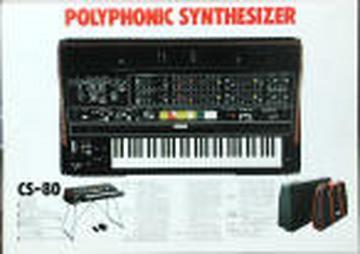
Yamaha CS80 group photo

Yahoo Groups archive

Yamaha CS80

Index last updated: 2026-04-28 23:44 UTC

Thread

Yamaha CS-80 for sale

Yamaha CS-80 for sale

2005-12-19 by David Rogoff

For sale: Yamaha CS-80, not counting modulars (or it's god-father, the 
GX-1), the heaviest, most knobs, most fun synthesizer ever built.

We're talking 171 knobs!  50 switches! No LCDs, no menus, no MIDI 
(although you can buy the Kenton MIDI kit for it)!

The keyboard is in very good condition. The panel and keyboard are 
almost like new and the tolex and hardware on the case is in pretty good 
shape.  All the knobs work.  It's been in a smoke-free home for at least 
the last few years, and has no signs of any smoke exposure before that.  
It has not been moved around or gigged with for at least several years.  
More details below.

I've had a great time bringing serial # 1646 back to good health, but 
it's time for me to sell it to a new, good home.  For better or worse, 
I'm a much better techie/engineer than musician.  I've had my fun, but 
now that it's all working well, it should be played and used to make 
great music. And I need to sell it to be able to pay for my next project :^)

I've owned/fixed up a few CSs over the years. I got a used CS-60 in 
1981, which I had for a couple of years (and modified heavily).  I had a 
CS-80 in 1986, which I fixed up and kept for about three years.  I got 
my last CS-80 in 1995, and only had for a few months (lightening load 
during a divorce).  I keep telling myself not to buy keyboards that 
weigh more than I do, but the CS-80 is too much fun.  I hope by the time 
(2015?) I feel the urge again, someone will finally make a new keyboard 
that can rival it.  

Here's some details about its condition and what I've done to it (there 
are tons of pictures of the outside and inside during my restoration at 
http://www.therogoffs.com/cs80):

Electronically:
To start with, this CS-80 has the second highest serial number I've 
seen, so it was one of the last ones made.  This means, not only that 
it's not as old as many others, but that it has the last rev of the VCO 
chips.  These are the most stable for tuning and didn't require any 
modifications for temperature tracking, like Yamaha recommended for 
earlier units.  The tuning wasn't bad when I got it, and since I did a 
complete tuning on it, it is super accurate over all keys, octaves, and 
voices.  I often have to detune the second voice bank to make sure it's 
there because the VCOs are dead on.

CMOS:
As well documented on Old Crow's excellent website (www.cs80.com), the 
CS-80 had a few design mistakes.  Almost all the digital control logic 
is built using 4000-series CMOS chips.  These chips, especially the 
older ones, could be very sensitive to static and can also fail over 
time.  Luckily, these are still made today.  As recommended by Crow, and 
other CS techs, I have replaced every 4000-series CMOS chip with new 
ones for many more years of life.  In addition, I have put all of the 
new chips in sockets, so if there is a failure in the future, it will be 
relatively easy to find and fix.  Yamaha also had very few bypass 
capacitors on the digital boards (none on one!). These caps help keep 
the power supplies quiet and the parts happy.  I've added a bypass caps 
for almost every single digital chip.  In addition, I added larger 
bypass caps on each board.  This work took a lot of $$$ in parts and 
more rework hours than I can remember, but it's a great insurance policy 
for the future life of the keyboard.

Power supply:
Almost every piece of electronic gear, from stereo amps, to 
synthesizers, use electrolytic capacitors in their power supplies to 
smooth the AC voltage from the wall socket into nice, smooth DC voltage 
for the internal circuits.  These capacitors have kind of a gel in them 
that drys out over the years, degrading their performance, until the are 
non-functional.  In old amplifiers, this commonly results in increasing 
hum.  I have removed all of these caps from the power supply and 
replaced them with new ones.  Since modern caps are smaller than their 
older, same-value parts, I was even able to put larger value caps in 
some places (larger generally equals better for power supplies caps).  I 
even replaced the caps used in series with the headphone jack.

Keys: I removed all the keys and washed them.  There's a few really tiny 
marks, but overall I'd give them an A.  They all feel nice too: initial 
touch (velocity - can control volume, brightness, and pitch bend) and 
after-touch (polyphonic pressure - can control LFO modulation and speed, 
volume, and brightness) are working on all keys.  As most fans know, the 
poly aftertouch is one of the keys features of the CS-80. There are very 
few keyboards that had this (I own two other: a Kurzweil MIDIBoard, and 
a Roland A-50, which I'm restoring - but neither feel as good as the 
CS-80).  It's such a great and natural feature to be able to play a 
chord and bring out one note by pressing that key harder. No keyboard 
has been made with this for many years.  I wish someone would bring it 
back!  I've also gone through all the key contacts, cleaning and 
adjusting, to fix any intermittent triggering on any key.

Ribbon:
Besides the keyboard, the other great, rare feature on the CS-80, is the 
ribbon controller.  This lets you bend an note up an octave and down 
infinity to zero!  And it's relative, so you can touch it anywhere, and 
that point becomes the starting point of the bend.  It's also great for 
guitar/violin-like trills: press anywhere with one finger and then tap a 
trill with another finger.  The ribbon works and looks perfect.

Cosmetics:
Panel: The front panel looks and works great.  All knobs, buttons, 
sliders, and lights are 100% functionally and cosmetically.  I went 
through every single one of the 171 knobs and 50 switches, including all 
the little ones for the memories.  Everything does what it's supposed to.

Case/Cover:  The cabinet is in good condition.  There are a few nicks in 
the tolex and the chrome hardware isn't perfect, but overall a B+.  The 
case cover is a little rougher, maybe a B-, but who cares since it's not 
on when you are playing, but it is important to have, to protect the 
panel and keyboard.  I've got the original casters that plug into the 
case and cover.  They are very useful for moving the CS-80 around short 
distances, but for big moves, you'll want a flight case.  I've also 
replaced many missing washers that an unknown previous owner/technician 
forgot to put back.

Stand: It's got the original Yamaha stand.  A couple of the screws to 
lock it to the CS-80 were missing, so I put together nice replacements 
(metric #8 bolts!).  I also added plastic furniture caps over the metal 
feet so it wouldn't tear up my wood floor.  There's some scratches and a 
few small nicks, but it looks pretty good - maybe a B/B-.  I don't have 
the fancy carrying bag for the stand and pedals.  The stand has a great 
feature: it lets one person move the CS-80 by himself.  Since it locks 
to the keyboard, you can pretty easily (and I'm not very big) roll the 
unit onto its casters and then move it, and then lift it back up onto 
the stand.  This is really helpful if there's no one around to help lift 
it. However, it won't help when you get to a flight of stairs :^)

Music Rest:  I could never find one of these!  However, I got the 
outline of one and tried to make one out of clear plexiglass.  Well, 
cutting plexiglass is harder than I thought, so it doesn't look that 
hot, but it's ok, and it works, so it's yours, free with purchase...

Misc:
It's got the original Yamaha expression pedal, which can control volume 
or a wah-wah effect.  I've got a generic foot switch, which can control 
sustain and/or portamento.

I'm also including a nice, double-sided printout of the owner's manual, 
from the Yamaha site.  I'll also give you a CDROM with all the pictures 
I've taken of the keyboard and every bit of info I've found on the 
Internet, including schematics, calibration procedures, theory of 
operations, and more.

Sale info:
I wanted to offer this to group members first (sorry if some people, who 
are on multiple synth group/mailing lists, get duplicate copies of 
this).  I'll keep it open to offers until after New Year's Day.  If I 
don't have a buyer by then, I'll put it on eBay.  Bottom line: CS-80 
that is better than A+ electronically and about a B/B+ cosmetically.  
Comes with case/cover, casters, original stand, original expression 
pedal, generic sustain/portamento pedal, music rest, and re-print of 
owner's manual.

If you want one that looks and works better than new, please see the 
amazing work that Kent Spong does for RL Music (see 
http://www.rlmusic.co.uk/mals_site/sale_stock_01.html - near bottom of 
page), but it's gonna cost you about three times what I'm asking.  I'd 
buy one if I had the money!  Speaking of which, I'm looking for offers 
starting at $3700.  I'd prefer, and give priority to, local (Southern 
California - Irvine) buyers who could come here, check it out in person, 
and drive it away.  As an added incentive, I'll even give it a free 
tuning (if it ever needs it) after a few months, either at my place, or 
yours, if reasonably close by.

If you need it shipped, you will pay all packing, shipping, and 
insurance costs.  I will have it professional crated and shipped by a 
company that has experience shipping large musical gear.  If you are 
familiar with a particular company, I will check them out.  From some 
postings I've read, I would estimate it would cost about $500 to ship it 
to U.K./Europe, but that's just a ball-park estimate.

I've been buying/fixing/selling synths over the Internet and through 
local want-ads for about 25 years now (for fun, not for a living).  I 
have an extensive, great record for deals, including a perfect feedback 
of over 200 on eBay 
(http://feedback.ebay.com/ws/eBayISAPI.dll?ViewFeedback&userid=david72hq) 
.  I welcome any questions and invite any local buyers to arrange to 
come by check it out in person.

Thanks,

 David

Re: [yamahacs80] Yamaha CS-80 for sale

2005-12-19 by Max Fazio

David
You made an amazing work with your CS-80 and even if we disagree onto some technical things I wish you can get the reward you deserve for such a work of love. I'm in Italy and unfortunately I haven't room for it , not counting the fear for letting the machine be tranported by someone else who's not me...I wish also the buyer will make a responsive use of the old boy and let it not take dust....
Max
Show quoted textHide quoted text
  ----- Original Message ----- 
  From: David Rogoff 
  To: AH analogue heaven AH ; yamahacs80@yahoogroups.com ; arturiacs-80v@yahoogroups.com ; oldsynths@yahoogroups.com 
  Sent: Monday, December 19, 2005 1:52 AM
  Subject: [yamahacs80] Yamaha CS-80 for sale


  For sale: Yamaha CS-80, not counting modulars (or it's god-father, the 
  GX-1), the heaviest, most knobs, most fun synthesizer ever built.

  We're talking 171 knobs!  50 switches! No LCDs, no menus, no MIDI 
  (although you can buy the Kenton MIDI kit for it)!

  The keyboard is in very good condition. The panel and keyboard are 
  almost like new and the tolex and hardware on the case is in pretty good 
  shape.  All the knobs work.  It's been in a smoke-free home for at least 
  the last few years, and has no signs of any smoke exposure before that.  
  It has not been moved around or gigged with for at least several years.  
  More details below.

  I've had a great time bringing serial # 1646 back to good health, but 
  it's time for me to sell it to a new, good home.  For better or worse, 
  I'm a much better techie/engineer than musician.  I've had my fun, but 
  now that it's all working well, it should be played and used to make 
  great music. And I need to sell it to be able to pay for my next project :^)

  I've owned/fixed up a few CSs over the years. I got a used CS-60 in 
  1981, which I had for a couple of years (and modified heavily).  I had a 
  CS-80 in 1986, which I fixed up and kept for about three years.  I got 
  my last CS-80 in 1995, and only had for a few months (lightening load 
  during a divorce).  I keep telling myself not to buy keyboards that 
  weigh more than I do, but the CS-80 is too much fun.  I hope by the time 
  (2015?) I feel the urge again, someone will finally make a new keyboard 
  that can rival it.  

  Here's some details about its condition and what I've done to it (there 
  are tons of pictures of the outside and inside during my restoration at 
  http://www.therogoffs.com/cs80):

  Electronically:
  To start with, this CS-80 has the second highest serial number I've 
  seen, so it was one of the last ones made.  This means, not only that 
  it's not as old as many others, but that it has the last rev of the VCO 
  chips.  These are the most stable for tuning and didn't require any 
  modifications for temperature tracking, like Yamaha recommended for 
  earlier units.  The tuning wasn't bad when I got it, and since I did a 
  complete tuning on it, it is super accurate over all keys, octaves, and 
  voices.  I often have to detune the second voice bank to make sure it's 
  there because the VCOs are dead on.

  CMOS:
  As well documented on Old Crow's excellent website (www.cs80.com), the 
  CS-80 had a few design mistakes.  Almost all the digital control logic 
  is built using 4000-series CMOS chips.  These chips, especially the 
  older ones, could be very sensitive to static and can also fail over 
  time.  Luckily, these are still made today.  As recommended by Crow, and 
  other CS techs, I have replaced every 4000-series CMOS chip with new 
  ones for many more years of life.  In addition, I have put all of the 
  new chips in sockets, so if there is a failure in the future, it will be 
  relatively easy to find and fix.  Yamaha also had very few bypass 
  capacitors on the digital boards (none on one!). These caps help keep 
  the power supplies quiet and the parts happy.  I've added a bypass caps 
  for almost every single digital chip.  In addition, I added larger 
  bypass caps on each board.  This work took a lot of $$$ in parts and 
  more rework hours than I can remember, but it's a great insurance policy 
  for the future life of the keyboard.

  Power supply:
  Almost every piece of electronic gear, from stereo amps, to 
  synthesizers, use electrolytic capacitors in their power supplies to 
  smooth the AC voltage from the wall socket into nice, smooth DC voltage 
  for the internal circuits.  These capacitors have kind of a gel in them 
  that drys out over the years, degrading their performance, until the are 
  non-functional.  In old amplifiers, this commonly results in increasing 
  hum.  I have removed all of these caps from the power supply and 
  replaced them with new ones.  Since modern caps are smaller than their 
  older, same-value parts, I was even able to put larger value caps in 
  some places (larger generally equals better for power supplies caps).  I 
  even replaced the caps used in series with the headphone jack.

  Keys: I removed all the keys and washed them.  There's a few really tiny 
  marks, but overall I'd give them an A.  They all feel nice too: initial 
  touch (velocity - can control volume, brightness, and pitch bend) and 
  after-touch (polyphonic pressure - can control LFO modulation and speed, 
  volume, and brightness) are working on all keys.  As most fans know, the 
  poly aftertouch is one of the keys features of the CS-80. There are very 
  few keyboards that had this (I own two other: a Kurzweil MIDIBoard, and 
  a Roland A-50, which I'm restoring - but neither feel as good as the 
  CS-80).  It's such a great and natural feature to be able to play a 
  chord and bring out one note by pressing that key harder. No keyboard 
  has been made with this for many years.  I wish someone would bring it 
  back!  I've also gone through all the key contacts, cleaning and 
  adjusting, to fix any intermittent triggering on any key.

  Ribbon:
  Besides the keyboard, the other great, rare feature on the CS-80, is the 
  ribbon controller.  This lets you bend an note up an octave and down 
  infinity to zero!  And it's relative, so you can touch it anywhere, and 
  that point becomes the starting point of the bend.  It's also great for 
  guitar/violin-like trills: press anywhere with one finger and then tap a 
  trill with another finger.  The ribbon works and looks perfect.

  Cosmetics:
  Panel: The front panel looks and works great.  All knobs, buttons, 
  sliders, and lights are 100% functionally and cosmetically.  I went 
  through every single one of the 171 knobs and 50 switches, including all 
  the little ones for the memories.  Everything does what it's supposed to.

  Case/Cover:  The cabinet is in good condition.  There are a few nicks in 
  the tolex and the chrome hardware isn't perfect, but overall a B+.  The 
  case cover is a little rougher, maybe a B-, but who cares since it's not 
  on when you are playing, but it is important to have, to protect the 
  panel and keyboard.  I've got the original casters that plug into the 
  case and cover.  They are very useful for moving the CS-80 around short 
  distances, but for big moves, you'll want a flight case.  I've also 
  replaced many missing washers that an unknown previous owner/technician 
  forgot to put back.

  Stand: It's got the original Yamaha stand.  A couple of the screws to 
  lock it to the CS-80 were missing, so I put together nice replacements 
  (metric #8 bolts!).  I also added plastic furniture caps over the metal 
  feet so it wouldn't tear up my wood floor.  There's some scratches and a 
  few small nicks, but it looks pretty good - maybe a B/B-.  I don't have 
  the fancy carrying bag for the stand and pedals.  The stand has a great 
  feature: it lets one person move the CS-80 by himself.  Since it locks 
  to the keyboard, you can pretty easily (and I'm not very big) roll the 
  unit onto its casters and then move it, and then lift it back up onto 
  the stand.  This is really helpful if there's no one around to help lift 
  it. However, it won't help when you get to a flight of stairs :^)

  Music Rest:  I could never find one of these!  However, I got the 
  outline of one and tried to make one out of clear plexiglass.  Well, 
  cutting plexiglass is harder than I thought, so it doesn't look that 
  hot, but it's ok, and it works, so it's yours, free with purchase...

  Misc:
  It's got the original Yamaha expression pedal, which can control volume 
  or a wah-wah effect.  I've got a generic foot switch, which can control 
  sustain and/or portamento.

  I'm also including a nice, double-sided printout of the owner's manual, 
  from the Yamaha site.  I'll also give you a CDROM with all the pictures 
  I've taken of the keyboard and every bit of info I've found on the 
  Internet, including schematics, calibration procedures, theory of 
  operations, and more.

  Sale info:
  I wanted to offer this to group members first (sorry if some people, who 
  are on multiple synth group/mailing lists, get duplicate copies of 
  this).  I'll keep it open to offers until after New Year's Day.  If I 
  don't have a buyer by then, I'll put it on eBay.  Bottom line: CS-80 
  that is better than A+ electronically and about a B/B+ cosmetically.  
  Comes with case/cover, casters, original stand, original expression 
  pedal, generic sustain/portamento pedal, music rest, and re-print of 
  owner's manual.

  If you want one that looks and works better than new, please see the 
  amazing work that Kent Spong does for RL Music (see 
  http://www.rlmusic.co.uk/mals_site/sale_stock_01.html - near bottom of 
  page), but it's gonna cost you about three times what I'm asking.  I'd 
  buy one if I had the money!  Speaking of which, I'm looking for offers 
  starting at $3700.  I'd prefer, and give priority to, local (Southern 
  California - Irvine) buyers who could come here, check it out in person, 
  and drive it away.  As an added incentive, I'll even give it a free 
  tuning (if it ever needs it) after a few months, either at my place, or 
  yours, if reasonably close by.

  If you need it shipped, you will pay all packing, shipping, and 
  insurance costs.  I will have it professional crated and shipped by a 
  company that has experience shipping large musical gear.  If you are 
  familiar with a particular company, I will check them out.  From some 
  postings I've read, I would estimate it would cost about $500 to ship it 
  to U.K./Europe, but that's just a ball-park estimate.

  I've been buying/fixing/selling synths over the Internet and through 
  local want-ads for about 25 years now (for fun, not for a living).  I 
  have an extensive, great record for deals, including a perfect feedback 
  of over 200 on eBay 
  (http://feedback.ebay.com/ws/eBayISAPI.dll?ViewFeedback&userid=david72hq) 
  .  I welcome any questions and invite any local buyers to arrange to 
  come by check it out in person.

  Thanks,

  David


------------------------------------------------------------------------------
  YAHOO! GROUPS LINKS 

    a..  Visit your group "yamahacs80" on the web.
      
    b..  To unsubscribe from this group, send an email to:
     yamahacs80-unsubscribe@yahoogroups.com
      
    c..  Your use of Yahoo! Groups is subject to the Yahoo! Terms of Service. 


------------------------------------------------------------------------------


[Non-text portions of this message have been removed]

Re: [yamahacs80] Yamaha CS-80 for sale

2005-12-19 by Wavecomputer360

I second this, Max!
I wish I\ufffdd find a CS80 in a shape like this in Germany, at a decent price
like that, with all that labour taken into account. I hope there will be a
good home for it.

Stephen


____________________________________________________________________

"Ambition makes you look pretty ugly." (Thom Yorke/Radiohead -- "Paranoid
Android")

"Hoellenengel" -- new album by Stephen Parsick, street date October 1, 2005.

For info and audio, please check www.parsick.com

It\ufffds out: "oughtibridge", the new [\ufffdramp] album, recorded live in England.

For info and audio, please visit the official [\ufffdramp] website at
www.doombient.com

WTB: "England\ufffds Hidden Reverse" by David Keenan (Coil, Current93, Nurse With
Wound, David Tibet).


----- Original Message -----
From: Max Fazio <faxiomas@...>
To: <yamahacs80@yahoogroups.com>
Sent: Monday, December 19, 2005 9:59 AM
Subject: Re: [yamahacs80] Yamaha CS-80 for sale


> David
> You made an amazing work with your CS-80 and even if we disagree onto some
technical things I wish you can get the reward you deserve for such a work
of love. I'm in Italy and unfortunately I haven't room for it , not counting
the fear for letting the machine be tranported by someone else who's not
me...I wish also the buyer will make a responsive use of the old boy and let
it not take dust....
> Max
>   ----- Original Message -----
>   From: David Rogoff
>   To: AH analogue heaven AH ; yamahacs80@yahoogroups.com ;
arturiacs-80v@yahoogroups.com ; oldsynths@yahoogroups.com
>   Sent: Monday, December 19, 2005 1:52 AM
>   Subject: [yamahacs80] Yamaha CS-80 for sale
>
>
>   For sale: Yamaha CS-80, not counting modulars (or it's god-father, the
>   GX-1), the heaviest, most knobs, most fun synthesizer ever built.
>
>   We're talking 171 knobs!  50 switches! No LCDs, no menus, no MIDI
>   (although you can buy the Kenton MIDI kit for it)!
>
>   The keyboard is in very good condition. The panel and keyboard are
>   almost like new and the tolex and hardware on the case is in pretty good
>   shape.  All the knobs work.  It's been in a smoke-free home for at least
>   the last few years, and has no signs of any smoke exposure before that.
>   It has not been moved around or gigged with for at least several years.
>   More details below.
>
>   I've had a great time bringing serial # 1646 back to good health, but
>   it's time for me to sell it to a new, good home.  For better or worse,
>   I'm a much better techie/engineer than musician.  I've had my fun, but
>   now that it's all working well, it should be played and used to make
>   great music. And I need to sell it to be able to pay for my next project
:^)
>
>   I've owned/fixed up a few CSs over the years. I got a used CS-60 in
>   1981, which I had for a couple of years (and modified heavily).  I had a
>   CS-80 in 1986, which I fixed up and kept for about three years.  I got
>   my last CS-80 in 1995, and only had for a few months (lightening load
>   during a divorce).  I keep telling myself not to buy keyboards that
>   weigh more than I do, but the CS-80 is too much fun.  I hope by the time
>   (2015?) I feel the urge again, someone will finally make a new keyboard
>   that can rival it.
>
>   Here's some details about its condition and what I've done to it (there
>   are tons of pictures of the outside and inside during my restoration at
>   http://www.therogoffs.com/cs80):
>
>   Electronically:
>   To start with, this CS-80 has the second highest serial number I've
>   seen, so it was one of the last ones made.  This means, not only that
>   it's not as old as many others, but that it has the last rev of the VCO
>   chips.  These are the most stable for tuning and didn't require any
>   modifications for temperature tracking, like Yamaha recommended for
>   earlier units.  The tuning wasn't bad when I got it, and since I did a
>   complete tuning on it, it is super accurate over all keys, octaves, and
>   voices.  I often have to detune the second voice bank to make sure it's
>   there because the VCOs are dead on.
>
>   CMOS:
>   As well documented on Old Crow's excellent website (www.cs80.com), the
>   CS-80 had a few design mistakes.  Almost all the digital control logic
>   is built using 4000-series CMOS chips.  These chips, especially the
>   older ones, could be very sensitive to static and can also fail over
>   time.  Luckily, these are still made today.  As recommended by Crow, and
>   other CS techs, I have replaced every 4000-series CMOS chip with new
>   ones for many more years of life.  In addition, I have put all of the
>   new chips in sockets, so if there is a failure in the future, it will be
>   relatively easy to find and fix.  Yamaha also had very few bypass
>   capacitors on the digital boards (none on one!). These caps help keep
>   the power supplies quiet and the parts happy.  I've added a bypass caps
>   for almost every single digital chip.  In addition, I added larger
>   bypass caps on each board.  This work took a lot of $$$ in parts and
>   more rework hours than I can remember, but it's a great insurance policy
>   for the future life of the keyboard.
>
>   Power supply:
>   Almost every piece of electronic gear, from stereo amps, to
>   synthesizers, use electrolytic capacitors in their power supplies to
>   smooth the AC voltage from the wall socket into nice, smooth DC voltage
>   for the internal circuits.  These capacitors have kind of a gel in them
>   that drys out over the years, degrading their performance, until the are
>   non-functional.  In old amplifiers, this commonly results in increasing
>   hum.  I have removed all of these caps from the power supply and
>   replaced them with new ones.  Since modern caps are smaller than their
>   older, same-value parts, I was even able to put larger value caps in
>   some places (larger generally equals better for power supplies caps).  I
>   even replaced the caps used in series with the headphone jack.
>
>   Keys: I removed all the keys and washed them.  There's a few really tiny
>   marks, but overall I'd give them an A.  They all feel nice too: initial
>   touch (velocity - can control volume, brightness, and pitch bend) and
>   after-touch (polyphonic pressure - can control LFO modulation and speed,
>   volume, and brightness) are working on all keys.  As most fans know, the
>   poly aftertouch is one of the keys features of the CS-80. There are very
>   few keyboards that had this (I own two other: a Kurzweil MIDIBoard, and
>   a Roland A-50, which I'm restoring - but neither feel as good as the
>   CS-80).  It's such a great and natural feature to be able to play a
>   chord and bring out one note by pressing that key harder. No keyboard
>   has been made with this for many years.  I wish someone would bring it
>   back!  I've also gone through all the key contacts, cleaning and
>   adjusting, to fix any intermittent triggering on any key.
>
>   Ribbon:
>   Besides the keyboard, the other great, rare feature on the CS-80, is the
>   ribbon controller.  This lets you bend an note up an octave and down
>   infinity to zero!  And it's relative, so you can touch it anywhere, and
>   that point becomes the starting point of the bend.  It's also great for
>   guitar/violin-like trills: press anywhere with one finger and then tap a
>   trill with another finger.  The ribbon works and looks perfect.
>
>   Cosmetics:
>   Panel: The front panel looks and works great.  All knobs, buttons,
>   sliders, and lights are 100% functionally and cosmetically.  I went
>   through every single one of the 171 knobs and 50 switches, including all
>   the little ones for the memories.  Everything does what it's supposed
to.
>
>   Case/Cover:  The cabinet is in good condition.  There are a few nicks in
>   the tolex and the chrome hardware isn't perfect, but overall a B+.  The
>   case cover is a little rougher, maybe a B-, but who cares since it's not
>   on when you are playing, but it is important to have, to protect the
>   panel and keyboard.  I've got the original casters that plug into the
>   case and cover.  They are very useful for moving the CS-80 around short
>   distances, but for big moves, you'll want a flight case.  I've also
>   replaced many missing washers that an unknown previous owner/technician
>   forgot to put back.
>
>   Stand: It's got the original Yamaha stand.  A couple of the screws to
>   lock it to the CS-80 were missing, so I put together nice replacements
>   (metric #8 bolts!).  I also added plastic furniture caps over the metal
>   feet so it wouldn't tear up my wood floor.  There's some scratches and a
>   few small nicks, but it looks pretty good - maybe a B/B-.  I don't have
>   the fancy carrying bag for the stand and pedals.  The stand has a great
>   feature: it lets one person move the CS-80 by himself.  Since it locks
>   to the keyboard, you can pretty easily (and I'm not very big) roll the
>   unit onto its casters and then move it, and then lift it back up onto
>   the stand.  This is really helpful if there's no one around to help lift
>   it. However, it won't help when you get to a flight of stairs :^)
>
>   Music Rest:  I could never find one of these!  However, I got the
>   outline of one and tried to make one out of clear plexiglass.  Well,
>   cutting plexiglass is harder than I thought, so it doesn't look that
>   hot, but it's ok, and it works, so it's yours, free with purchase...
>
>   Misc:
>   It's got the original Yamaha expression pedal, which can control volume
>   or a wah-wah effect.  I've got a generic foot switch, which can control
>   sustain and/or portamento.
>
>   I'm also including a nice, double-sided printout of the owner's manual,
>   from the Yamaha site.  I'll also give you a CDROM with all the pictures
>   I've taken of the keyboard and every bit of info I've found on the
>   Internet, including schematics, calibration procedures, theory of
>   operations, and more.
>
>   Sale info:
>   I wanted to offer this to group members first (sorry if some people, who
>   are on multiple synth group/mailing lists, get duplicate copies of
>   this).  I'll keep it open to offers until after New Year's Day.  If I
>   don't have a buyer by then, I'll put it on eBay.  Bottom line: CS-80
>   that is better than A+ electronically and about a B/B+ cosmetically.
>   Comes with case/cover, casters, original stand, original expression
>   pedal, generic sustain/portamento pedal, music rest, and re-print of
>   owner's manual.
>
>   If you want one that looks and works better than new, please see the
>   amazing work that Kent Spong does for RL Music (see
>   http://www.rlmusic.co.uk/mals_site/sale_stock_01.html - near bottom of
>   page), but it's gonna cost you about three times what I'm asking.  I'd
>   buy one if I had the money!  Speaking of which, I'm looking for offers
>   starting at $3700.  I'd prefer, and give priority to, local (Southern
>   California - Irvine) buyers who could come here, check it out in person,
>   and drive it away.  As an added incentive, I'll even give it a free
>   tuning (if it ever needs it) after a few months, either at my place, or
>   yours, if reasonably close by.
>
>   If you need it shipped, you will pay all packing, shipping, and
>   insurance costs.  I will have it professional crated and shipped by a
>   company that has experience shipping large musical gear.  If you are
>   familiar with a particular company, I will check them out.  From some
>   postings I've read, I would estimate it would cost about $500 to ship it
>   to U.K./Europe, but that's just a ball-park estimate.
>
>   I've been buying/fixing/selling synths over the Internet and through
>   local want-ads for about 25 years now (for fun, not for a living).  I
>   have an extensive, great record for deals, including a perfect feedback
>   of over 200 on eBay
>
(http://feedback.ebay.com/ws/eBayISAPI.dll?ViewFeedback&userid=david72hq)
>   .  I welcome any questions and invite any local buyers to arrange to
>   come by check it out in person.
>
>   Thanks,
>
>   David
>
>
>
>
> --------------------------------------------------------------------------
----
>   YAHOO! GROUPS LINKS
>
>     a..  Visit your group "yamahacs80" on the web.
>
>     b..  To unsubscribe from this group, send an email to:
>      yamahacs80-unsubscribe@yahoogroups.com
>
>     c..  Your use of Yahoo! Groups is subject to the Yahoo! Terms of
Service.
>
>
> --------------------------------------------------------------------------
----
Show quoted textHide quoted text
>
>
>
> [Non-text portions of this message have been removed]
>
>
>
>
>
> Yahoo! Groups Links
>
>
>
>
>
>

Move to quarantaine

This moves the raw source file on disk only. The archive index is not changed automatically, so you still need to run a manual refresh afterward.