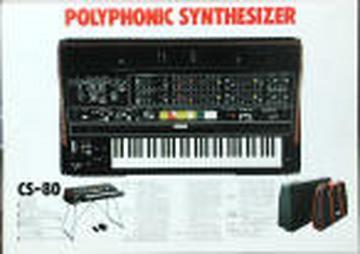
My CS80 photo with stand as promised...
2004-09-15 by Quazimodo
Yahoo Groups archive
Index last updated: 2026-04-28 23:44 UTC
Thread
2004-09-15 by Quazimodo
Hi chaps.

A long delay but better late than never eh?

I have now uploaded a photo of my CS80 with the custom stand I was
talking about a while ago, I was worried about overheating issues as
the stand covers the vent slots (loosely though - so there is still
air circulation)...

Cheers.
TOM
2004-09-16 by The Old Crow
I have CS-80 #1322 in my workshop for a full overhaul: chips
replacement, power supply refurbished, keyboard assembly dismantled and
cleaned, full calibration and test.  If all goes well, should be finished
by the end of the month.

Crow
/**/
2004-10-19 by David Rogoff
Hi all.

I'm getting into refurbishing/fixing my CS-80 and thought some people
would be interested in seeing what's involved.  I created an album in
the Photos page called CS80 renovation.

There's a picture labeled "Here's where it's happening!", which shows
a corner of my TV room, converted to a repair shop.  I picked up a
Weller desoldering station and Beckman Oscilloscope very cheap on
eBay.  On the floor, you can see the box from Digikey where I got all
the CMOS chips, IC sockets, and capacitors.

There are also three pics of the TSB boards.  These are the first I'm
upgrading.  They multiplex the aftertouch voltages from the keyboard.
 I desoldered the five 4051 chips and installed machined sockets.  One
semi-problem: the holes between the rows of pins are supposed to be
exactly 0.3" apart. Well, they're slightly wider.  This isn't a
problem with the chips, since the leads are flexible.  However, it
made putting in the sockets a pain. Also, since the socket pins were
forces into a slight angle, it made getting the new 4051s in
difficult.  For the last few, I cut the sockets in half and inserted
each row separately.  This made everything much easier.

In the pic "Back of upgraded TSB board", you can see the little bypass
caps I put on the 4051s.  The 4051s are different than most digital
CMOS parts since they're analog switches.  They have a negative supply
(-6.5v), and two positive supplies, one for digital and one for
analog.  They are both tied to +8.5v.  The minimal bypassing was
between these two supplies. I added caps from each to ground.  The
ones that reached a longer distance are covered in red heat-shrink tubing.

In pic "TSB board after upgrade" you can see the 4051s in their
sockets.  In the top, left corner you can also see two bigger, blue
capacitors I added to bypass the +8.5 and -6.5 supplied where they
enter the board (the red and green wires in the corners).

One last weird thing: the two TSB boards in my CS80 are slightly
different versions!  I think they're electronically identical, but the
PC boards are a bit different.  After I put the caps on the first
board I was just going to put them in the same places on the second
board.  When I tried to do that, I couldn't find some of the reference
points I was looking for. I thought I was going blind, but then
realized the differences.

The good part is that everything still works after all the soldering
(which is really good since it was all working before I started)!

Now I'm on to the other boards.

 David
2004-10-20 by STEPHEN TELLER
Sounds great David! Keep us posted. Then when you finish you'll be all
ready to work on mine!  ; )


Stephen Teller
Stephen Teller Music
805/480-9614
s.teller@...
On Oct 20, 2004, at 10:17 AM, yamahacs80@yahoogroups.com wrote:

> Subject: Re: Another CS-80 on the overhaul bench
>
>
> Hi all.
>
> I'm getting into refurbishing/fixing my CS-80 and thought some people
> would be interested in seeing what's involved.  I created an album in
> the Photos page called CS80 renovation.
>
> There's a picture labeled "Here's where it's happening!", which shows
> a corner of my TV room, converted to a repair shop.  I picked up a
> Weller desoldering station and Beckman Oscilloscope very cheap on
> eBay.  On the floor, you can see the box from Digikey where I got all
> the CMOS chips, IC sockets, and capacitors.
>
> There are also three pics of the TSB boards.  These are the first I'm
> upgrading.  They multiplex the aftertouch voltages from the keyboard.
>  I desoldered the five 4051 chips and installed machined sockets.  One
> semi-problem: the holes between the rows of pins are supposed to be
> exactly 0.3" apart. Well, they're slightly wider.  This isn't a
> problem with the chips, since the leads are flexible.  However, it
> made putting in the sockets a pain. Also, since the socket pins were
> forces into a slight angle, it made getting the new 4051s in
> difficult.  For the last few, I cut the sockets in half and inserted
> each row separately.  This made everything much easier.
>
> In the pic "Back of upgraded TSB board", you can see the little bypass
> caps I put on the 4051s.  The 4051s are different than most digital
> CMOS parts since they're analog switches.  They have a negative supply
> (-6.5v), and two positive supplies, one for digital and one for
> analog.  They are both tied to +8.5v.  The minimal bypassing was
> between these two supplies. I added caps from each to ground.  The
> ones that reached a longer distance are covered in red heat-shrink
> tubing.
>
> In pic "TSB board after upgrade" you can see the 4051s in their
> sockets.  In the top, left corner you can also see two bigger, blue
> capacitors I added to bypass the +8.5 and -6.5 supplied where they
> enter the board (the red and green wires in the corners).
>
> One last weird thing: the two TSB boards in my CS80 are slightly
> different versions!  I think they're electronically identical, but the
> PC boards are a bit different.  After I put the caps on the first
> board I was just going to put them in the same places on the second
> board.  When I tried to do that, I couldn't find some of the reference
> points I was looking for. I thought I was going blind, but then
> realized the differences.
>
> The good part is that everything still works after all the soldering
> (which is really good since it was all working before I started)!
>
> Now I'm on to the other boards.
>
>  David
>
2004-10-23 by David Rogoff
Update:

I finished the first of two KBC boards.  A bunch of pictures are in
Photos -> CS80 Renovation -> KBC.  The caps on the back of each IC go
between VDD and VSS.  The strange thing is that usually VSS is
0v/ground and VDD is anywhere from +5v to +18 for CMOS.  However,
since the CMOS digital chips are also being used to swtich analog
control voltages, Yamaha uses +8.5v for VDD and -6.5v for VSS.

Therefore, the little bypass caps bypass the two supplies to each
other, not to ground.  On the TSB board I put seperate caps to ground
from each, but there weren't easily accessible grounds on the KBCs.
It's ok, just not optimal.  In the picture
cs80_kbc_after-empty_sockets you can see a couple of big, blue bypass
caps on the front of the board (left edge, top and bottom.  These do
bypass the VDD and VSS seperately to ground.

One more KBC to go.  Did I mention this stuff is a real pain to do?
The desoldering station is lots of fun, though.  I hope to finish all
the CMOS replacement in the next week, or so.  I'll be selling the
desoldering station then, so let me know if anyone wants to buy it!
Here's the eBay auction where I bought it last month:
http://cgi.ebay.com/ws/eBayISAPI.dll?ViewItem&item=3841768300.  I just
want what I paid for it.

 David
2004-10-24 by The Old Crow
I would have simply put the TSB board bypass capacitors from Vdd to Vee,
since Vee=Vss (pins 7 and 8 are tied together).  I use Mil-max sockets
with integral capacitors, myself.  More expensive than tacking caps on the
bottom, but after doing 30 of these machines I go for efficiency these
days. ;)  And yes, the slightly off-spec (300mil) side-to-side hole
spacing is a pain.  It is best to buy strips of machined pins and solder
them in flea-clip style, but with intergral cap sockets I don't have this
luxury.  Still, it is not that hard to deal with.

Crow
/**/
On Sat, 23 Oct 2004, David Rogoff wrote:

> Update:
>
> I finished the first of two KBC boards.  A bunch of pictures are in
> Photos -> CS80 Renovation -> KBC.  The caps on the back of each IC go
> between VDD and VSS.  The strange thing is that usually VSS is
> 0v/ground and VDD is anywhere from +5v to +18 for CMOS.  However,
> since the CMOS digital chips are also being used to swtich analog
> control voltages, Yamaha uses +8.5v for VDD and -6.5v for VSS.
>
> Therefore, the little bypass caps bypass the two supplies to each
> other, not to ground.  On the TSB board I put seperate caps to ground
> from each, but there weren't easily accessible grounds on the KBCs.
2004-10-31 by David Rogoff
New stuff:

I just added some cool lights to my CS-80.  When tuning the keyboard,
or for troubleshooting, you need to know which voice card is sounding.
 There are eight TRG signals that go from the KAS board (which scans
the keyboard) to the M boards (voice cards). I tried driving LEDs
directly from these, but the load lowered the voltage too much.  It
still worked, but I was worried it would be flakey.  So, I copied
(with minor value changes) the same transistor drivers (the CMOS parts
used in the keyboard circuits don't have much power to drive anything)
used on the KAS to drive the TRG lines.  The results are shown in
Photos -> CS80 Renovation -> lights.

I used tri-color LEDs so that they're green when idle and red when
active.  Because there's nothing blocking the light between the LEDs,
an LED glowing red makes the green ones next to it look a bit orange.
 Right now the board is just loose, but I might mount it under the
panel, with the LEDs to the left of the ribbon.  I've also thought of
adding some LEDs for the PWM rates, the ring mod rate, and the LFO rate.

One more thing:  the CS-80 service manual came with great, huge,
fold-out schematics and block diagrams for the whole unit.  There are
very good scans of these on synthfool at
http://www.synthfool.com/schematics/cs80_1.jpg and
http://www.synthfool.com/schematics/cs80_2.jpg.  I tried printing
these out in parts and taping them together, but it was a big pain and
didn't line up.  Last week I just popped the files on a CDR, went to
Kinkos, and had them both printed on their large-format
black-and-white printer.  For both of them printed about 3 x 6 feet it
cost $16.  Great wall posters and invaluable for tracking down problems!

 David
2004-11-01 by barbara_Streisand@hotmail.com
----- Original Message -----From: David RogoffSent: Sunday, October 31, 2004 8:15 PMSubject: [yamahacs80] Channel lights - was Re: Another CS-80 on the overhaul bench
New stuff:
I just added some cool lights to my CS-80. When tuning the keyboard,
or for troubleshooting, you need to know which voice card is sounding.
There are eight TRG signals that go from the KAS board (which scans
the keyboard) to the M boards (voice cards). I tried driving LEDs
directly from these, but the load lowered the voltage too much. It
still worked, but I was worried it would be flakey. So, I copied
(with minor value changes) the same transistor drivers (the CMOS parts
used in the keyboard circuits don't have much power to drive anything)
used on the KAS to drive the TRG lines. The results are shown in
Photos -> CS80 Renovation -> lights.
I used tri-color LEDs so that they're green when idle and red when
active. Because there's nothing blocking the light between the LEDs,
an LED glowing red makes the green ones next to it look a bit orange.
Right now the board is just loose, but I might mount it under the
panel, with the LEDs to the left of the ribbon. I've also thought of
adding some LEDs for the PWM rates, the ring mod rate, and the LFO rate.
One more thing: the CS-80 service manual came with great, huge,
fold-out schematics and block diagrams for the whole unit. There are
very good scans of these on synthfool at
http://www.synthfool.com/schematics/cs80_1.jpg and
http://www.synthfool.com/schematics/cs80_2.jpg. I tried printing
these out in parts and taping them together, but it was a big pain and
didn't line up. Last week I just popped the files on a CDR, went to
Kinkos, and had them both printed on their large-format
black-and-white printer. For both of them printed about 3 x 6 feet it
cost $16. Great wall posters and invaluable for tracking down problems!
David
2004-11-05 by David Rogoff
Someone asked for the schematic of the LED driver.  I did one up and
stuck it in the folder with the other LED pictures (Photos -> CS80
Renovation -> lights).  The resistor values aren't that critical -
they're just the closest Radio Shack had to the ones already used on
the KAS.  The transistors are generic PNPs that Radio Shack sells 15
for $2.60 (part # 276-1604).  The little proto-board (with box) was
also from RS (# 270-283).  Oh - and the 47k in series with the LED is
supposed to be 470 ohm.

 David


--- In yamahacs80@yahoogroups.com, <barbara_Streisand@h...> wrote:
> Great thanks for the files!!!
> best david
>   ----- Original Message -----
>   From: David Rogoff
>   To: yamahacs80@yahoogroups.com
>   Sent: Sunday, October 31, 2004 8:15 PM
>   Subject: [yamahacs80] Channel lights - was Re: Another CS-80 on
the overhaul bench
>
>
>
>   New stuff:
>
>   I just added some cool lights to my CS-80.  When tuning the keyboard,
>   or for troubleshooting, you need to know which voice card is sounding.
>   There are eight TRG signals that go from the KAS board (which scans
>   the keyboard) to the M boards (voice cards). I tried driving LEDs
>   directly from these, but the load lowered the voltage too much.  It
>   still worked, but I was worried it would be flakey.  So, I copied
>   (with minor value changes) the same transistor drivers (the CMOS parts
>   used in the keyboard circuits don't have much power to drive anything)
>   used on the KAS to drive the TRG lines.  The results are shown in
>   Photos -> CS80 Renovation -> lights.
>
>   I used tri-color LEDs so that they're green when idle and red when
>   active.  Because there's nothing blocking the light between the LEDs,
>   an LED glowing red makes the green ones next to it look a bit orange.
>   Right now the board is just loose, but I might mount it under the
>   panel, with the LEDs to the left of the ribbon.  I've also thought of
>   adding some LEDs for the PWM rates, the ring mod rate, and the LFO
rate.
>
>   One more thing:  the CS-80 service manual came with great, huge,
>   fold-out schematics and block diagrams for the whole unit.  There are
>   very good scans of these on synthfool at
>   http://www.synthfool.com/schematics/cs80_1.jpg and
>   http://www.synthfool.com/schematics/cs80_2.jpg.  I tried printing
>   these out in parts and taping them together, but it was a big pain and
>   didn't line up.  Last week I just popped the files on a CDR, went to
>   Kinkos, and had them both printed on their large-format
>   black-and-white printer.  For both of them printed about 3 x 6 feet it
>   cost $16.  Great wall posters and invaluable for tracking down
problems!
>
>   David
>
>
>
>
>         Yahoo! Groups Sponsor
>               ADVERTISEMENT
>
>
>
>
>
>
------------------------------------------------------------------------------
>   Yahoo! Groups Links
>
>     a.. To visit your group on the web, go to:
>     http://groups.yahoo.com/group/yamahacs80/
>
>     b.. To unsubscribe from this group, send an email to:
>     yamahacs80-unsubscribe@yahoogroups.com
>
>     c.. Your use of Yahoo! Groups is subject to the Yahoo! Terms of
Service.
2004-11-23 by David Rogoff
Latest update (I'd been waiting for some more parts):

Power Supply (pics under Photos > CS80 renovation > Power Supply):
I replaced all the bypass caps on the power supply circuit board.  As
some of you know (especially if you've read Crow's site), the big
electrolytic caps dry out after many years and stop doing their job,
which is to smooth out the voltage.

I used parts with at least the same capacitance value (in general,
more is better) and voltage value.  The catch is that the size of caps
have changed over the years.  It's not just micro-chips that have
gotten smaller (see pic "caps are smaller now!" to see new/old caps
next to each other).  In fact, the old 5600uF caps had a third lead,
which wasn't electrically connected, just to support it on the board.
 This made mounting the biggest one a little tricky.

My wife didn't appreciate that the old, lavender-colored caps have
been replaced by ugly black, grey, and brown ones. Oh well.


TKC (pics under Photos > CS80 renovation > TKC):
This board was 100% old CMOS digital chips with no bypass caps!  I
definitely needed the desoldering station for this one.  It's also
tricky, since there are about 12 types of chips on this board, which
all look virtually the same.  In addition, they all face one way,
except about four of them!  If you look at "Back - after with caps",
you'll see why Crow was smart to use the sockets with the built-in
bypass caps.

I think the only board I have left is the KAS.  I should have my
de-soldering station for sale in a couple of weeks!

 David
2004-11-28 by David Rogoff
Last installment on chip/cap replacement!  I can hang up my
desoldering station (p.s. - I am now selling the desoldering station.
 If anyone is interested, here's the link to the eBay auction where I
bought it a couple of months ago:
http://cgi.ebay.com/ws/eBayISAPI.dll?ViewItem&item=3841768300
As you can see, I paid $100 + $20 shipping.  I'll let it go to anyone
in the group for the same price.  If I don't get an offer in the next
week, I'll put it up on eBay).

The final board was the KAS (pics under Photos > CS80 renovation >
KAS).  This has the custom Yamaha chip that scans the keyboard and the
custom Yamaha exponential DAC that generates the 8 control voltages
for the VCOs and VCFs.  The desoldering, socket installation, and chip
replacement went smoothly.  I also replaced the two electrolytic
bypass caps on the +/-15 supply.

This was the last of the rework, so I turn on the power and ... voice
3 is a constant, high pitch.  Ok, don't panic.  I 'scopeed the output
of the DAC and see a high voltage with some modulation on it.  Try
replacing the 4016 CMOS part that this voltage runs through.  No effect.

I looked over the KAS theory pages at
http://home.debitel.net/user/jhaible/jh_cs50.html.  Look at some
waveforms between the keyboard scanner and the DAC.  Everything looks
fine.  Did I blow the DAC?  Ok, time to panic.

Well, the same DAC is used on each of the KBC boards to implement the
high/low volume and brilliance controls.  So, I (really carefully)
desolder the DACs from the KAS and KBC2, put in sockets, clean up the
chip pins, and swap the chips.  No difference!  Good news is that it
doesn't look like I blew the DAC.

So, I start tracing the net on the PC board with a light and a
magnifying glass.  Turns out to be a tiny solder bridge on the 4016
chips, pulling the line to a high voltage.  Two seconds with a
soldering iron and everything works!  Yay!  Blood pressure returns to
normal.

Nothing like working on old, expensive, huge, heavy, complicated gear
that you can't get most of the spare parts for!  I wonder why Kevin
stopped working on these :^)

Now on to tuning/calibration and then the cosmetic stuff.  Oh, and
actually playing it!

 David


--- In yamahacs80@yahoogroups.com, "David Rogoff" <david@t...> wrote:
>
> Latest update (I'd been waiting for some more parts):
>
> Power Supply (pics under Photos > CS80 renovation > Power Supply):
> I replaced all the bypass caps on the power supply circuit board.  As
> some of you know (especially if you've read Crow's site), the big
> electrolytic caps dry out after many years and stop doing their job,
> which is to smooth out the voltage.
>
> I used parts with at least the same capacitance value (in general,
> more is better) and voltage value.  The catch is that the size of caps
> have changed over the years.  It's not just micro-chips that have
> gotten smaller (see pic "caps are smaller now!" to see new/old caps
> next to each other).  In fact, the old 5600uF caps had a third lead,
> which wasn't electrically connected, just to support it on the board.
>  This made mounting the biggest one a little tricky.
>
> My wife didn't appreciate that the old, lavender-colored caps have
> been replaced by ugly black, grey, and brown ones. Oh well.
>
>
> TKC (pics under Photos > CS80 renovation > TKC):
> This board was 100% old CMOS digital chips with no bypass caps!  I
> definitely needed the desoldering station for this one.  It's also
> tricky, since there are about 12 types of chips on this board, which
> all look virtually the same.  In addition, they all face one way,
> except about four of them!  If you look at "Back - after with caps",
> you'll see why Crow was smart to use the sockets with the built-in
> bypass caps.
>
> I think the only board I have left is the KAS.  I should have my
> de-soldering station for sale in a couple of weeks!
>
>  David

