--- In DTXpress@yahoogroups.com, "s_troop2" <s_troop2@v...> wrote:
> I have a rather large DTXpress 2.0 set.
>
> Here's the scoop...
>
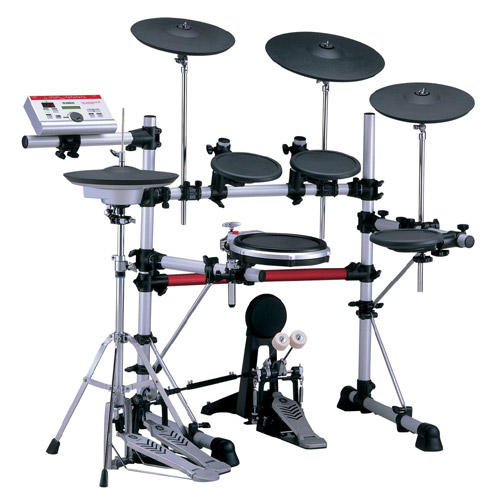
> 5 single pads (65s) (HH, 3 mounted toms, 1 tom next to HH)
> 3 dual trigger pads (80S) (ride, 2 floor toms)
> 1 3 trigger pad - snare
>
> 1 single trigger cymbal
> 2 dual trigger cymbals
>
> 2 BPS80s (splashes, cowbells toerh fun stuf!!)
>
> 1 kick & high hat pedal.
>
> Okay...so I got all that out of the way. My deal is I only have one
> module (DTX 2.0) I need another. One will control cymbals & BP80
and
> the other will control drums.

Ken,

Congratulations on all fronts. You have definitely entered the game
with a flourish. Taste, necessity, and budget are the criteria for
the second module or trigger device. Since you're going to be
connecting stereo cymbals to it, you'll need a unit with at least a
few inputs capable of voicing them--either another DTXpressII, an
XpressI, some kind of Roland, or a long-disontinued DTX 2.0. I might
have included Roland's TMC-6 trigger to MIDI device, or its dear-
departed counterparts, but since, as its name implies, it has only
six inputs, you'd fall short of a full house. A new Roland module
might be too expensive; a used one might be, too, or overkill. An
XpressI, however, would cost you no more than $180-$200 on the used
market, and it would allow you to use your bow/edge cymbals. An old
DTX 2.0 would also fill the bill for not much more; the only drawback
is that it's, well, old. If you've got money to burn, the XpressII is
the ticket; it has what you need and has more re-sale value.

> 1. How will I be able to hear both modules through headphones? Is
> there a device that combines both outputs to a single?

The way to integrate two modules is with something called a mixer. It
will have inputs for the stereo outputs of both modules--and more,
depending on which you get--as well as a headphone jack or two. It
will have level/balance control, a panning spectrum, and possible
effects--again, depending on what level of mixer you choose. If your
needs are modest, the $80 small, well-built Rolls MX-28 will do the
trick. It has stereo inputs for both modules, as well as another for,
say, a CD player if you want to add it to the mix to play along.
Behringer and other companies also have options that are very popular
on this board, and elsewhere, for under $100 (I'm not a particular
fan of this company, but many members have reported great success
with the mixers). Mixers can be elaborate and expensive, but if
you're not adding one for a band, with loads of busses,
inputs/outputs, etc., they are easy to coordinate.

> 2. If I get a different module with different sounds can the two
> modules "share" sounds via MIDI? (I am MIDI ignorant...very!)

Yes, they can connect to each other via MIDI, but one module would
get shortchanged for the sounds of the other. Trigger to MIDI
devices, like the TMC-6 that I mentioned above, work on this
principle, but for them it makes sense. They have no sounds of their
own; their inputs derive their voices solely rom the module to which
they connect via MIDI; they have no embedded sounds of their own.
They serve simply as extra inputs (with their own trigger
parameters). So, you escape the MIDI quandary for now. The mixer is
the answer to your double-module predicament.

Ed
Message
Re: Need multiple modules help!!
2003-11-21 by emf
Attachments
- No local attachments were found for this message.