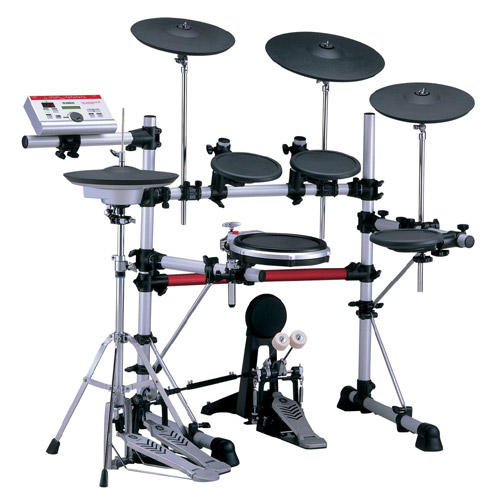
Yamaha DTXpress/DTXplorer/DTXtreme group photo

Yahoo Groups archive

Yamaha DTXpress/DTXplorer/DTXtreme

Index last updated: 2026-04-28 22:44 UTC

Thread

higher quality sounds with a sampler

higher quality sounds with a sampler

2003-05-09 by peterpan

heya guys,

a was chattin 2 a mate of mine yesterday about my setup, and he 
thought it would be a good idea for me to invest in a sampler. he 
said that it should be possible to record real high quality acoustic 
sounds for each pad, so that i can trigger these sounds through the 
pads rather than the compressed synth sounds supplied with the 
dtxpress brain. 

have any of u done something like this before? even if u haven't, do 
u reckon its a good idea?

cheers, pete

Re: higher quality sounds with a sampler

2003-05-09 by liberatusvirus

Why not, if you can afford the time, the effort, and the expense? 
You could use a PC software sampler or a hardware sampler--software 
is reputed to be the better way to go. You can see what your options 
are and manipulate them better. You could use the DTX module as your 
trigger interface; either mute it or use it to layer your samples. 
But even though you're already familiar with the basics of how it 
all works by virtue of using the dtx pads and module, which is 
actually the whole trigger/MIDI/sampler/audio chain rolled into one 
package, the process itself will take some time to master--if you 
ever master such a thing. Getting your sounds right involves all 
sorts of creative and practical considerations. If you have the gut 
feeling that your module, whatever it happens to be, is lacking in 
certain respects, then maybe doing your own sampling and processing 
sounds to your liking is the way to go. My feeling is that most 
people don't really exploit all that they can from their modules (me 
included). Furthermore, rumor has it that the next wave of module 
technology from Yamaha, as well as Roland, will incorporate sampling 
capability as a major component. I, for one, am going to wait for it 
(this summer for Yamaha, or so I'm told). There's a point at which I 
become computer-shy.

--- In DTXpress@yahoogroups.com, "peterpan" <malakies2000@y...> 
wrote:
> 
> heya guys,
> 
> a was chattin 2 a mate of mine yesterday about my setup, and he 
> thought it would be a good idea for me to invest in a sampler. he 
> said that it should be possible to record real high quality 
acoustic 
> sounds for each pad, so that i can trigger these sounds through 
the 
> pads rather than the compressed synth sounds supplied with the 
> dtxpress brain. 
> 
> have any of u done something like this before? even if u haven't, 
do 
Show quoted textHide quoted text
> u reckon its a good idea?
> 
> cheers, pete

Re: higher quality sounds with a sampler

2003-05-09 by moosetication

--- "liberatusvirus" wrote:
> Furthermore, rumor has it that the next wave of module 
> technology from Yamaha, as well as Roland, will incorporate
> sampling capability as a major component. I, for one, am
> going to wait for it...

I'm very keen to see what Yamaha produce here. If they do it as well 
as they do on their high-end digital pianos, it will be jaw-
droppingly good.

It's worth a few words on it (even though it's not e-drums) to whet 
your appetites. We have a Clavinova CLP990 (top end of "last year's 
model" of Clavinovas). Now, on "cheap" piano samplers, they sample 
every few notes (up to an octave sometimes) and then digitally 
interpolate. Moreover, they only sample a "simple" key stroke. 
Yamaha samples the entire keyboard. The grand piano sample alone is 
80Mb. Not only do they sample both key on and key off, but they also 
sample interactions with other keys (for example, hold down a key to 
sustain it and then strike another - the sustained note will be 
modified by the effect of the new one) but also with the soundboard 
and the sustain pedals. It really is truly, truly remarkable and to 
most ears indistinguishable from the concert grand from which it's 
sampled.

Now, mentally extend that to acoustic drum samples. If it works as 
above, we could really start to hear something remarkable. The way a 
crash/ride interacts between the crash and the ride. The resonance 
interaction between toms. The subtle effect of kick-mounted toms 
through the kick itself. Snare buzz. Real cross-stick vs side-stick 
differences.

Damn, I'm now drooling.

The downside? It is, shall we say, far from inexpensive.

Stewart

Re: higher quality sounds with a sampler

2003-05-09 by moosetication

--- I wrote:
> If it works as above, we could really start to
> hear something remarkable.

Obcaveat:

I should have said that my earlier message is the purest speculation, 
based on what I know of their pianos. I do not work for Yamaha, nor 
am I related to or acquainted with anyone who does. I don't own 
Yamaha stock or sell their products. Hell, I can't even spell 
Yammaahhaa.

Stewart

Re: higher quality sounds with a sampler

2003-05-09 by liberatusvirus

Stewart,

The keyboard version sounds amazing. It is staggering to think of 
what the upper end of digital technology can accomplish at this 
stage when the right sort put their minds to it. Sampling, say, trap 
percussion in a way that permits even an approximation of acoustics 
must be an incredibly tall order--like cloning. First of all, drums 
and such are so damned unmathematical. A keyboard is like an 
excercise in Pythagorean theory, with harmonic overtones, 
undertones, dissonance, sustains, etc., all suggesting musicality. 
Those of us who've struggled with the decay feature on the Yamaha 
modules know just how hard it is to get even the right fade on 
digital percussion. But how do you qualify the interaction between 
various sorts of untuned, differentially resonant things so that you 
can quantify them accurately enough to fool the ear--quite apart 
from sampling and manipulating single sounds to avoid the machine-
gun effect? What we're talking about on digital drums is controlled 
crosstalk--the ability of digital drums to sound like they occupy 
the same space without sounding like they occupy THE SAME SPACE. But 
even in acoustic situations, manufacturers try to limit this sort of 
interference with various mounts and materials. So what would be a 
natural sympathetic vibration? 

Anyway, such are the ruminations of an ignorant man. All edification 
is welcome.

Ed
--- In DTXpress@yahoogroups.com, "moosetication" 
<moosetication@y...> wrote:
> --- "liberatusvirus" wrote:
> > Furthermore, rumor has it that the next wave of module 
> > technology from Yamaha, as well as Roland, will incorporate
> > sampling capability as a major component. I, for one, am
> > going to wait for it...
> 
> I'm very keen to see what Yamaha produce here. If they do it as 
well 
> as they do on their high-end digital pianos, it will be jaw-
> droppingly good.
> 
> It's worth a few words on it (even though it's not e-drums) to 
whet 
> your appetites. We have a Clavinova CLP990 (top end of "last 
year's 
> model" of Clavinovas). Now, on "cheap" piano samplers, they sample 
> every few notes (up to an octave sometimes) and then digitally 
> interpolate. Moreover, they only sample a "simple" key stroke. 
> Yamaha samples the entire keyboard. The grand piano sample alone 
is 
> 80Mb. Not only do they sample both key on and key off, but they 
also 
> sample interactions with other keys (for example, hold down a key 
to 
> sustain it and then strike another - the sustained note will be 
> modified by the effect of the new one) but also with the 
soundboard 
> and the sustain pedals. It really is truly, truly remarkable and 
to 
> most ears indistinguishable from the concert grand from which it's 
> sampled.
> 
> Now, mentally extend that to acoustic drum samples. If it works as 
> above, we could really start to hear something remarkable. The way 
a 
> crash/ride interacts between the crash and the ride. The resonance 
> interaction between toms. The subtle effect of kick-mounted toms 
> through the kick itself. Snare buzz. Real cross-stick vs side-
stick 
Show quoted textHide quoted text
> differences.
> 
> Damn, I'm now drooling.
> 
> The downside? It is, shall we say, far from inexpensive.
> 
> Stewart
Re: higher quality sounds with a sampler

2003-05-09 by moosetication

--- "liberatusvirus" wrote:
> But how do you qualify the interaction between 
> various sorts of untuned, differentially resonant
> things...

Oh, I'm not claiming it's either easy or an equivalent problem. It 
certainly seems that sampling such interactions on a piano is 
somewhat more deterministic than an acoustic drum kit. After all, 
piano strings are also supposed to be pitched just so, of a known 
length, struck in a given place, arranged a known distance apart, and 
so on. However, (with respect) smarter minds than mine or yours will 
have worked on this and if they can get even close (perhaps just 
modeling the interactions within a single piece of percussion) then 
groovy things may be in the offing. For example... what do most of us 
complain about most? Cymbals, I'd guess. It doesn't seem to be beyond 
the realms of hope that they can make a better job there using these 
sorts of techniques.

Here's hoping. Well, actually probably not. If it is that good, I 
won't be able to afford it!

Stewart

Re: [DTXpress] Re: higher quality sounds with a sampler

2003-05-09 by Vernon Graner

moosetication said:
> The way a
> crash/ride interacts between the crash and the ride. The resonance
> interaction between toms. The subtle effect of kick-mounted toms
> through the kick itself. Snare buzz. Real cross-stick vs side-stick
> differences.
>
> Damn, I'm now drooling.
>
> The downside? It is, shall we say, far from inexpensive.

Other downside? As a sound engineer, those "realism" touches you describe
above were the exact types of things I was always trying to
minimize/eliminate! Isolating a tom from a cymbal, getting rid of the
snare buzz when the bass guitar was playing and the drums were *supposed*
to be silent, etc. etc.

I s'pose it would add to the "realism" of the kit, but IMHO, it is
possible to take realism too far... I sure wouldn't want to go to a
theatre to see JAWS and then come home missing a leg and sporting a nasty
sun-burn! :D

Vern

-- 
Vern Graner CNE/CNA/SSE     | "If the network is down, then you're
Senior Systems Engineer     | obviously incompetent so why are we
Texas Information Services  | paying you? Of course, if the network
vern@... www.txis.com  | is up, then we obviously don't need
Cell 507-7851 Desk 328-8947 | you, so why are we paying you?" VLG

Re: higher quality sounds with a sampler

2003-05-09 by liberatusvirus

Stewart,

Better minds than ours? Perish the thought. It's an exciting 
prospect, and balancing it with the issue that Vern raises makes it 
all the more interesting. We have nothing to gain here but knowledge.

Ed
--- In DTXpress@yahoogroups.com, "moosetication" 
<moosetication@y...> wrote:
> --- "liberatusvirus" wrote:
> > But how do you qualify the interaction between 
> > various sorts of untuned, differentially resonant
> > things...
> 
> Oh, I'm not claiming it's either easy or an equivalent problem. It 
> certainly seems that sampling such interactions on a piano is 
> somewhat more deterministic than an acoustic drum kit. After all, 
> piano strings are also supposed to be pitched just so, of a known 
> length, struck in a given place, arranged a known distance apart, 
and 
> so on. However, (with respect) smarter minds than mine or yours 
will 
> have worked on this and if they can get even close (perhaps just 
> modeling the interactions within a single piece of percussion) 
then 
> groovy things may be in the offing. For example... what do most of 
us 
> complain about most? Cymbals, I'd guess. It doesn't seem to be 
beyond 
> the realms of hope that they can make a better job there using 
these 
Show quoted textHide quoted text
> sorts of techniques.
> 
> Here's hoping. Well, actually probably not. If it is that good, I 
> won't be able to afford it!
> 
> Stewart

Re: higher quality sounds with a sampler

2003-05-09 by underneathheaven

So we would ideally want the benefits of electronics drums minus the 
flaws of acoustic drums?

-UN.H


--- In DTXpress@yahoogroups.com, "liberatusvirus" 
<liberatusvirus@y...> wrote:
> Stewart,
> 
> Better minds than ours? Perish the thought. It's an exciting 
> prospect, and balancing it with the issue that Vern raises makes 
it 
> all the more interesting. We have nothing to gain here but 
knowledge.
> 
> Ed
> --- In DTXpress@yahoogroups.com, "moosetication" 
> <moosetication@y...> wrote:
> > --- "liberatusvirus" wrote:
> > > But how do you qualify the interaction between 
> > > various sorts of untuned, differentially resonant
> > > things...
> > 
> > Oh, I'm not claiming it's either easy or an equivalent problem. 
It 
> > certainly seems that sampling such interactions on a piano is 
> > somewhat more deterministic than an acoustic drum kit. After 
all, 
> > piano strings are also supposed to be pitched just so, of a 
known 
> > length, struck in a given place, arranged a known distance 
apart, 
> and 
> > so on. However, (with respect) smarter minds than mine or yours 
> will 
> > have worked on this and if they can get even close (perhaps just 
> > modeling the interactions within a single piece of percussion) 
> then 
> > groovy things may be in the offing. For example... what do most 
of 
> us 
> > complain about most? Cymbals, I'd guess. It doesn't seem to be 
> beyond 
> > the realms of hope that they can make a better job there using 
> these 
> > sorts of techniques.
> > 
> > Here's hoping. Well, actually probably not. If it is that good, 
I 
Show quoted textHide quoted text
> > won't be able to afford it!
> > 
> > Stewart

Move to quarantaine

This moves the raw source file on disk only. The archive index is not changed automatically, so you still need to run a manual refresh afterward.