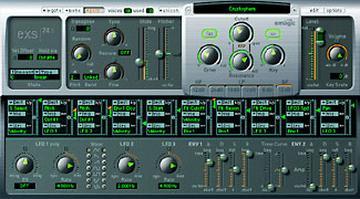
At 12:23 PM 7/4/2011, you wrote:

> >> what is Dc good for?
> >
> > checking that box will concurrently apply the built-in amplitude
> envelope to the release sample; when the note-off event occurs the
> release sample amplitude depends on the state of this envelope;
> playing staccato will probably let the release sound play at full
> amplitude, yet if the note is held on long enough, this amplitude
> might have decayed to 0, meaning there won't be any release sound at all...
> >
> > if unchecked, it will make the exs|24 instrument wait for the
> note-off event before the release sample is triggered - at full
> amplitude, of course!
>
>Doesn't work here.
>When Trigger is set to key release, the sample always plays at the
>same volume, no matter if the key was pressed for a long or a short
>time, and no matter if Dc is checked or not. Also, the ENV2
>parameters have no influence at all then (I can even set A, D, S,
>and R to zero). The only thing that influences the sample's envelope
>is the Time parameter.
>I tried with Logic 9, MainStage 2 and Logic 8, it's all the same.

Right. "Dc" I think means Decay Control. When Dc is checked, the
"Time" parameter in the Group is a Note Counter, in milliseconds.
This measures the time between noteon and noteoff. If the Time
parameter is 2000ms, and there was 1000ms (1 sec) between noteon and
noteoff, the release sample will be 50% of the original volume. It's
the "correct" way to deal with RT volume. Some people prefer release
velocity control, but people often don't play with that in mind.

You program the Time parameter with the actual decay of the sample in
mind. For example, take a piano; look at the actual decay, then put
the Time parameter consistent with it.

I believe that the Env2 (Amp) Decay parameter is paid attention to
when considering the release time of the RT. Remember the Sustain
level is still considered in calculating the Decay Time. When the
Sustain Level is 0, the Decay Time is as-is. If (for example) the
Sustain Level is 50%, you cut the Decay Time in half. (EXS uses
"rate-based" envelopes.) This is where the Group Offsets for the Env2
(Amp) settings are valuable, you can create your own custom settings
for the RT samples.

Garth Hjelte
Sampler User
Message
Re: [EXS] Dc parameter?
2011-07-04 by Garth Hjelte
Attachments
- No local attachments were found for this message.