EXS 24 Logic Sampler Users Group group photo

Yahoo Groups archive

EXS 24 Logic Sampler Users Group

Index last updated: 2026-04-28 23:25 UTC

Thread

Dc parameter?

Dc parameter?

2011-07-03 by Ingo Debus

Hi all,

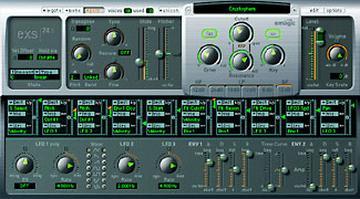
I want to trigger a sample on key-release. I've done this before, and I remember that the group parameters Dc (Decay) and Time are involved. Time is for the length of a very simple amplitude envelope for the sample, but what is Dc good for? The help tells me that I have to activate Dc to access Time, but I can access Time no matter if Dc is activated or not. Does it have any other function? Or is this just a new feature/bug of Logic 9?

Ingo

Dc parameter?

2011-07-04 by Feat

At 21:16 +0200 3/07/11, Ingo Debus wrote:
>what is Dc good for?

checking that box will concurrently apply the built-in amplitude envelope to the release sample; when the note-off event occurs the release sample amplitude depends on the state of this envelope; playing staccato will probably let the release sound play at full amplitude, yet if the note is held on long enough, this amplitude might have decayed to 0, meaning there won't be any release sound at all...

if unchecked, it will make the exs|24 instrument wait for the note-off event before the release sample is triggered - at full amplitude, of course!

Re: [EXS] Dc parameter?

2011-07-04 by Ingo Debus

Am 04.07.2011 um 10:32 schrieb Feat:

> At 21:16 +0200 3/07/11, Ingo Debus wrote:
>> what is Dc good for?
> 
> checking that box will concurrently apply the built-in amplitude envelope to the release sample; when the note-off event occurs the release sample amplitude depends on the state of this envelope; playing staccato will probably let the release sound play at full amplitude, yet if the note is held on long enough, this amplitude might have decayed to 0, meaning there won't be any release sound at all...
> 
> if unchecked, it will make the exs|24 instrument wait for the note-off event before the release sample is triggered - at full amplitude, of course!

Doesn't work here.
When Trigger is set to key release, the sample always plays at the same volume, no matter if the key was pressed for a long or a short time, and no matter if Dc is checked or not. Also, the ENV2 parameters have no influence at all then (I can even set A, D, S, and R to zero). The only thing that influences the sample's envelope is the Time parameter.
I tried with Logic 9, MainStage 2 and Logic 8, it's all the same.

Ingo

[Non-text portions of this message have been removed]

Re: [EXS] Dc parameter?

2011-07-04 by Garth Hjelte

At 12:23 PM 7/4/2011, you wrote:

> >> what is Dc good for?
> >
> > checking that box will concurrently apply the built-in amplitude 
> envelope to the release sample; when the note-off event occurs the 
> release sample amplitude depends on the state of this envelope; 
> playing staccato will probably let the release sound play at full 
> amplitude, yet if the note is held on long enough, this amplitude 
> might have decayed to 0, meaning there won't be any release sound at all...
> >
> > if unchecked, it will make the exs|24 instrument wait for the 
> note-off event before the release sample is triggered - at full 
> amplitude, of course!
>
>Doesn't work here.
>When Trigger is set to key release, the sample always plays at the 
>same volume, no matter if the key was pressed for a long or a short 
>time, and no matter if Dc is checked or not. Also, the ENV2 
>parameters have no influence at all then (I can even set A, D, S, 
>and R to zero). The only thing that influences the sample's envelope 
>is the Time parameter.
>I tried with Logic 9, MainStage 2 and Logic 8, it's all the same.

Right. "Dc" I think means Decay Control. When Dc is checked, the 
"Time" parameter in the Group is a Note Counter, in milliseconds. 
This measures the time between noteon and noteoff. If the Time 
parameter is 2000ms, and there was 1000ms (1 sec) between noteon and 
noteoff, the release sample will be 50% of the original volume. It's 
the "correct" way to deal with RT volume. Some people prefer release 
velocity control, but people often don't play with that in mind.

You program the Time parameter with the actual decay of the sample in 
mind. For example, take a piano; look at the actual decay, then put 
the Time parameter consistent with it.

I believe that the Env2 (Amp) Decay parameter is paid attention to 
when considering the release time of the RT. Remember the Sustain 
level is still considered in calculating the Decay Time. When the 
Sustain Level is 0, the Decay Time is as-is. If (for example) the 
Sustain Level is 50%, you cut the Decay Time in half. (EXS uses 
"rate-based" envelopes.) This is where the Group Offsets for the Env2 
(Amp) settings are valuable, you can create your own custom settings 
for the RT samples.

Garth Hjelte
Sampler User
Re: [EXS] Dc parameter?

2011-07-04 by Ingo Debus

Am 04.07.2011 um 19:10 schrieb Garth Hjelte:

> Right. "Dc" I think means Decay Control. When Dc is checked, the 
> "Time" parameter in the Group is a Note Counter, in milliseconds. 
> This measures the time between noteon and noteoff. If the Time 
> parameter is 2000ms, and there was 1000ms (1 sec) between noteon and 
> noteoff, the release sample will be 50% of the original volume. It's 
> the "correct" way to deal with RT volume. Some people prefer release 
> velocity control, but people often don't play with that in mind.
> 
> You program the Time parameter with the actual decay of the sample in 
> mind. For example, take a piano; look at the actual decay, then put 
> the Time parameter consistent with it.
> 

Are we talking about the same program here? EXS24 for Apple Macintosh that comes with Logic Pro 9.1.4 and MainStage 2.1.3? ;-)

I cannot set Time to 2000. Maximum value is 1000. Also, as I wrote, the amplitude and envelope of the release sample is absolutely independent of the length of the note previously played (the time between note on and note off).
BTW, what does RT stand for? Release Trigger?

> I believe that the Env2 (Amp) Decay parameter is paid attention to 
> when considering the release time of the RT. Remember the Sustain 
> level is still considered in calculating the Decay Time.

I believe that the Env2 parameters are completely ignored when Trigger is set to key released. At least that's what the help file says (slightly hidden, under "Envelope 1 Offsets" and "Envelope 2 Offsets").

> When the 
> Sustain Level is 0, the Decay Time is as-is. If (for example) the 
> Sustain Level is 50%, you cut the Decay Time in half. (EXS uses 
> "rate-based" envelopes.) This is where the Group Offsets for the Env2 
> (Amp) settings are valuable, you can create your own custom settings 
> for the RT samples.


The group offsets for Env2 aren't accessible as soon as Trigger is set to key released.

Ingo


[Non-text portions of this message have been removed]

Re: [EXS] Dc parameter?

2011-07-04 by Garth Hjelte

Before we start, is there a reason why the Reply-To on your emails 
goes to exs-users-owner@yahoogroups.com? Fortunately, I caught that. 
Otherwise my reply would not have gone to the list.

At 03:35 PM 7/4/2011, you wrote:

> > Right. "Dc" I think means Decay Control. When Dc is checked, the
> > "Time" parameter in the Group is a Note Counter, in milliseconds.
> > This measures the time between noteon and noteoff. If the Time
> > parameter is 2000ms, and there was 1000ms (1 sec) between noteon and
> > noteoff, the release sample will be 50% of the original volume. It's
> > the "correct" way to deal with RT volume. Some people prefer release
> > velocity control, but people often don't play with that in mind.
> >
> > You program the Time parameter with the actual decay of the sample in
> > mind. For example, take a piano; look at the actual decay, then put
> > the Time parameter consistent with it.
> >
>
>Are we talking about the same program here? EXS24 for Apple 
>Macintosh that comes with Logic Pro 9.1.4 and MainStage 2.1.3? ;-)

Yep! I am not in front of it at the moment but I have extensive 
experience with it. Any numerical examples are meant to illustration, 
numerical values may be wrong.

I will also say I will be checking on Logic 8, not 9, but the 
functionality should be the same (unless Logic 9 bugged it, which I doubt).

>I cannot set Time to 2000. Maximum value is 1000.

See above.

>Also, as I wrote, the amplitude and envelope of the release sample 
>is absolutely independent of the length of the note previously 
>played (the time between note on and note off).

OK, I'll check tomorrow when I'm in front of it, but I wrote from 
memory that has been burned in pretty well. Dc is the note counter 
and that's how it works.

>BTW, what does RT stand for? Release Trigger?

Right.

> > I believe that the Env2 (Amp) Decay parameter is paid attention to
> > when considering the release time of the RT. Remember the Sustain
> > level is still considered in calculating the Decay Time.
>
>I believe that the Env2 parameters are completely ignored when 
>Trigger is set to key released. At least that's what the help file 
>says (slightly hidden, under "Envelope 1 Offsets" and "Envelope 2 Offsets").

Whether the sound is looped also factors into it (strangely). The 
documentation may be completely wrong.

> > When the
> > Sustain Level is 0, the Decay Time is as-is. If (for example) the
> > Sustain Level is 50%, you cut the Decay Time in half. (EXS uses
> > "rate-based" envelopes.) This is where the Group Offsets for the Env2
> > (Amp) settings are valuable, you can create your own custom settings
> > for the RT samples.
>
>The group offsets for Env2 aren't accessible as soon as Trigger is 
>set to key released.

I'll check this Tuesday.

Garth Hjelte
Sampler User

Move to quarantaine

This moves the raw source file on disk only. The archive index is not changed automatically, so you still need to run a manual refresh afterward.