Thoughts from the mind of Josh Emmons, 20-11-2002:

>For me, the difference is that CPUs, RAM, updates, USB, 802.11,
>PCMCIA, and other computer industry techno-phrases are all explained
>very well in manuals or are at least documented in some book or another
>by O'Reilly & Associates.

You got a point there.  It's true, I think, that most VSTi's
presuppose some synth background and don't do a very good job of
explaining what VCO and VCF's are.  Never gave that much though,
really.  I mean, if there was indeed such an explanatory section in
any manual, I would skip it anyway... but come to think of it, I
think you may be right.

>Not that I have anything against trial and error!  I think it's
>probably the best way to learn.  I'm just saying I can see how we got
>to this state of affairs when we can all talk on the same level about
>tech, but not about instruments or samplers, or whatever the heck a VCO
>is -- the tech knowledge is more accessible.

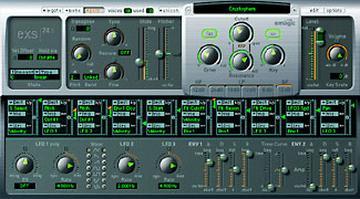
Yes, in a sense...  Still almost every synth, hardware or software,
operates on the same basic principles: a sound generator (oscillator
or samples) goes into a filter, which goes into an amplifier.  And
these can all be modulated be either a periodic source (LFO) or a
non-periodic source (ADSR).  And that's basically all there is to it,
no matter how complicated it may get.  And this principle has been
around since the first Moogs from the 60-ies.  So... in a sense this
technology is ancient, and has been around in every synth for some 40
years.  I guess I expected such an ancient technology to be somewhat
"common sense" by now, despite the lack of documentation.  I thought
that the mere fact that almost every synth has been operating on
these principles for decades was enough to... spread the knowledge or
something.

And yes, I know that in the above I ignore FM synthesis, additive
synthesis, granular, virtual modelling, etc.  These are all still
_relatively_ "niche" technologies though -- except maybe for FM.  The
bulk of synths out there still use old fashioned subtractive
synthesis.

BTW, there surely is a website somewhere that goes into the details
of the various synthesis principles, isn't there?

And, for the record, a VCO is a Voltage Controlled Oscillator.  Old
technology, commercialised for the masses by Moog, in which the
frequency of an oscillator was determined by the incoming voltage.
The keyboard would simply produce different voltages for different
keys, and voila, you would have different notes when striking
different keys.  All old analog synths use this same principle of
voltage driven modules.  Very clever and flexible -- except that it
was next to impossible to make polyphonic synths this way. So a VCF
is a Voltage Controlled Filter, and a VCA is ditto, amplifier.
Some digital synths adapted this terminology, and called their
oscillator a DCO -- a Digitally Controlled Oscillator -- suggesting
some sort of connection with the old VCO, while there really isn't
that much in common between the two (except that they both act as the
sound source, of course).  Same with DCF's and DCA's.  A bit silly
imo, but I suppose it got the message across so users would
understand what the various parts did.  Okay, end of "ancient tech
lecture".


--
Hendrik Jan Veenstra  <h@...>
Omega Art: http://www.ision.nl/users/h/index.html
Message
Re: [exs] Programming tip from John Lehmkuhl
2002-11-21 by Hendrik Jan Veenstra
Attachments
- No local attachments were found for this message.