EXS 24 Logic Sampler Users Group group photo

Yahoo Groups archive

EXS 24 Logic Sampler Users Group

Index last updated: 2026-04-28 23:25 UTC

Thread

Programming tip from John Lehmkuhl

Programming tip from John Lehmkuhl

2002-11-20 by Eli Krantzberg

Hi All,

For those of you who may have missed it on the LUG yesterday, John Lehmkuhl posted a nice little step by step tutorial on setting filter cutoff and key tracking parameters to be effected by velocity to get more playable instruments. I found it quite useful and thought I'd pass it along. Here it is:


---------------------


Message: 13
   Date: Tue, 19 Nov 2002 13:35:26 -0800
Show quoted textHide quoted text
   From: John Lehmkuhl <realkuhl@...>
Subject: [GEN] Velocity and the ESX24

>> EXS24 has a decent low pass filter. If you set it up right, it will give
>> anything much more dynamics than the way you originally call it up.
Anybody
>> want a step by step on how to turn on the filter and assign velocity to it
>> ??

> I'd love to get your methods on the most effective ways of setting this up.
> Thanks!
>
>
> --
> Eli Krantzberg


To make this simple I figured I'd do this "tutorial" with a pre-existing
program to start.  Follow the steps below:

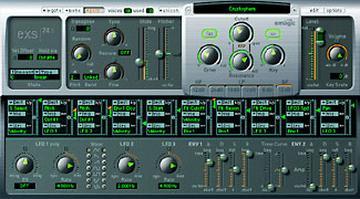
 From the EXS factory folder, load up "Stereo Grand ECO".
 From my Korg Triton keyboard, this is not very dynamic, even though the
filter is turned on.
 To give the filter more range lets do 2 things. First, bring down the
filter cutoff (big know top middle of screen that says "Cutoff" above it). I
wanted to make this a much darker piano since it's not very pretty when it's
bright. So I moved the cutoff knob from it's 11:30 position to about 9:00.
That made it nice and dark, but almost too dark. I want it so that if I dig
in with velocity, that it will get brighter. To the right of the filter knob
You see the "ADSR" slider. Actually, you see 2 halves, the top half is the
"Top" of your velocity range and the Bottom half sets how dark the sound
will be with a velocity value of 1. Take that top half of the circle and
raise it up - I have it at about 70%. Again this is VERY subjective based on
what keyboard controller you use (the Nord Lead plays WAY to sensitively
with the above setting compared to the Triton's velocity curve).

Now that the sound is very dark when you play soft, it might be too dark in
the lower range of the keyboard. That's what the "Key" knob is for. With
it's current setting, it is filtering the bottom of the keyboard range too
much so bring it down to about 9:00 and notice how the bottom range of the
keyboard is brighter now  - much better.

 It gets too dark sounding too quickly. That is because the Env 1 "D" value
is too short. Crank that slider up to about 90-95% and play the top register
really hard to hear the filter action.

 Finally, to make it even more expressive you could have the Amp respond
more to velocity. It's not very dynamic in its' default setting. So, Grab
the lower half of the slider called "Level" and bring that down to 30% (it's
currently at about 60%) and notice how the sound is now even more softer
when you play softly.

Viola !!

Now you can play solo piano with the "Stereo Grand ECO" patch where you
couldn't before.


Hope this "helps" ==)
EXS can do so much more, but lets start with this.

Sincerely,
John Lehmkuhl

Re: [exs] Programming tip from John Lehmkuhl

2002-11-20 by Hendrik Jan Veenstra

Thoughts from the mind of Eli Krantzberg, 20-11-2002:

>For those of you who may have missed it on the LUG yesterday, John 
>Lehmkuhl posted a nice little step by step tutorial on setting 
>filter cutoff and key tracking parameters to be effected by velocity 
>to get more playable instruments. I found it quite useful and 
>thought I'd pass it along. Here it is:

All sorts of respect for John, but isn't this plain vanilla & rather 
obvious old-fashioned synth programming?  Or does this remark only 
show that I'm getting old and come from a generation who actually 
tweaked the knobs they had at their disposal?  I mean, a filter 
tracking velocity & key is... well.. sort of lesson 1 in synth 
programming, isn't it?  And no, I don't mean this in some sort of 
arrogant way.  I just don't quite get it...

-- 
Hendrik Jan Veenstra  <h@...>
Omega Art: http://www.ision.nl/users/h/index.html

Re: [exs] Programming tip from John Lehmkuhl

2002-11-20 by Ben Hall

"Hendrik Jan Veenstra" <h@...> wrote:

> All sorts of respect for John, but isn't this plain vanilla & rather
> obvious old-fashioned synth programming?

I'm sure it is for some, but there are plenty of other people that tend to
play rather than program, so don't really delve into this sort of tweaking.
It certainly is basic stuff for John, which is why he asked if anyone would
like a little walkthrough, rather than just posting it...

Anyway, I think it's cool when people post this sort of good info, and I for
one have learnt *a lot* from Skip's programming skills over the years - I
would never turn down tips from good people - you can never stop learning...
And he's certainly one of the best voicing programmers out there.

> Or does this remark only show that I'm getting old and
> come from a generation who actually tweaked the knobs
> they had at their disposal?

Actually, it's mostly the other way around for me - the older I get the less
programming I do and the more I concentrate on the simple things - the
playing, the arrangements, the song, the lyrics etc.

I find these days, with *sooo* many sounds at my disposal, the need for
tweaking is much less than when I just had a CZ-101 and a drum machine and
had to do *everything* with that one synth. I used to really program the
nuts out of my limited gear. To do the same with my current gear would mean
I'd never get any music done..!! (An XV-5080 is rather deeper than a
CZ-101..!)

Of course, knowing what to do when you need to tweak things is very useful,
and being able to program sounds means that you can often find your voice
with otherwise often quite bland instruments, so they are good skills to
have - but for me, it's the end result that's important. If I need to
program something from scratch for a particular reason, I will do it. If I
can achieve what I want through more immediate means, then great! :-)

Ben Hall
www.benhall.co.uk

Re: [exs] Programming tip from John Lehmkuhl

2002-11-20 by Sascha Franck

Just my two cents:
A simple velocity-to-cutoff function is there straight in the EXS (you'll
find it under the hidden parameters).
Sufficient for a lot of things, no need to setup any filter ADSR either
(even if such a setting might give you better results).

Regards,
Sascha

Re: [exs] Programming tip from John Lehmkuhl

2002-11-20 by Eli Krantzberg

Hendrik Jan Veenstra wrote:

>
> All sorts of respect for John, but isn't this plain vanilla & rather
> obvious old-fashioned synth programming?  Or does this remark only
> show that I'm getting old and come from a generation who actually
> tweaked the knobs they had at their disposal?

For people who haven't been eating vanilla their whole life, it's a great exciting flavour!

I'm 42 years old and keyboards aren't my first instrument (I'm a drummer mainly and vibraphonist secondly, keyborad player thirdly). Aside from using some old drum machines for live use in the late eighties, I only got into Midi in the early nineties. I missed that whole generation of synth programming in the mid eighties. I didn't come up from that skool. So, while I do "know" about this sort of stuff already, it's not second nature to me. And not knowing it intuitively in my bones, I learn a little something new each time it is explained a little bit differently. I "get it" a little bit more each time.

I don't think I'm alone in this sort of situation. I'm a career musican who isn't a keyboard player who came into midi later on. It's mostly, in my experience, real "keyboard" players from the eighties who eat this stuff for breakfast everyday. And I know way more home studio/midi musicians/engineers who _don't_ have this sort of background than who do.

Having the EXS has really opened up my understanding of this sort of programming a lot. Seeing it all in one screen really helps me get the bigger picture. I was always lost scrolling through those EG, VDF, Env, WG, TVF, TVA, etc wiondows on the little LCD screens.


--
Eli Krantzberg
Nightshift Orchestra / Almat Productions
http://www.nightshiftorchestra.com

Re: [exs] Programming tip from John Lehmkuhl

2002-11-20 by Hendrik Jan Veenstra

Thoughts from the mind of Eli Krantzberg, 20-11-2002:

>Hendrik Jan Veenstra wrote:
>
>  > All sorts of respect for John, but isn't this plain vanilla & rather
>>  obvious old-fashioned synth programming?  Or does this remark only
>>  show that I'm getting old and come from a generation who actually
>>  tweaked the knobs they had at their disposal?
>
>For people who haven't been eating vanilla their whole life, it's a 
>great exciting flavour!
>[..etc...]
>And I know way more home studio/midi musicians/engineers who _don't_ 
>have this sort of background than who do.

Okay, okay... you almost sound somewhat offended.  Really, I didn't 
mean any harm.  Was just wondering -- being a mid-80ies keyboardist 
myself :-).  And, I mean, everybody nowadays raves about how great 
Absynth is, and the ES2, and all such gear, which had me thinking 
that all these people are notorious knob-tweakers...  After all, 
these synths have knobs, and if people rave about them, they surely 
have tweaked these knobs...

Well, apparently I'm mistaken...  Okay, learning something new every day...

>Having the EXS has really opened up my understanding of this sort of 
>programming a lot. Seeing it all in one screen really helps me get 
>the bigger picture. I was always lost scrolling through those EG, 
>VDF, Env, WG, TVF, TVA, etc wiondows on the little LCD screens.

Ah...  That's interesting...  And kind of funny, in a way.  I mean, 
here we are, all worrying about CPU cycles, and software updates, and 
the fastest RAM, and USB and Firewire, and ASIO vs DIO, and all sorts 
of technical gibberish that most people would find completely 
unintelligible -- and apparently (almost) everyone here knows what 
we're talking about.  And then it appears that this same sort of 
techno-geek-literacy we all share does _not_ apply when it comes down 
to the instruments we play music with...  I mean, that *is* somewhat 
curious, in a way, isn't it?  Not that it matters that much.  Not at 
all in fact.  Still it's a somewhat curious state of affairs imho.

-- 
Hendrik Jan Veenstra  <h@...>
Omega Art: http://www.ision.nl/users/h/index.html

Re: [exs] Programming tip from John Lehmkuhl

2002-11-20 by Ned Bouhalassa

I agree with you, Hendrik, that it would a strange state of affairs, but 
I'm not sure that we can say that most or even half the people on this list 
have never or rarely used typical analog synthesis routing/programming to 
get sounds out of their softsynths. I mean, how many people post on a 
regular basis vs how many people read this list? It _would_ be interesting 
to have a poll where we ask people if they have any understanding of terms 
like ADSR, VCO, frequency modulation vs amplitude modulation, LFO mod to 
filter cutoff, etc.

Ned

Hendrik Jan Veenstra wrote:
  > Ah...  That's interesting...  And kind of funny, in a way.  I mean,
> here we are, all worrying about CPU cycles, and software updates, and
> the fastest RAM, and USB and Firewire, and ASIO vs DIO, and all sorts
> of technical gibberish that most people would find completely
> unintelligible -- and apparently (almost) everyone here knows what
> we're talking about.  And then it appears that this same sort of
> techno-geek-literacy we all share does _not_ apply when it comes down
> to the instruments we play music with...  I mean, that *is* somewhat
> curious, in a way, isn't it?  Not that it matters that much.  Not at
> all in fact.  Still it's a somewhat curious state of affairs imho.


http://www.nedfx.com

       Ned Bouhalassa

n e d @ n e d f x . c o m

RE: [exs] Programming tip from John Lehmkuhl

2002-11-20 by Kim Chr. Hvidkjaer

Hi Ned,

For starters (regarding the poll), I'm quite a newbie to the whole ADSR,
VCO, LFO, etc babble. I've been using computers for maaaaany years so those
terms are only all to familiar. My background is as a guitarist, why the
synth-world is somewhat new (but not THAT new ;-)..

Kim..
Show quoted textHide quoted text
-----Original Message-----
From: Ned Bouhalassa [mailto:ned@...]
Sent: 20. november 2002 18:09
To: exs-users@yahoogroups.com
Subject: Re: [exs] Programming tip from John Lehmkuhl


I agree with you, Hendrik, that it would a strange state of affairs, but
I'm not sure that we can say that most or even half the people on this list
have never or rarely used typical analog synthesis routing/programming to
get sounds out of their softsynths. I mean, how many people post on a
regular basis vs how many people read this list? It _would_ be interesting
to have a poll where we ask people if they have any understanding of terms
like ADSR, VCO, frequency modulation vs amplitude modulation, LFO mod to
filter cutoff, etc.

Ned

Hendrik Jan Veenstra wrote:
  > Ah...  That's interesting...  And kind of funny, in a way.  I mean,
> here we are, all worrying about CPU cycles, and software updates, and
> the fastest RAM, and USB and Firewire, and ASIO vs DIO, and all sorts
> of technical gibberish that most people would find completely
> unintelligible -- and apparently (almost) everyone here knows what
> we're talking about.  And then it appears that this same sort of
> techno-geek-literacy we all share does _not_ apply when it comes down
> to the instruments we play music with...  I mean, that *is* somewhat
> curious, in a way, isn't it?  Not that it matters that much.  Not at
> all in fact.  Still it's a somewhat curious state of affairs imho.


http://www.nedfx.com

       Ned Bouhalassa

n e d @ n e d f x . c o m


To unsubscribe from this group, send a blank email to:
   exs-users-unsubscribe@egroups.com
For a list of places to get free samples please see:
   http://groups.yahoo.com/group/exs-users/links/


Your use of Yahoo! Groups is subject to http://docs.yahoo.com/info/terms/

Re: [exs] Programming tip from John Lehmkuhl

2002-11-20 by Eli Krantzberg

Hendrik Jan Veenstra wrote:

>
> Okay, okay... you almost sound somewhat offended.  Really, I didn't
> mean any harm.

I know, I'm not offended. Just wanted to make it clear: I'm not as dumb as I look :-)

> And then it appears that this same sort of
> techno-geek-literacy we all share does _not_ apply when it comes down
> to the instruments we play music with...  I mean, that *is* somewhat
> curious, in a way, isn't it?

Yes, it is. But we all find our own unique paths into this technology and how to use it. We're not all savy on the same levels about the same things. There's a jingle writer here in town I occasionally work for. He uses Logic 3.6 on a stock 7600/132. I am always shocked when he calls me with the most basic questions about file management or midi channel routing, etc. And I'm not joking when I say basic. It's a miracle to me that he can even get midi into Logic sometimes. But the guy is one of the busiest most prolific jingle writers in this city.

Ned wrote:

> It _would_ be interesting
> to have a poll where we ask people if they have any understanding of terms
> like ADSR, VCO, frequency modulation vs amplitude modulation, LFO mod
> to
> filter cutoff, etc.
>

Well, I'll start off by saying, that I know what (almost) all of these concepts mean. But I don't have a lot of hands on real world day to day experience with some of them. It hasn't really "sunk in" to my brain. Every time I read about or learn a new little tip or nuance on applying some of this, it becomes a bit clearer. It's like driving on a foggy road. You can still make your way, and get from point A to point B. But each time it becomes unravelled for me a little more for me, it's like the fog clears a little bit more.


--
Eli Krantzberg
Nightshift Orchestra / Almat Productions
http://www.nightshiftorchestra.com

Re: [exs] Programming tip from John Lehmkuhl

2002-11-20 by Sascha Franck

Hendrik Jan Veenstra wrote:
> Ah...  That's interesting...  And kind of funny, in a way.  I mean,
> here we are, all worrying about CPU cycles, and software updates, and
> the fastest RAM, and USB and Firewire, and ASIO vs DIO, and all sorts
> of technical gibberish that most people would find completely
> unintelligible -- and apparently (almost) everyone here knows what
> we're talking about.  And then it appears that this same sort of
> techno-geek-literacy we all share does _not_ apply when it comes down
> to the instruments we play music with...  I mean, that *is* somewhat
> curious, in a way, isn't it?  Not that it matters that much.  Not at
> all in fact.  Still it's a somewhat curious state of affairs imho.

Isn't that just the same with a lot of things?
Take music in general (or Eli's example for a specific technical case); how
many people are there (in the socalled pro league that is) that still know
how to read sheet music, interprete chords or even play an instrument at
all? Less and less. The same might be true for technical experience in other
areas.
Seems as if us ol' handworkers are dying away - and I can even understand
that. Myself, I studied music, know quite a lot about theory, blabla, and
from a technical viewpoint I even know the most hidden screws of any of my
guitars (and I got quite some...). Any of my students would run away if I'd
even try to tell them to wax their pickups by themselves. The same might be
true for synths. People just like presets.
And no, this is no criticism at all. In the end it's just the music that
counts. I could care less whether someone was using presets or not, or
whether someone knows how to arrange something over a Dom7/13/b9 chord.
Actually, that was different in my "fusion years". I was just looking for
those great players - only to find out that in the end they were "musician's
musicians". I learnt to care more about the music itself when playing in a
rather straight rock/pop/grunge band.

Sascha

Re: [exs] Programming tip from John Lehmkuhl

2002-11-20 by Ned Bouhalassa

True enough, Sascha, except we still need lots of people who know how to 
program... presets!

Ned (who loves good presets)

Sascha Franck wrote:

> And no, this is no criticism at all. In the end it's just the music that
> counts. I could care less whether someone was using presets or not, or
> whether someone knows how to arrange something over a Dom7/13/b9 chord.


http://www.nedfx.com

       Ned Bouhalassa

n e d @ n e d f x . c o m

Re: [exs] Programming tip from John Lehmkuhl

2002-11-20 by Matt Lyon

>> It _would_ be interesting  to have a poll where we ask people if they
> have any understanding of terms  like ADSR, VCO, frequency modulation vs
> amplitude modulation, LFO mod to  filter cutoff, etc.

I'll delurk to answer this one.

I've only been into this stuff (computer audio, synthesis, music in
general) for a few years, and I'd say I have a fairly good grasp on most
of the terminology. Then again, I got into this stuff because I was
inspired by artists who tweak their gear to no end, and so that was my
motivation. On top of that, I am the sort of person who naturally explores
and tweaks technology--I've been using Macintoshes for eight years and I
know almost anything a non-programmer could know about OS 9, and quite a
bit more about OS X than the average person.

The EXS is my first (and only) sampler, but I picked up right away that
you can get extra mileage out of a sample set by creating a couple of
extra copies of the patch file with exs settings embedded into them. I've
been tempted to jump ship to Kontakt, but I'm poor right now and so will
wait to see about this "MKII" sequel to the EXS allows for more and better
tweaking.

I've got some nice multisample sets I made of the EVD6 before my demo
expired, all custom programmed (i.e., not the included presets), and they
all benefitted from an extra "synthy" version with a low filter and the
mod wheel mapped to filter amount. I'll see if I can get a few of these
posted in the next few days.

But, as a disclaimer, I've also picked up a lot of my tweaking knowledge
from endless hours playing with Max/MSP. After you build your own
animatable formant filter bank, things like the "cutoff" and "key" knobs
don't challenge you quite as much. :)

Oh, and speaking of Max/MSP... I have some patches I've turned into
plugins available free to any Mac/OS9 users. They're at {
http://www.postsomnia.com }. You don't even need Pluggo, just the now
freely available pluggo runtime libraries (linked from my site). The
Doktor Destrukto synth alone has four knobs to control the filter cutoff.
:p

/matt

Re: [exs] Programming tip from John Lehmkuhl

2002-11-20 by Eli Krantzberg

Sascha Franck wrote:

>  in my "fusion years". I was just looking for
> those great players - only to find out that in the end they were "musician's
> musicians". I learnt to care more about the music itself when playing in a
> rather straight rock/pop/grunge band.

I had a similar experience coming up. I was a jazz player, a lifetime or two ago; playing all the "musician's musicans" in town. But it's only when I started playing in a cover band that I (and my band members) started getting into all the nuances of really "listening" properly to each other and the tunes we were playing, and playing parts in the simplified "authentic" way they were written to be played.

And FTR, I also agree with Ned. We still need lots op people who are great programmers to program great presets. I wouldn't be where I am today if it weren't for presets :-)

--
Eli Krantzberg
Nightshift Orchestra / Almat Productions
http://www.nightshiftorchestra.com

Re: [exs] Programming tip from John Lehmkuhl

2002-11-21 by Josh Emmons

> Hendrik Jan Veenstra wrote:
>> Ah...  That's interesting...  And kind of funny, in a way.  I mean,
>> here we are, all worrying about CPU cycles, and software updates, and
>> the fastest RAM, and USB and Firewire, and ASIO vs DIO, and all sorts
>> of technical gibberish that most people would find completely
>> unintelligible -- and apparently (almost) everyone here knows what
>> we're talking about.  And then it appears that this same sort of
>> techno-geek-literacy we all share does _not_ apply when it comes down
>> to the instruments we play music with...  I mean, that *is* somewhat
>> curious, in a way, isn't it?  Not that it matters that much.  Not at
>> all in fact.  Still it's a somewhat curious state of affairs imho.
>>

For me, the difference is that CPUs, RAM, updates, USB, 802.11,  
PCMCIA, and other computer industry techno-phrases are all explained 
very well in manuals or are at least documented in some book or another 
by O'Reilly & Associates.  I've been making music with Logic for a year 
and with Cakewalk for four years before that.  I bought EXS-24 about 6 
months ago, and the only thing the documentation told be about LFOs or 
VCOs is that they were there.  Even the notoriously spotty Logic 
documentation at least filled me in on the differences between ASIO and 
DIO and what I would want to use in what situation.  The EXS-24 has 
left it all up to either having a background in synthesis/samplers 
(which I don't have) or trial and error.

Not that I have anything against trial and error!  I think it's 
probably the best way to learn.  I'm just saying I can see how we got 
to this state of affairs when we can all talk on the same level about 
tech, but not about instruments or samplers, or whatever the heck a VCO 
is -- the tech knowledge is more accessible.

Cheers,
-josh emmons

Re: [exs] Programming tip from John Lehmkuhl

2002-11-21 by Hendrik Jan Veenstra

Thoughts from the mind of Eli Krantzberg, 20-11-2002:

>Hendrik Jan Veenstra wrote:
>
>>  Okay, okay... you almost sound somewhat offended.  Really, I didn't
>  > mean any harm.
>
>I know, I'm not offended. Just wanted to make it clear: I'm not as 
>dumb as I look :-)

Okay :-).  Although... I wouldn't know what you look like.  I know 
you _sound_ pretty dumb at times :-))).  No, kidding of course...

>Yes, it is. But we all find our own unique paths into this 
>technology and how to use it. We're not all savy on the same levels 
>about the same things.

True.  I just presupposed that anyone using a hi-tech sequencer and 
virtual synths would know what a VCO is, so to say.  I realise though 
that this indeed isn't necessary to get actual work done...

-- 
Hendrik Jan Veenstra  <h@...>
Omega Art: http://www.ision.nl/users/h/index.html

Re: [exs] Programming tip from John Lehmkuhl

2002-11-21 by Hendrik Jan Veenstra

Thoughts from the mind of Josh Emmons, 20-11-2002:

>For me, the difference is that CPUs, RAM, updates, USB, 802.11, 
>PCMCIA, and other computer industry techno-phrases are all explained
>very well in manuals or are at least documented in some book or another
>by O'Reilly & Associates.

You got a point there.  It's true, I think, that most VSTi's 
presuppose some synth background and don't do a very good job of 
explaining what VCO and VCF's are.  Never gave that much though, 
really.  I mean, if there was indeed such an explanatory section in 
any manual, I would skip it anyway... but come to think of it, I 
think you may be right.

>Not that I have anything against trial and error!  I think it's
>probably the best way to learn.  I'm just saying I can see how we got
>to this state of affairs when we can all talk on the same level about
>tech, but not about instruments or samplers, or whatever the heck a VCO
>is -- the tech knowledge is more accessible.

Yes, in a sense...  Still almost every synth, hardware or software, 
operates on the same basic principles: a sound generator (oscillator 
or samples) goes into a filter, which goes into an amplifier.  And 
these can all be modulated be either a periodic source (LFO) or a 
non-periodic source (ADSR).  And that's basically all there is to it, 
no matter how complicated it may get.  And this principle has been 
around since the first Moogs from the 60-ies.  So... in a sense this 
technology is ancient, and has been around in every synth for some 40 
years.  I guess I expected such an ancient technology to be somewhat 
"common sense" by now, despite the lack of documentation.  I thought 
that the mere fact that almost every synth has been operating on 
these principles for decades was enough to... spread the knowledge or 
something.

And yes, I know that in the above I ignore FM synthesis, additive 
synthesis, granular, virtual modelling, etc.  These are all still 
_relatively_ "niche" technologies though -- except maybe for FM.  The 
bulk of synths out there still use old fashioned subtractive 
synthesis.

BTW, there surely is a website somewhere that goes into the details 
of the various synthesis principles, isn't there?

And, for the record, a VCO is a Voltage Controlled Oscillator.  Old 
technology, commercialised for the masses by Moog, in which the 
frequency of an oscillator was determined by the incoming voltage. 
The keyboard would simply produce different voltages for different 
keys, and voila, you would have different notes when striking 
different keys.  All old analog synths use this same principle of 
voltage driven modules.  Very clever and flexible -- except that it 
was next to impossible to make polyphonic synths this way. So a VCF 
is a Voltage Controlled Filter, and a VCA is ditto, amplifier.
Some digital synths adapted this terminology, and called their 
oscillator a DCO -- a Digitally Controlled Oscillator -- suggesting 
some sort of connection with the old VCO, while there really isn't 
that much in common between the two (except that they both act as the 
sound source, of course).  Same with DCF's and DCA's.  A bit silly 
imo, but I suppose it got the message across so users would 
understand what the various parts did.  Okay, end of "ancient tech 
lecture".


-- 
Hendrik Jan Veenstra  <h@...>
Omega Art: http://www.ision.nl/users/h/index.html

Re: [exs] Programming tip from John Lehmkuhl

2002-11-21 by Ned Bouhalassa

Good question Hendrik,

Hey, synthesis newbies - I got somethin' for ya! There's an annoying pop-up 
or two, but this webpage explains pretty well much of the terminology used 
in traditional synthesis techniques and hardware:

http://tyala.freeyellow.com/2ansynth.htm

This info continues to apply to the latest goodies, like EXS24, Kontakt, 
Absynth, Reaktor, Atmosphere, etc, etc, etc.

Ned

Hendrik Jan Veenstra wrote:
> BTW, there surely is a website somewhere that goes into the details
> of the various synthesis principles, isn't there?


http://www.nedfx.com

       Ned Bouhalassa

n e d @ n e d f x . c o m

Re: [exs] Programming tip from John Lehmkuhl

2002-11-21 by Hendrik Jan Veenstra

Thoughts from the mind of Matt Lyon, 20-11-2002:

>Oh, and speaking of Max/MSP... I have some patches I've turned into
>plugins available free to any Mac/OS9 users. They're at {
><http://www.postsomnia.com>http://www.postsomnia.com }. You don't 
>even need Pluggo, just the now
>freely available pluggo runtime libraries (linked from my site). The
>Doktor Destrukto synth alone has four knobs to control the filter cutoff.
>:p

Just d'l-ed this stuff, with the Pluggo 3 runtime installer. 
Installer puts lots stuff in my extensions folder, I reboot, boot up 
Logic, and then the plugs tell me they can't find the required 
Max/Msp thingies.  Anyone have any clue?

And now I'm on the subject of disfunctioning things: I've been trying 
to get Inspector (what's it again?  some freq-analyzer, I think, 
right?) to run, but that's a no-go as well.  Simply doesn't show up 
in my plugin popup.  Tried most I could think of...

Not that I'm in desparate need of even more plugins for which I don't 
have time to learn to master them, but still...  it's annoying if 
things don't work like they're supposed to.  Or should I maybe 
finally upgrade my Mac OS to 9.2.2 (from 9.0.4)?  Insights anyone?

-- 
Hendrik Jan Veenstra  <h@...>
Omega Art: http://www.ision.nl/users/h/index.html

Re: [exs] Programming tip from John Lehmkuhl

2002-11-21 by Sascha Franck

Ned Bouhalassa wrote:
> Hey, synthesis newbies - I got somethin' for ya! There's an annoying
pop-up
> or two, but this webpage explains pretty well much of the terminology used
> in traditional synthesis techniques and hardware:
>
> http://tyala.freeyellow.com/2ansynth.htm
>
> This info continues to apply to the latest goodies, like EXS24, Kontakt,
> Absynth, Reaktor, Atmosphere, etc, etc, etc.

Also check out the backissues of SOS magazine. They cover about everything
when it comes to synth programming.
You'll find links to the backissues here (scroll to the bottom of the page):
http://bwmodular.crosswinds.net/links.htm

Also, on this page you'll find a LOT of tutorials (not only for
synthsounds):
http://www.intermusic.com/articlelist.asp?FeatureType=TUT&Channel=KBD

Regards,
Sascha

Re: [exs] Programming tip from John Lehmkuhl

2002-11-21 by Joshua S Emmons

> Yes, in a sense...  Still almost every synth, hardware or software,
> operates on the same basic principles: a sound generator (oscillator
> or samples) goes into a filter, which goes into an amplifier.  And
> these can all be modulated be either a periodic source (LFO) or a
> non-periodic source (ADSR).  And that's basically all there is to it,
> no matter how complicated it may get.  And this principle has been
> around since the first Moogs from the 60-ies.  So... in a sense this
> technology is ancient, and has been around in every synth for some 40
> years.  I guess I expected such an ancient technology to be somewhat
> "common sense" by now, despite the lack of documentation.  I thought
> that the mere fact that almost every synth has been operating on
> these principles for decades was enough to... spread the knowledge or
> something.


If this was the first paragraph in the EXS-24 manual (with, perhaps, 
some definitions of what an "oscillator" is and how it's used to 
generate or modulate sound, what fiters filter, what effect the 
amplifier has on this sound, and what an ADSR is) then I would have been 
much less confused when flipping switches and slides in my EXS-24.  It's 
like the rosetta stone of synths and it wouldn't have to take up more 
than a page or two.  It could be a broiler plate that emagic stuck on 
the front of all their docs.

> BTW, there surely is a website somewhere that goes into the details
> of the various synthesis principles, isn't there?

I had hoped so, but all I found was this stupid list ;-)

Kidding, of course.  You guys are great and I'd have never made it as 
far with Logic as I have without y'all.  But all the same, if any of you 
know of a site that lays good, basic, 60s synth groundwork, don't 
hesitate to pass it on!

> And, for the record, a VCO is a Voltage Controlled Oscillator.  Old
> technology, commercialised for the masses by Moog, in which the
> frequency of an oscillator was determined by the incoming voltage.
> The keyboard would simply produce different voltages for different
> keys, and voila, you would have different notes when striking
> different keys.

snip

> Okay, end of "ancient tech lecture".

It seems to me that no field looks at ancient tech with as much 
veneration as does the (electronic) music field.  The more ancient tech 
lectures on this list, the better, IMHO!

Cheers,
-josh emmons


-- 
There is no spoon, only Zuul.

RE: [exs] Programming tip from John Lehmkuhl

2002-11-23 by Kim Chr. Hvidkjaer

Great link! (me being synth-newbie ;)..

Any other goodies for us little people to read? ;)
Show quoted textHide quoted text
-----Original Message-----
From: Ned Bouhalassa [mailto:ned@...]
Sent: 21. november 2002 14:18
To: exs-users@yahoogroups.com
Subject: Re: [exs] Programming tip from John Lehmkuhl


Good question Hendrik,

Hey, synthesis newbies - I got somethin' for ya! There's an annoying pop-up
or two, but this webpage explains pretty well much of the terminology used
in traditional synthesis techniques and hardware:

http://tyala.freeyellow.com/2ansynth.htm

This info continues to apply to the latest goodies, like EXS24, Kontakt,
Absynth, Reaktor, Atmosphere, etc, etc, etc.

Ned

Hendrik Jan Veenstra wrote:
> BTW, there surely is a website somewhere that goes into the details
> of the various synthesis principles, isn't there?


http://www.nedfx.com

       Ned Bouhalassa

n e d @ n e d f x . c o m


To unsubscribe from this group, send a blank email to:
   exs-users-unsubscribe@egroups.com
For a list of places to get free samples please see:
   http://groups.yahoo.com/group/exs-users/links/


Your use of Yahoo! Groups is subject to http://docs.yahoo.com/info/terms/

Move to quarantaine

This moves the raw source file on disk only. The archive index is not changed automatically, so you still need to run a manual refresh afterward.