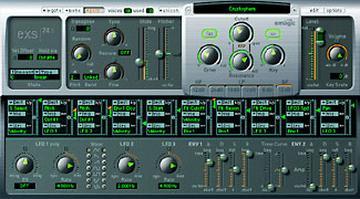
> Yes, in a sense...  Still almost every synth, hardware or software,
> operates on the same basic principles: a sound generator (oscillator
> or samples) goes into a filter, which goes into an amplifier.  And
> these can all be modulated be either a periodic source (LFO) or a
> non-periodic source (ADSR).  And that's basically all there is to it,
> no matter how complicated it may get.  And this principle has been
> around since the first Moogs from the 60-ies.  So... in a sense this
> technology is ancient, and has been around in every synth for some 40
> years.  I guess I expected such an ancient technology to be somewhat
> "common sense" by now, despite the lack of documentation.  I thought
> that the mere fact that almost every synth has been operating on
> these principles for decades was enough to... spread the knowledge or
> something.


If this was the first paragraph in the EXS-24 manual (with, perhaps,
some definitions of what an "oscillator" is and how it's used to
generate or modulate sound, what fiters filter, what effect the
amplifier has on this sound, and what an ADSR is) then I would have been
much less confused when flipping switches and slides in my EXS-24.  It's
like the rosetta stone of synths and it wouldn't have to take up more
than a page or two.  It could be a broiler plate that emagic stuck on
the front of all their docs.

> BTW, there surely is a website somewhere that goes into the details
> of the various synthesis principles, isn't there?

I had hoped so, but all I found was this stupid list ;-)

Kidding, of course.  You guys are great and I'd have never made it as
far with Logic as I have without y'all.  But all the same, if any of you
know of a site that lays good, basic, 60s synth groundwork, don't
hesitate to pass it on!

> And, for the record, a VCO is a Voltage Controlled Oscillator.  Old
> technology, commercialised for the masses by Moog, in which the
> frequency of an oscillator was determined by the incoming voltage.
> The keyboard would simply produce different voltages for different
> keys, and voila, you would have different notes when striking
> different keys.

snip

> Okay, end of "ancient tech lecture".

It seems to me that no field looks at ancient tech with as much
veneration as does the (electronic) music field.  The more ancient tech
lectures on this list, the better, IMHO!

Cheers,
-josh emmons


--
There is no spoon, only Zuul.
Message
Re: [exs] Programming tip from John Lehmkuhl
2002-11-21 by Joshua S Emmons
Attachments
- No local attachments were found for this message.