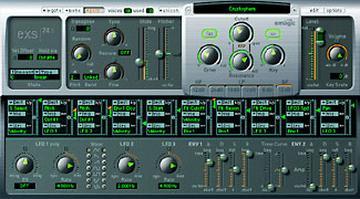
[re: random modulation source]
--- In exs-users@yahoogroups.com, PersingEP@a... wrote:
> This is something you can do in Stylus and Atmosphere for
example....it is
> very cool.

Yep, the people who designed Atmosphere do seem to have put a lot of
thought into it, don't they! :-)
Bought it a few weeks ago, very happy with it, think I'll be using
its "orchestral" strings a lot.

I suppose that if you want a hihat line to jump around the stereo
field or vary its decay on each note independently of velocity, one
could /try/ to work around the lack on a proper randomise parameter
on other instruments by assigning a controller number and using the
sequencer to tediously program in a pseudo-random sequence of
controller changes ... but when you have a strings section, and want
(eg) random placement of each note within a chord within the stereo
field, then controllers will normally pan the entire chord as a
block, which isn't the right effect.
So I was very pleased to spot "random" on Atmosphere's modulation
matrix!


<rambling on...>
You can't apply these sorts of polyphonic effects afterwards with
audio signal processing, so to set additional parameters on a per-
note basis, I guess you'd have to:
 (A) have the sequencer and instrument utilising a form of "extended
MIDI" that has one or more additional parameters per noteon event,
that can be programmed on the event list and used as (static per
note) modulation sources on the instrument (perhaps logic already
allows MIDI extensions, but the logic instruments don't seem to
support them yet), or
 (B) use special controller event(s) before each note, and have some
way of telling the instrument that it is only supposed to use the
initial value for playing the note, and not respond to further
controller changes mid-note (which would happen when notes
overlapped), or
 (C) find some wierd way of doing it with programmed polyphonic
aftertouch.

emagic could capitalise on their ownership of both logic and the
logic-specific instruments, and implement custom MIDI noteon
extensions so that we could do this. Then if we decided that a guitar
part needed an additional three fixed parameters per note to play
with, we could have them, and each note played on the emagic
instrument could get its own programmable attack time, damping
strength, pitch envelope strength and so on.

For compatability with non-emagic instruments, logic could then allow
background conversion between "extended parameter" noteons, noteons
preceded by controller events, and noteons associated with polyphonic
aftertouch events.
The "preceding controller events" version would probably be best for
transmission of multiple additional values through conventional MIDI
hardware, but might play oddly on polyphonic parts if the receiving
instrument didn't realise that it wasn't supposed to allow variation
once a note was already playing, and would slow the data stream
rather (lots of extra status bytes).
The "poly aftertouch" version would already work on lots of standard
MIDI instruments (but would presumably only allow one additional
parameter)
And the "extended MIDI noteon" mode would be the optimal solution for
advanced programming of multiple additional parameters on emagic's
own softinstruments (where the datastream is completely under
emagic's own control, and having the wrong number of noteon
parameters wouldn't matter).

I suppose the extra information would be stored as logic-specific
events so that it didn't freak out earlier versions of logic, and
you'd need an extra track parameter to say how it was to be formatted
for transmission to softinstruments, midi ports, etc.

It'd be fun!
Message
EXS additional control? (was: Re: [exs] MkII Select by CC ...)
2002-12-28 by Eric Baird <eric_baird@compuserve.com>
Attachments
- No local attachments were found for this message.