Thoughts from the mind of Herbert Boland, 11/22/02:

>Still a bit overwhelmed by the programming power of the MkII I stumble
>on things that make me very curious.

It's amazing what they added indeed...  Conceptually it's all pretty
clear (well, most of it) but personally I cannot at all oversee the
possibilities the new additions create.  Rather mindboggling...

>To focus on one:  a group can be selected by combinations of CC, note
>value, bender and group#. You can combine up to three of them for a
>group select. Can someone enlighten me? In which cases do you e.g. use
>groups to activate other groups? Maybe some of the gurus here can give
>examples of programming realistic brass or string patches using these
>modifiers.

I hadn't even noticed, but indeed, in the Instrument Editor, if you
pick a "Select by" option in a Group, a second "Select by" is added
in which you can pick another selection criterion.  This is all quite
esoteric stuff, I must say, and afaik hasn't been documented at all.
I just played around with it a couple of minutes, and think I got it
figured out -- the theory at least.

First of all, all Select criteria must be satisfied *simultaneously*
before a Group actually sounds.  I.e. if you pick C1 as the Note to
select Group1, and additionally set the 2nd "Select" to "Controller
1, values 0-63", then Group 1 will only play after you've hit C1
_and_ CC1 has a value between 0 and 63.
So suppose you have 3 groups: group1 and group2 are both assigned to
Select by Note C1, and group3 is set to Select by Note C#1.  You also
set group1 to Select by CC1, 0-63 and group2 to CC1, 64-127.
Now hit C#1: group3 plays, plain and simple.  Hit C1: group1 or 2
plays, depending on the current CC1 value.
So you could use this to have two Notes select between e.g violin and
trumpet, and then use the modwheel to select between either violin
staccato/legato or trumpet staccato/legato.  I'm not sure though why
you would do it this way: you might as well assign the 4 groups to 4
different keys, and use that to select between violin-s/l and
trumpet-s/l.  As I said: this is the (or: my) theory.  Any ideas for
real-world applications are welcome.

As for the Select by Group#, this is the most puzzling of all imo.
Again suppose there are 3 groups, G1, G2 and G3.  Set G1 to Select by
Group:start, set G2 to Select by Group:G1, and G3 to Select by
Group:G2.
Now play staccato (i.e. unconnected) notes: you'll hear the notes
being played by G1, G2, G3, G1, G2... respectively.  I.e. if G1 has
played, then the next note will be played by G2, since G2 is set to
Select by G1.

However (this is where it gets puzzling): play a note, and keep the
key down. Suppose you happen to hear G1 playing.  Now play additional
keys: they'll all play G1.  I.e. as long as you play legato
(overlapping notes) the next group will _not_ be triggered -- all
notes will be played by the same group.  Only as soon as you release
all keys, and then hit a new key, will G2 sound.

Furthermore: one of the Groups must be set to "Select by Group:start"
for this feature to work.  This is probably the way to "get the EXS
on its way".  I.e. the EXS must know which group to start with.  You
can't have 2 groups set up like "G1 selects G2, and G2 selects G1" -
you'll simply hear nothing.
Also the groups should be picked out uniquely.  You can't have G1 set
to 'start' and then have both G2 and G3 selected by G1: only one of
the groups (G2 or G3) will actually sound.

Still there?  Fine :-).  I'm not sure how you would ever use this
"Select by Group#".  One application (although not too sensible imo)
would be to have e.g. 6 kick-drums assigned to the same key, each in
its own group, and then have group2 be selected by group1, group3 by
group2, etc, so that each new kick-hit (which usually is unattached
from the previous hit) triggers the next kickdrum.  This way
successive notes would cycle through all 6 kicks...

Rather pointless imo.  What you _would_ want (maybe) is 6 layered
kicks, and each note picks out a _random_ kick-sound -- to give a
kind of natural variation.  But _that_ can be achieved in the EXS
itself (not in the Instrument Editor I mean).  Set the 'Select Range'
in the Instrument editor to adjacent ranges. With 3 groups (kicks)
that would be e.g. 0-42, 43-84, 85-127.  In the EXS set the
modulation matrix to "dest: sample select, source: LFO1", and set
LFO1 to a random wave (2nd from below).  Set an appropriate speed for
LFO1, and off you go.

If anyone can think of some sort of sensible way to use the "Select
by Group" stuff, I would be very curious to know.

>(now is a good time someone starts writing "the ultimate EXS programming
>guide")

Yeah :-).

BTW, anyone already explore the Remote function?  Fun to play with.
Set Remote to C2, grab e.g. a Cmin chord somewhere high on the
keyboard, press your sustain pedal, and then start playing in to
C#1-B2 range...
It's just a pity that they limited the range to 2 octaves, and didn't
make this adjustable -- or dependent on the pitchbend range or
something.
And it's a bit silly that it's not even 2 full octaves.  When setting
Remote to C2, the range is C#1 to B2, whereas you'd have expected C1
to C3.  Oh well...

Finally one annoying detail.  I don't like to complain about the
interface or whatever, but isn't it completely braindead to have the
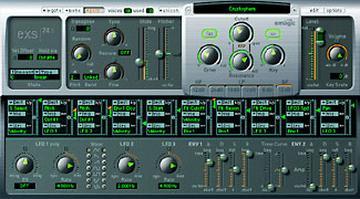
+/- buttons (instrument select) on opposite sides of the instrument
popup?  Of course you never use them -- just use a keycommand -- but
then either leave them out and force people to use a keycommand, or
put them such that it's actually easy to flip back & forth between
sounds.  Putting them so wide apart requires an awful lot of mousing
if you don't just want to go 'forward'.  And given the size of the
buttons, this isn't easy at all.  Completely stupid imo.  Can you
spell RSI?

For the rest: I'm very curious to see what people come up with.
It'll take us quite some time to get to the bottom of this beast, I
guess.  Isn't it great? -- this is not just some sort of update --
it's a completely new & wild instrument, and it's for free...


--
Hendrik Jan Veenstra  <h@...>
Omega Art: http://www.ision.nl/users/h/index.html